Women's Printed Shirts Guide
Printed shirts and blouses live on their repeat patterns: silk, rayon and cotton carrying florals, geometrics and conversational motifs through work and weekend dressing.
Shop Women's Printed Shirts Now
Shop Women's Printed Shirts on Amazon Shop Women's Printed Shirts on eBayThe Amazon and eBay links on this page are affiliate links. If you make a purchase through them, Apparel Search may earn a commission.
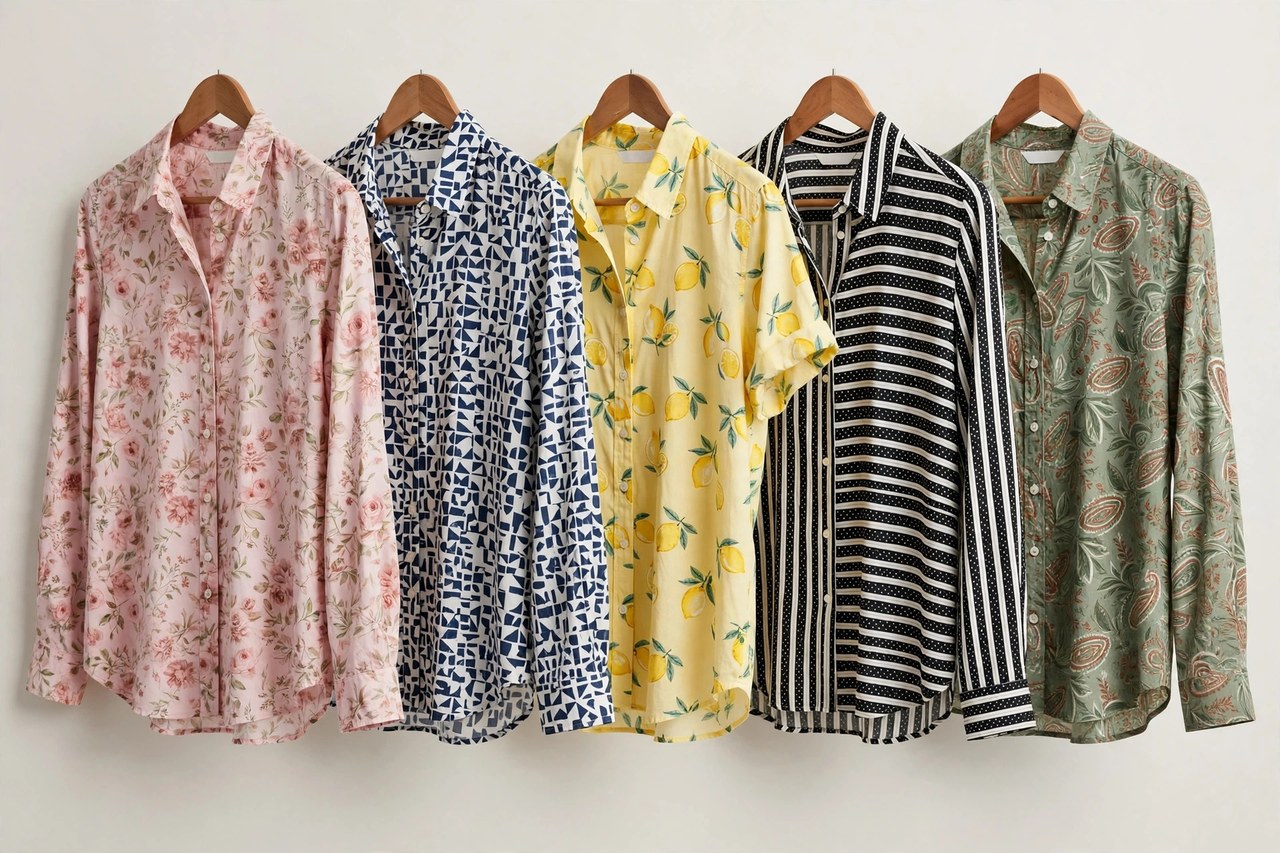
The printed shirt occupies the smart half of the print-top world. Where a print tee is casual by construction, a printed shirt or blouse — with its collar, button front and sleeves meant to be seen under a jacket — is built for work, dinners and settings where casual will not do. Print transforms these tailored shapes: a navy trouser suit is one outfit with a white shirt and a completely different, more personal one with a printed blouse, which is why the printed shirt is the classic refresh purchase for a working wardrobe.
This guide covers printed shirts as their own subject: the repeat patterns that define them and how repeats are engineered, the three great fabric choices of silk, rayon and cotton and what each does to a print, and the care prints require if they are to stay crisp rather than tired. It closes with styling and fit, because a printed shirt succeeds or fails on how its pattern behaves at the collar, the placket and the cuff — the tailored details no print tee has to worry about.
Repeat Patterns and Print Engineering
Most shirt prints are repeats: a motif engineered to tile seamlessly across the fabric so the pattern appears continuous from shoulder to hem. The classic repeat types each carry a different register. Florals run from ditsy sprigs to trailing botanical vines. Geometrics — dots, spots, checks, small diamonds and retro tiles — are the office-safe backbone of the category. Stripes and plaids are repeats with direction, adding the extra engineering question of matching at seams. Conversational prints use recognizable motifs — fruit, animals, landmarks, bicycles — and trade formality for charm. Paisley and scarf prints borrow from menswear and silk-square traditions and read the dressiest of all.
Engineering quality shows at the joins. On a well-made printed shirt, the pattern aligns or flows plausibly across the button placket rather than colliding mid-motif, pockets (where present) are cut to continue the print, and the motif scale suits the garment: a repeat so large that the collar and body seem to come from different fabrics looks accidental, however beautiful the print. Rotary and screen printing give crisp edges on cotton and rayon; digital printing allows photographic detail and huge color counts on silk and polyester. Run a fingernail lightly over a bold motif: sharp prints sit in or on the fabric cleanly, while blurred edges in the store predict a shirt that will look faded long before it is.
Fabrics: Silk, Rayon and Cotton
Silk is the prestige print fabric: its smooth filaments take dye to a depth and luminosity no other fiber matches, so silk prints glow rather than merely show. A silk printed blouse drapes fluidly, tucks without bulk and elevates everything it is worn with; its costs are price and care, since most silk shirts want gentle hand washing or dry cleaning. Rayon and viscose are silk's practical understudies: plant-derived, fluid and matte, carrying watercolor florals and soft geometrics beautifully at a fraction of silk's price, in exchange for careful cool washing and a tendency to crease. Modern lyocell versions improve on both counts.
Cotton — as lawn, voile, poplin or a light twill — gives the crispest printed shirt: collars stand, cuffs hold, prints print with graphic sharpness, and the whole garment launders at home without ceremony. Cotton prints read more daytime and tailored than fluid rayon or silk versions of the same pattern. Polyester and silk-look synthetics complete the range, offering near-permanent color and wrinkle resistance for travel and uniforms of a personal kind, with a slightly less breathable wear. Choose the fabric by the shirt's job: silk for the blouse that must impress, rayon for drape on a budget, cotton for the weekly work rotation.
Styling, Fit and Care for Prints
Styling a printed shirt is an exercise in support casting. The print holds the foreground, so partners should be solid and drawn from its palette: the ground color of the print is the safest trouser or skirt choice, an accent color the bolder one. Under a blazer or cardigan, only the collar, placket and cuffs show, which turns one strong print into a seasoning rather than a main course — the easiest way to wear a bold shirt to a conservative office. Tucked, half-tucked or worn loose over slim trousers changes the register from tailored to relaxed; the shirt's own length and hem shape, straight or shirttail, tell you which it was designed for.
Fit checks are print-specific. The placket should close without gaping and without the pattern pulling into distortion at the bust; shoulder seams should sit true so the repeat hangs evenly; sleeves should reach the wrist with the print's scale unbroken by excessive bunching. Care is the category's tax: wash printed shirts inside out, cool and gentle, with like colors, since dark grounds can crock onto light collars in early washes. Never wring rayon, roll silk in a towel rather than wringing, and dry all prints away from direct sun, which bleaches the exposed front panel first. Iron on the reverse at the fabric's setting — or steam — so the print face never meets a hot plate. Kept this way, a printed shirt makes plain tailoring look personal.
Related Women's Guides
Photos


Looking for Women's Clothing Stores?
This guide helps you choose women's printed shirts. To browse where to buy, visit our women's clothing store directory, where you can find retailers that carry them.