Women's Print Tops Guide
A print top does the talking for an outfit: floral, stripe, animal or abstract pattern on a simple shape, styled against solids so the pattern — not the competition — gets noticed.
Shop Women's Print Tops Now
Shop Women's Print Tops on Amazon Shop Women's Print Tops on eBayThe Amazon and eBay links on this page are affiliate links. If you make a purchase through them, Apparel Search may earn a commission.
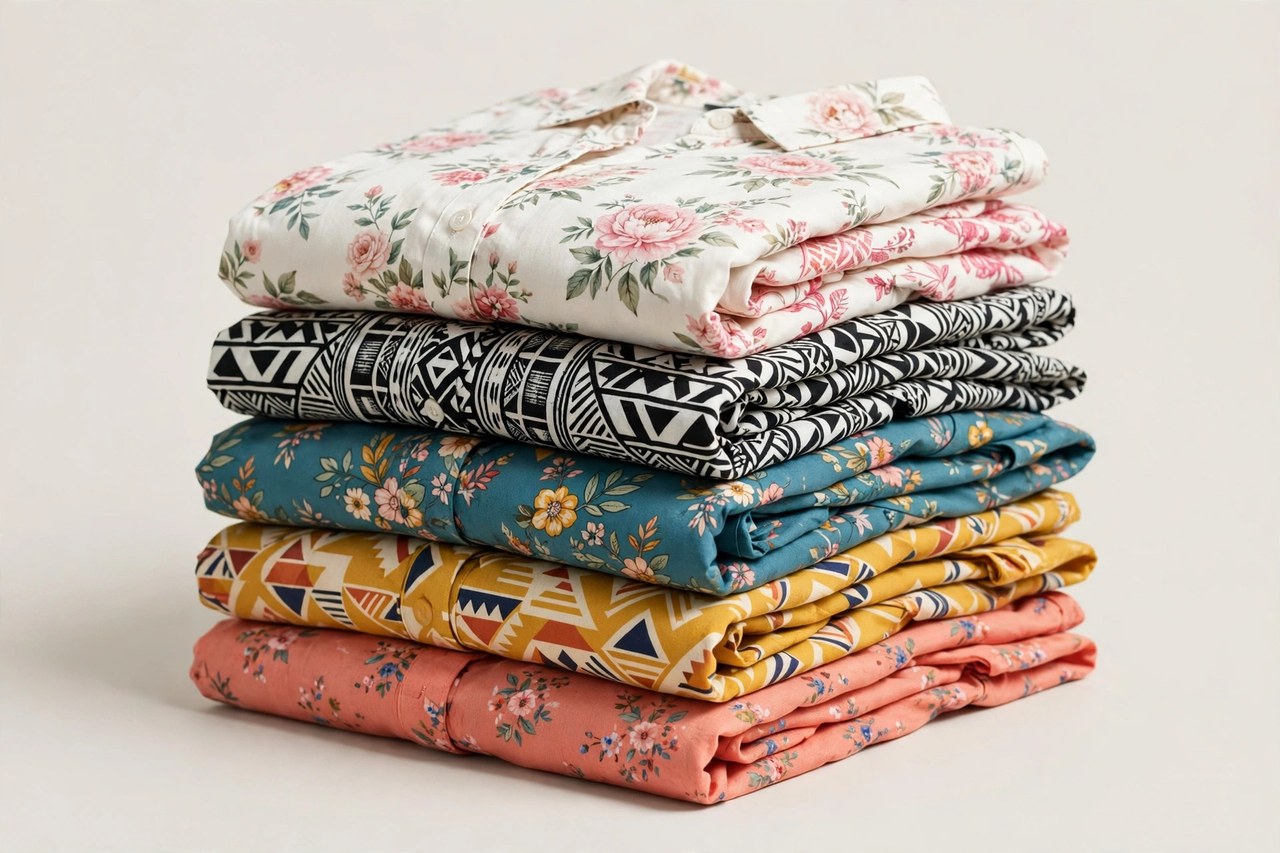
Print tops are the hardest-working shortcut in the wardrobe. A solid top needs jewelry, a layer or an interesting bottom to become an outfit; a printed top arrives with its interest built in. Jeans plus a floral blouse, a plain skirt plus a striped tee, trousers plus an abstract-print shell — in each case the print supplies the color story, the focal point and the personality, and everything else can stay simple. That is why nearly every women's line, from T-shirts to silk blouses, is offered in prints each season.
The skill in buying print tops is not finding prints — it is choosing the right print, at the right scale, in the right placement for your body and your wardrobe. This guide works through the main print families, the principles of scale and placement that decide whether a print flatters or overwhelms, the fabrics prints are offered on, and the styling rule that governs almost every successful printed-top outfit: let the print lead, and keep its partners quiet.
The Print Families: Floral, Stripe, Animal, Abstract
Floral prints are the perennial leaders, ranging from tiny ditsy sprigs that read almost as texture to bold botanical blooms that function as artwork. Ditsy florals suit casual and vintage-leaning outfits; large florals make the statement on blouses and occasion tops. Stripes are the most architectural print: horizontal breton stripes are a casual classic, vertical stripes lengthen, and variegated or diagonal stripes modernize simple tees and shirts. Placement matters with stripes — engineered stripe alignment at seams is a quality marker worth checking at the side seams and placket.
Animal prints — leopard, snake, zebra — behave as neutrals in a mature wardrobe, pairing with black, camel, denim and red alike, and they recur every few seasons without ever fully leaving. Abstract and geometric prints cover everything from retro swirls and polka dots to painterly brushstrokes and graphic color-blocking; they are the most modern family and the easiest to wear to work, since they carry no thematic message. Smaller families round out the racks: conversational prints with motifs such as fruit or birds, checks and plaids at the casual end, and tie-dye and ombre effects where the print is a treatment rather than a repeat.
Scale, Placement and Proportion
Scale is the first decision. As a working rule, print scale should echo body scale: petite frames are rarely overwhelmed by small-to-medium prints and can be swamped by very large motifs, while taller or larger frames carry bold, widely spaced prints that can look sparse and lost on a smaller frame. This is a guideline, not a law — a large print in soft, low-contrast colors wears easier than a small print in harsh contrast. What matters most is that the print's energy matches the garment's size: a dramatic print needs a simple, sufficiently large canvas, which is why oversized motifs look best on relaxed blouses and worst on tiny, fussy tops.
Placement is the second decision. Better printed tops are cut so motifs sit sensibly: no large bloom centered awkwardly, no stripe breaking badly at the bust, patterns matched or at least harmonized at center fronts and plackets. Border prints, where the pattern concentrates at the hem or neckline, are placement used deliberately and can draw the eye exactly where you want it. When trying a print top on, check it in motion and at conversational distance, not just close to the mirror — prints are read by other people at three meters, and a print that resolves into a pleasing overall effect at that distance is the one that will earn its wear.
Fabrics, Styling With Solids and Care
Print tops come on every top fabric, and the fabric sets the register. Cotton and cotton-jersey prints are casual and breathable. Rayon and viscose prints drape fluidly and carry watercolor and floral designs beautifully, at the price of gentler washing. Silk and silk-look polyester prints are the dressy tier, for blouses worn to work and evenings. Knit prints have the pattern knitted or printed on stretch jersey, giving tee comfort with blouse interest. In every case, check print quality by stretching the fabric slightly: a surface print that cracks white at the stretch lines will age faster than a well-penetrated print.
Styling follows one master rule: pair prints with solids drawn from the print's own colors. Pull the navy from a floral into your trousers, the cream from a leopard into your knit, and the outfit coheres automatically. A second print can be added once the first is mastered — stripe with floral is the classic mix — provided the two share a color and differ clearly in scale. Care is print care: wash inside out, cool and gentle, separate strong prints for the first washes against dye transfer, and dry away from direct sun, which fades the exposed shoulder line first. A print top kept bright keeps doing its job: making simple clothes look like an outfit.
Related Women's Guides
Photos

More to Explore on Apparel Search
Women’s Clothes Guide by Letter: Women's Apparel Directory N · Women's Clothes Directory O · Women's Apparel Directory Q · Women's Fashion Directory R · Women's Clothing Directory S · Women's Clothes Directory T
Looking for Women's Clothing Stores?
This guide helps you choose women's print tops. To browse where to buy, visit our women's clothing store directory, where you can find retailers that carry them.