Women's Printed T-Shirts Guide
A printed t-shirt is a plain tee transformed by textile printing — and the printing method, more than the design, decides whether the image lasts as long as the shirt.
Shop Women's Printed T-Shirts Now
Shop Women's Printed T-Shirts on Amazon Shop Women's Printed T-Shirts on eBayThe Amazon and eBay links on this page are affiliate links. If you make a purchase through them, Apparel Search may earn a commission.
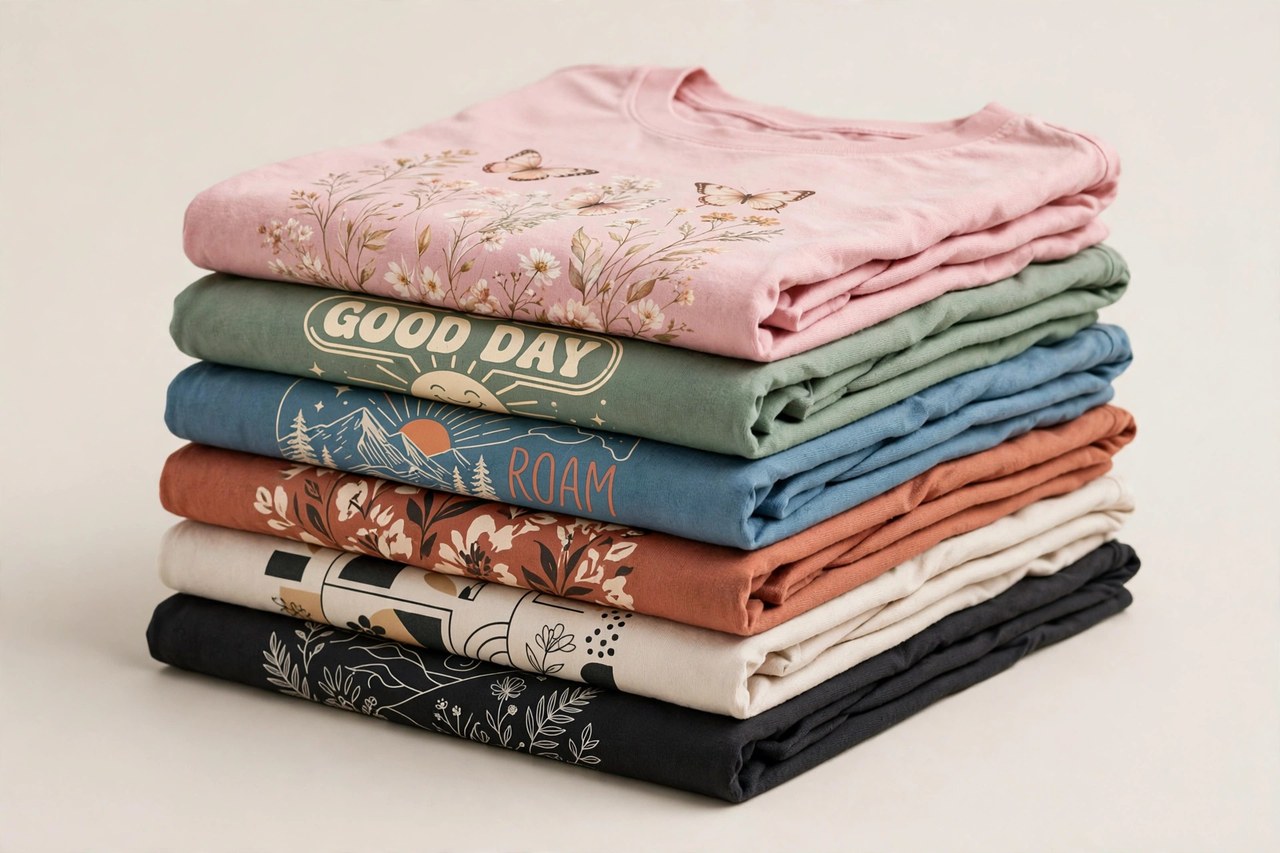
Start with the garment itself. A t-shirt is a casual top, with short or long sleeves, shaped like the letter T when spread flat — a straight body with two sleeves set at right angles to it. It is usually cotton or cotton-blend jersey, with no fastenings, and in plain form it is the simplest top in the wardrobe. Textile printing processes turn that plain garment into a printed t-shirt, carrying an image, a slogan or a pattern.
This guide is about the garment and its printing. It compares the four main print methods — screen printing, direct-to-garment, sublimation and heat transfer — explains what each does to fabric, feel and durability, and gives the quality checks that separate a print that survives fifty washes from one that cracks by the fifth. The styling life of the printed tee has its own guide, linked below; here the subject is manufacture and quality.
The Four Printing Methods
Screen printing is the traditional method: ink is pushed through a prepared mesh screen, one screen per color, onto the shirt. It produces a distinct, slightly raised ink layer with saturated color, and it is the most durable everyday print — a good screen print outlasts the shirt around it. It suits bold designs in a limited number of colors and becomes economical in runs of dozens or hundreds, which is why band tees, event tees and team shirts are screen printed. Its limits are fine photographic detail and very small production runs.
Direct-to-garment (DTG) printing works like an inkjet printer for cloth, spraying water-based inks into the fibers of a (usually cotton) shirt. It handles photographs, gradients and unlimited colors, and feels soft because the ink sits in the fabric. Its trade-offs are less punchy color than screen printing and faster fading in harsh washing. Sublimation dyes polyester fibers with heat: the print has zero feel and cannot crack, but requires polyester and pale shirts. Heat transfer applies film or vinyl with a heat press; vinyl gives crisp graphics, while cheap transfer film cracks and peels earliest.
Print Quality: How to Judge It
Judge any printed tee with four checks. Registration and sharpness: edges should be clean, colors should meet without gaps or overlaps, and fine lines should not bleed. Coverage: on a dark shirt, the design should be fully opaque, which requires a white underbase layer beneath the colors — a dark-shirt print that looks dusty or lets the shirt color ghost through was skimmed. Hand feel: run your palm over the print; screen prints feel like a thin flexible film, DTG feels like fabric, and any print that feels stiff, plastic and board-like across a large area will wear uncomfortably and crack sooner. Stretch recovery: stretch the printed area gently — a quality print flexes with the jersey and returns without splitting into cracks.
The shirt under the print matters as much as the print. A substantial mid-weight cotton jersey holds a large print flat; a tissue-thin fashion tee lets a heavy screen print pucker and drag. Ringspun cotton gives DTG a smoother surface and sharper image. Check placement too: centered, level, a few inches below the neckline is standard; a crooked print is a production error, not a style.
Women's Fits and Fabrics
Printed t-shirts are sold in three broad cuts. The classic unisex cut is straight-bodied with a crew neck, the standard blank for event and souvenir tees. The women's fitted cut adds a shaped waist, narrower shoulders, shorter sleeves and often a scoop or V-neck, and it carries a chest print on a smaller, differently curved canvas — good makers scale and reposition the design for it rather than shrinking the unisex art. The relaxed and oversized cut drops the shoulder and widens the body, and takes large back prints and all-over sublimation designs particularly well.
Fabric follows the printing method. Cotton and high-cotton blends are the screen printing and DTG standard. Polyester blends are required for sublimation and common in athletic printed tees. Tri-blends (cotton, polyester, rayon) give the softest, most vintage hand and take distressed-look prints beautifully, at some cost to sharpness. Match method to fabric: a photograph belongs on DTG cotton or sublimation polyester, bold lettering on screen print or vinyl.
Care and Buying Tips
Print care is a short routine with a long payoff. Wash printed tees inside out, in cold water, with similar colors. Skip chlorine bleach and harsh detergents. Hang dry where you can; if you tumble, use low heat, because high heat cracks screen prints and lifts transfers. Never iron directly on a print — iron inside out, or around the design. Vinyl and transfer prints are the most heat-sensitive, so sort your habits by the method on the shirt.
Buy in this order: choose the design, identify the method, then check the shirt. Listings that name their printing method and fabric content are usually the honest ones. For a custom order, DTG and transfer services let you print one shirt; for a group order, screen printing's quality-per-price rises fast with quantity. Buy the process as carefully as the picture, and the shirt will keep both.
Related Women's Guides
Photos


Looking for Women's Clothing Stores?
This guide helps you choose women's printed t-shirts. To browse where to buy, visit our women's clothing store directory, where you can find retailers that carry them.