Women's Pocket Tees Guide
A pocket tee is the classic T-shirt plus one small, useful detail — a pocket sewn onto the chest, turning the simplest top in the wardrobe into something with a point of view.
Shop Women's Pocket Tees Now
Shop Women's Pocket Tees on Amazon Shop Women's Pocket Tees on eBayThe Amazon and eBay links on this page are affiliate links. If you make a purchase through them, Apparel Search may earn a commission.
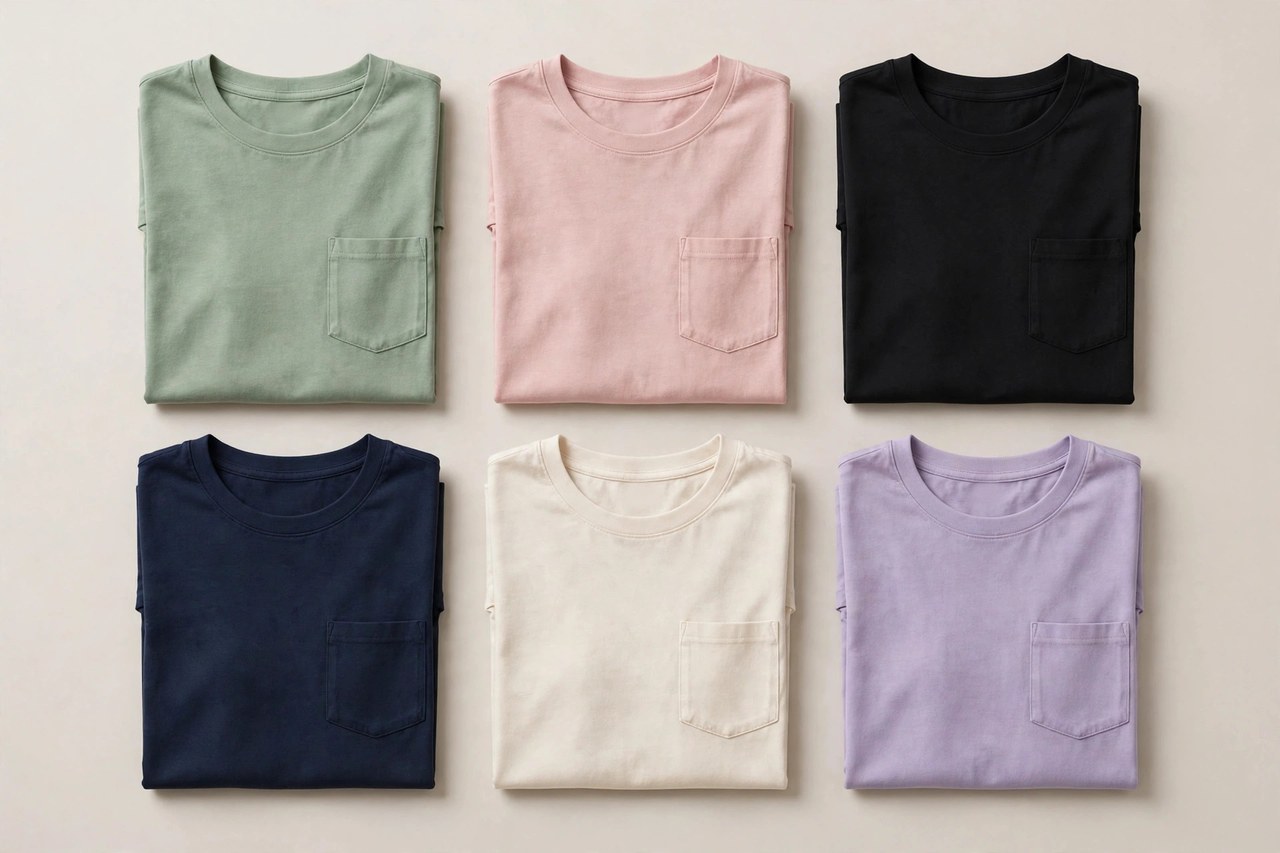
A pocket tee is a T-shirt with a pocket — specifically, in modern dress, a small patch pocket sewn onto the left chest. It sounds like the smallest possible variation on the simplest garment ever made, and yet the pocket tee has held its own category for decades, because that one pocket changes the shirt's character: it adds a focal point to a plain front, a whiff of workwear utility, and a place (however modest) to put a thing. For women, pocket tees range from borrowed-look boxy cuts to soft, draped fashion versions.
This guide starts with the pocket itself — what the word means and how garment pockets are built — then covers the tee underneath, the fabrics and fits that make a good one, and the small but real art of pocket placement, sizing and styling. It is a short garment with a longer history than you would expect.
What a Pocket Is
In clothing terms, a pocket is a small bag or envelope-like receptacle, sewn into or onto a garment, for carrying small objects. The definition covers both families: pockets sewn into a garment (the hidden kind, set into a seam or a slash in the cloth, as in trousers) and pockets sewn onto it (patch pockets, applied flat to the surface, as on a tee).
The word is older than the construction. In earlier centuries a pocket was literally a separate small bag, tied around the waist under skirts or worn at the belt, reached through slits in the garment — the 'lucy locket lost her pocket' of the nursery rhyme. Sewn-in pockets took over during the nineteenth and twentieth centuries, and the patch pocket became standard workwear: on shirts, overalls and jackets, sized for notebooks, pencils and tobacco tins. The tee-shirt pocket inherits that workwear lineage in miniature.
The Tee Underneath: Shape and Fabric
The tee itself takes its name and shape from its silhouette: laid flat, a T-shirt forms a T — a straight body with short sleeves set at right angles. It began as underwear and naval issue in the early twentieth century, became workwear, then the universal casual top. The pocket version followed once the tee was established outerwear, borrowing the chest pocket from work shirts.
Fabrics decide the shirt's tier. Plain cotton jersey is the standard, soft and breathable; slub jersey, with its slightly uneven yarns, gives a textured, vintage surface that suits the pocket's workwear air; cotton-polyester and tri-blends drape softer, resist wrinkles and hold color; a touch of elastane helps a fitted tee keep its line. Fabric weight shows at the pocket: on tissue-thin jersey the pocket sags and pulls, while a midweight jersey carries it crisply.
Pocket Placement, Size and Women's Fits
Placement follows convention: the pocket sits on the wearer's left chest, its top edge roughly at the level of the second button of an imaginary placket, centered between the armhole and the center front. Size is modest — roughly three and a half to four and a half inches wide on most women's tees, scaled in better brands to the shirt's size (a detail worth checking, because a pocket cut for a small looks lost on a 2X, and vice versa).
Women's pocket tees come in three broad fits. The classic or boyfriend cut is straight and relaxed, the workwear original, best half-tucked. The fitted cut shapes at the waist with a slightly scooped or crew neck. The fashion cut drapes in rayon-blend jersey, often with a deeper V or a curved hem, the pocket softening along with everything else. Neckline choice interacts with the pocket: a crew neck keeps the pocket the sole feature, a V-neck shares attention, and a scoop neck moves the look dressier.
Styling, Care and Buying Tips
The pocket tee styles like a tee, with the pocket doing quiet extra work. It breaks up a plain front under an open overshirt or cardigan, gives a white-tee-and-jeans outfit a finished detail, and reads well tucked into skirts and trousers where a blank tee can look like an undershirt. Because the pocket is a small geometric accent, it pairs happily with a pendant necklace that ends above it or well below it — not at its edge. Keep actual pocket cargo light: a card, a ticket, sunglasses hooked over the top edge by one arm.
Care is tee care with one addition: turn the shirt inside out before washing so the pocket's edges and any contrast fabric are protected, wash cool with similar colors, and reshape the pocket flat while damp so it dries crisp rather than curled. Avoid ironing a printed or contrast pocket on high heat. When buying, tug the pocket's top corners gently — they should feel anchored — check the pocket is the shirt's own fabric weight or better, and confirm placement in the mirror.
Related Women's Guides
Photos

More to Explore on Apparel Search
Women’s Clothes Guide by Letter: Women's Apparel Directory N · Women's Clothes Directory O · Women's Apparel Directory Q · Women's Fashion Directory R · Women's Clothing Directory S · Women's Clothes Directory T
Looking for Women's Clothing Stores?
This guide helps you choose women's pocket tees. To browse where to buy, visit our women's clothing store directory, where you can find retailers that carry them.