Women's Ringer Tees Guide
A ringer tee is defined by its trim — contrasting ribbed bands at the collar and sleeves that ring a plain jersey body in a second color.
Shop Women's Ringer Tees Now
Shop Women's Ringer Tees on Amazon Shop Women's Ringer Tees on eBayThe Amazon and eBay links on this page are affiliate links. If you make a purchase through them, Apparel Search may earn a commission.
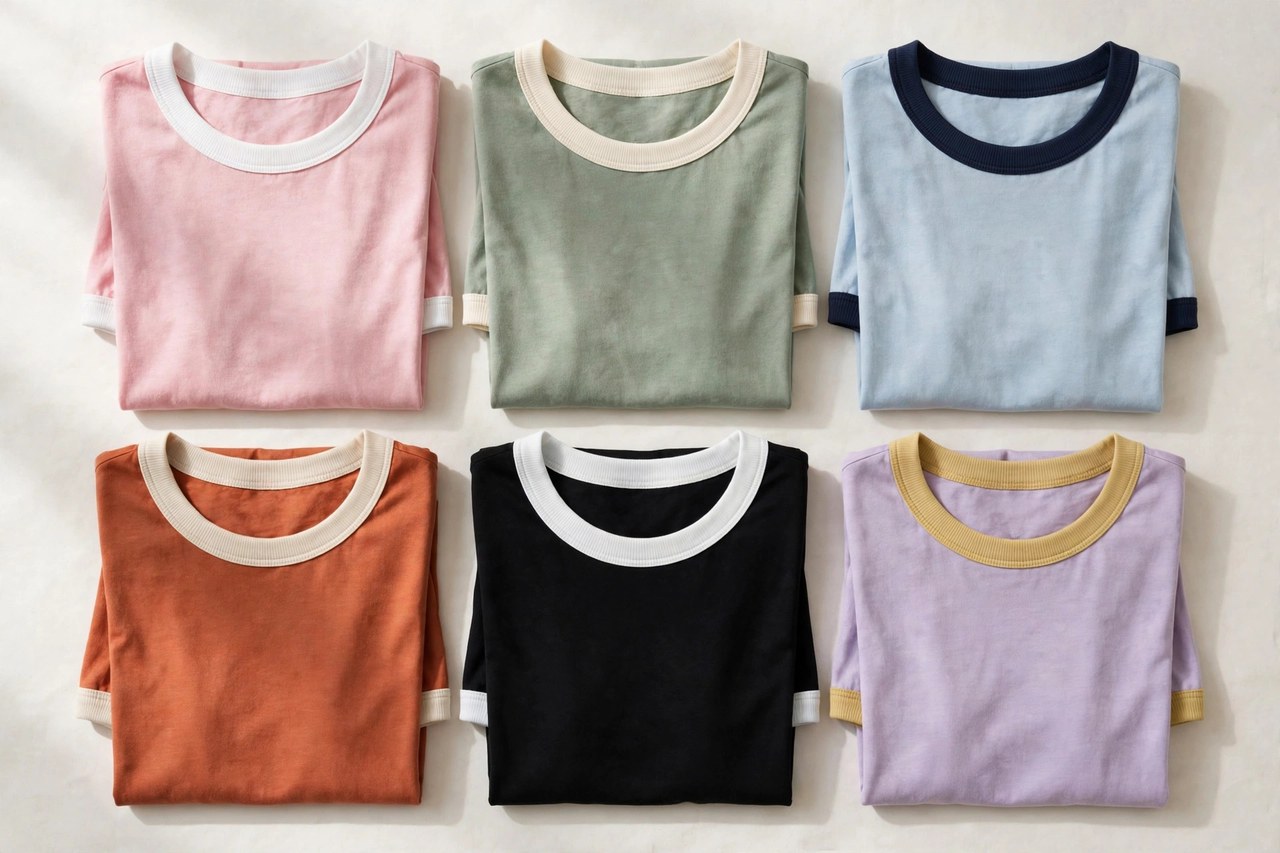
A ringer tee is one of the easiest garments in fashion to define exactly: a jersey t-shirt finished with contrasting ribbed bands at the neckline and at the ends of the sleeves — rings of a second color that frame the body of the shirt. Change the body color, change the ring color, print something on the chest or leave it plain: every variation is still a ringer as long as those two bands contrast, and a shirt with matching trim is simply a tee.
This guide covers the ringer as its own style, distinct from its raglan cousins on this site even though the two are often confused and frequently combined. It explains the construction of the bands, the retro and summer-camp associations that keep the style cycling back, how women's ringer fits differ from the boxy originals, and the simple care that keeps the contrast bands from fading at a different speed than the body they ring.
Construction: What the Bands Do
The ringer's bands are not decoration pasted onto a finished shirt; they are functional ribbing given a color job. The collar band is the ribbed crew neck a tee needs to hold its shape, and the sleeve bands finish the short sleeve hem with a snug ribbed edge that keeps the sleeve sitting neatly on the upper arm instead of flaring. Making those necessary parts in a contrasting color was originally a practical way to use up trim and identify team or camp shirts; it became the style.
Look closely at band quality when buying. Good bands are rib knit with elastane, lie flat without curling, and are sewn with an even, stretchy seam where they meet the body. The sleeve band should hold gently, not squeeze, and the collar band should sit at the base of the neck without standing away. Because the bands are ribbed and the body is plain jersey, the two fabrics take dye and wear slightly differently — a subtle tonal shift between them after many washes is normal in older ringers and is part of their vintage charm.
Style History: Gym, Camp and Retro Cycles
Ringer tees carry strong associations: 1970s gym classes and summer camps, roller rinks, band merchandise and the general retro-athletic wardrobe. The style was standard issue wherever groups were outfitted cheaply and color-coding helped — one body color, one trim color per team or cabin — and that group-uniform heritage is exactly what later fashion borrowed. Vintage and reproduction ringers lean into it with distressed prints and period graphics, while clean, plain ringers read as a minimal retro accent rather than a costume.
The ringer also illustrates how small details cycle. It disappears for years, then returns on the strength of one visible season of retro styling, because it photographs well, suits many body types, and gives a plain jeans outfit a designed element for almost no effort. Women's versions arrived with the same cycles, cut closer than the unisex originals. If you like the look, buy well during an in-cycle year, when fabric and fit choices are widest; the shirt itself will outlast the trend either way.
Women's Fits, Colors and Graphics
Women's ringer tees come in several fits: classic relaxed, closest to the original; fitted or baby-tee cuts, shorter and closer, which amplify the retro note; and cropped versions pairing the trim with a shortened body. Sleeve length stays short by definition, since the band needs a sleeve end to ring, and the band itself can be narrow and neat or wide and boldly sporty. Try the sleeve band on your arm rather than judging on the hanger; it is the one place this forgiving shirt can actually feel wrong.
Color combinations follow a durable logic. A white or heather body takes any ring color and shows graphics best. Dark bodies with light rings read dressier and hide wear. Tonal ringers — navy on blue, cream on tan — give the construction without the sporty contrast, for shoppers who like the finish but not the team reference. Graphics traditionally sit center-chest in one or two print colors chosen to match the rings, a coherence worth checking: a print that ignores the trim color usually means the design was not made for the shirt.
Care for Two Colors on One Shirt
A ringer asks the same question as any two-tone garment: will the colors stay in their places? Wash new ringers inside out in cold water, separately or with like colors for the first few washes, since dark ribbed bands are the most likely source of dye transfer onto a light body. Gentle detergent and low tumble drying protect both the jersey and the ribbing's recovery; high heat ages the sleeve and collar bands first, showing up as wavy, stretched trim on a body that is otherwise fine.
Fold ringers rather than hanging them, as with most jersey tees, and iron the body if needed while avoiding direct high heat on printed graphics and ribbed bands. Stored and washed this way, a ringer tee fades gracefully as a unit and develops the soft, slightly worn character the style has always traded in.
Related Women's Guides
Photos


More to Explore on Apparel Search
Looking for Women's Clothing Stores?
This guide helps you choose women's ringer tees. To browse where to buy, visit our women's clothing store directory, where you can find retailers that carry them.