T-shirt Printers Guide
How t-shirt printing works, and where buyers, printers and suppliers each begin.
The t-shirt printers guide is developed to assist with finding companies that provide t-shirt printing services, and to gather the helpful resources that assist t-shirt printers themselves. This page is the hub of the t-shirt printing section: it explains the core method — screen printing — in enough detail to talk to a printer intelligently, introduces direct to garment printing as the second major method, and routes every kind of visitor to the right page, whether you are looking for t-shirt printers, are a professional printer looking for supplies, or simply need custom shirts printed for a school or special event.
Do you know the difference between a print shop and a printing factory? The print shops page answers that in full. In short: a print shop is the storefront, short-run route; a factory is the production-quantity route — and the guides in this section serve both.
T-shirt Printing Resources
Screen Printing: How the Main Method Works
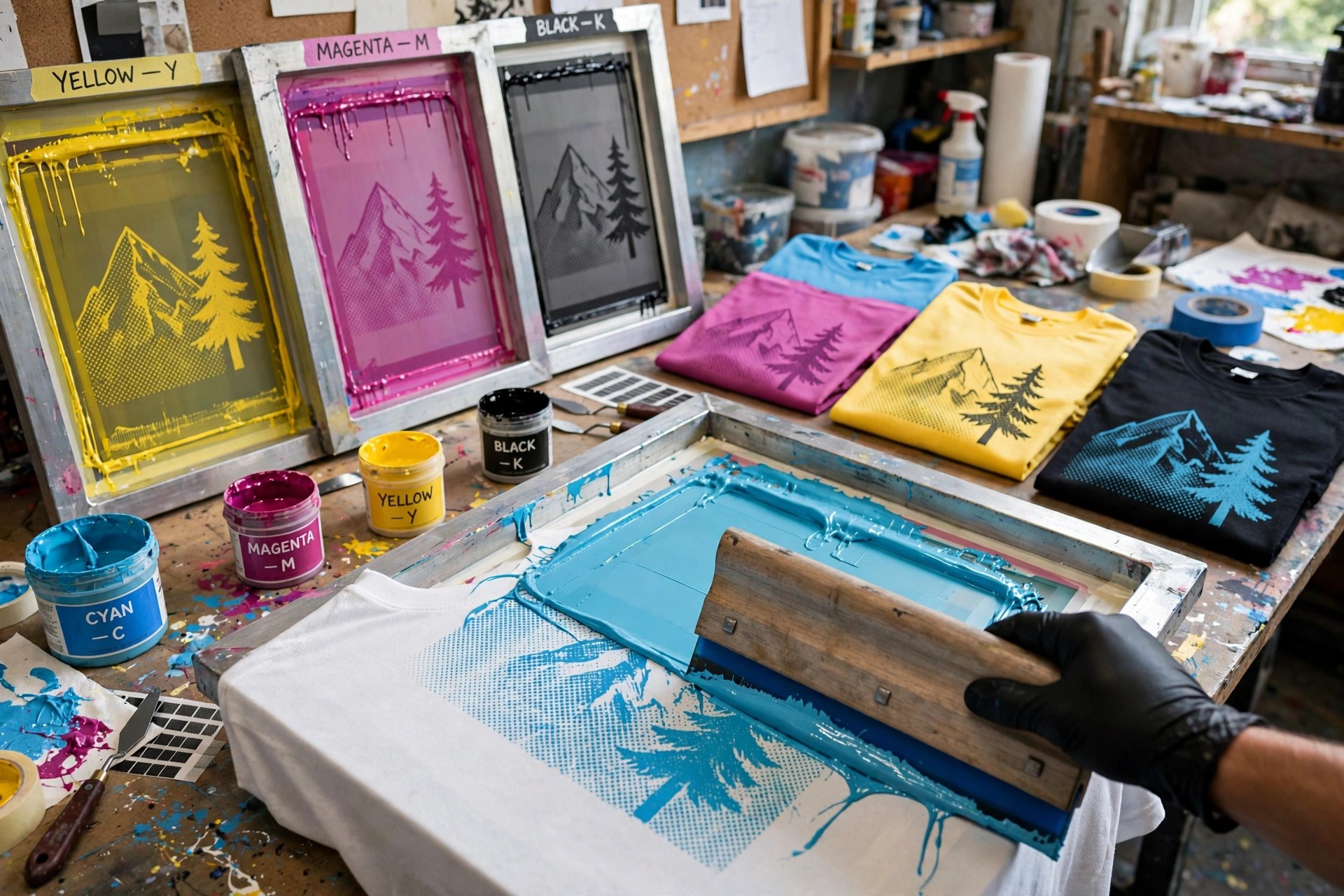
The most common form of commercial t-shirt decoration is screen printing. In screen printing, a design is separated into individual colors. Plastisol or water-based inks are applied to the shirt through mesh screens which limit the areas where ink is deposited — one screen per color, printed in sequence and cured so the inks set. In most commercial t-shirt printing, the specific colors in the design are used as spot colors, which keeps logos and team colors exact and repeatable across a run and across reorders.
To achieve a wider color spectrum with a limited number of colors, process printing — using only cyan, magenta, yellow and black ink — or simulated process — using only white, black, red, green, blue and gold ink — is effective. Process printing is best suited for light-colored shirts, where the transparent inks blend against a white ground. Simulated process is best suited for dark-colored shirts, where an opaque underbase and a small set of strong colors rebuild the image. Choosing between spot color, process and simulated process is the first technical conversation to have with a printer, because it decides screen count, cost and how faithfully a photograph or gradient will reproduce.
Direct to Garment and the Other Methods
Screen printing is only one of the methods for printing tees. Direct to garment printing is another method that has been growing in popularity: a DTG printer sprays water-based ink directly onto the garment, so a full-color design needs no screens and no per-color setup. That economics favors short runs, photographic artwork and print-on-demand work, while screen printing keeps its advantage as quantities grow and the setup cost spreads across the run. Heat transfers and sublimation complete the usual menu — transfers for names, numbers and very small jobs, sublimation for vivid all-over prints on polyester. The Comprehensive T-shirt Printers Guide compares all of the methods with their business implications.
Who This Guide Serves
Are you looking for t-shirt printers? Are you a professional t-shirt printer? Are you looking for t-shirt printing supplies? Do you manufacture textile printing machinery to print on t-shirts? Do you want custom t-shirts printed for your school or special event? Do you own a business and wish to have your corporate logo printed on t-shirts? If you answered yes to any of these questions, this guide is a good place to begin your research: buyers go to the directory and the looking-for-printers page, working printers go to the tips and supplies pages, and everyone starts with the method explanations above so the conversations that follow use the same vocabulary.
Photos

More Manufacturing Resources
Common Questions
What is the most common method of commercial t-shirt printing?
Screen printing. A design is separated into individual colors, and plastisol or water-based inks are applied through mesh screens, one screen per color, then cured. It is durable and economical at quantity, which is why most commercial work uses it.
What is the difference between process and simulated process printing?
Process printing builds a wide color spectrum from cyan, magenta, yellow and black, and suits light-colored shirts. Simulated process uses a small set of spot colors such as white, black, red, green, blue and gold, and suits dark-colored shirts.
When is direct to garment printing the better choice?
When the run is short or the artwork is full-color and detailed. DTG sprays ink directly onto the garment with no screens or per-color setup, so small quantities and photographic designs cost less than setting up a screen printing job.