Custom Apparel Printing
Custom printing for local requirements and for the fashion industry — print shops for short runs, factories for scale.
Custom apparel printing covers two quite different kinds of order, and choosing the right route starts with knowing which one you have. A local business, school event, sports team or family gathering usually needs a modest quantity of shirts printed with one design — the classic work of a neighborhood print shop. A wholesaler or large retailer needs thousands of printed t-shirts, sweatshirts or underwear produced to a specification and a delivery date — the work of a clothing printing factory. This page routes both kinds of buyer, and points to the guides, directories and machinery resources behind each route.
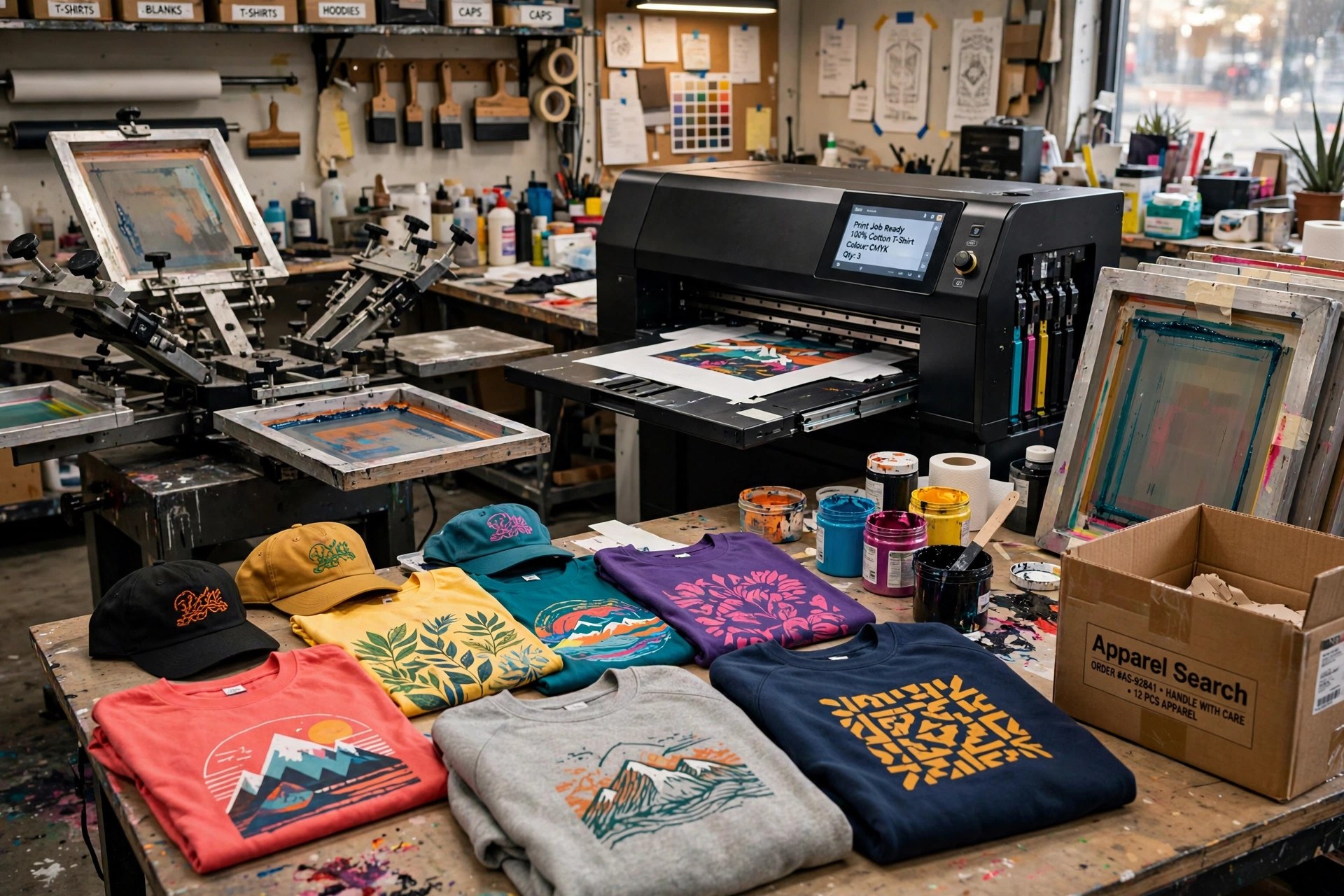
Below are examples of custom printed apparel of the kind these services produce every day: logo shirts for staff, numbered jerseys for teams, event tees, and branded sweatshirts and caps. Whichever route fits, the same basics decide the result — a print method matched to the design, a garment blank matched to the budget, and artwork prepared at the size and resolution the printer asks for.
Custom Printing Guides & Directories
Print Shops: Custom Printing for Local Requirements
Print shops are storefront operations that print apparel such as t-shirts for a local business, a school event, a local sports team or a special family event, in the quantities those customers actually need — dozens, not tens of thousands. Because the shop is local, the customer can see garment samples, approve a proof in person and pick up the finished order. Short-run methods dominate here: screen printing for simple spot-color designs in moderate quantities, direct to garment printing for full-color artwork and very small runs, and heat transfers for names and numbers. The T-shirt Printers Guide and the printer directory linked above are the starting points for finding these services.
A good local order is mostly decided before printing starts. The shop needs the design in a usable file format, the exact garment style, sizes and colors, and a firm in-hand date. Names and numbers for team jerseys, sponsor logos in set positions and event dates that cannot move are the details worth confirming in writing, because a short run leaves no surplus stock to pull a corrected shirt from.
Printing Factories: Large-Scale Clothing & Fabric Printing
The factory route serves apparel wholesalers and larger retail stores. These manufacturers print t-shirts, underwear, sweatshirts and other garments in production quantities, working to the buyer specifications for blank quality, print placement, ink type and packing. Factory printing is organized around capacity: automatic screen printing carousels, conveyor dryers and, for fabric printed before cutting, rotary or flatbed textile printing lines. Minimum quantities are correspondingly higher, and pricing is quoted per piece at volume rather than per job.
Buyers at this scale evaluate a factory on more than price: consistent registration across a long run, color matching to an approved standard, curing that survives washing, and the ability to repeat the same print on a reorder months later. The printing factories section linked above is the directory for this tier of the trade, while the print shops page explains where the boundary between a shop and a factory usually falls.
Machinery for Custom Apparel Printing
Both routes run on machinery, and the method a shop or factory offers follows from the equipment it owns. Screen printing presses, direct to garment printers, heat presses, conveyor dryers and exposure units each support different work. Brother is one of the established makers of garment printers for custom apparel printing, and its garment printer line is a useful reference point for what current DTG equipment does — print resolution, garment sizes handled and production speed — when comparing machines or when asking a shop what it prints on.
Photos

Printing Machinery
More Manufacturing Resources
Common Questions
Should an order go to a print shop or a printing factory?
Quantity and purpose decide. A local business, school, team or event needing a modest run belongs with a print shop. A wholesaler or large retailer ordering production quantities of printed garments belongs with a printing factory equipped for long runs.
What garments can be custom printed?
T-shirts are the most common, and the same services print sweatshirts, underwear, caps, jerseys and other apparel. Factories print garments and fabric at production scale, while print shops focus on finished garments in short runs.
What does a printer need to start a custom order?
A usable artwork file, the garment style, sizes and colors, quantities per size, print placement, and a firm delivery date. Team names and numbers, sponsor logo positions and event dates should be confirmed in writing before printing begins.