Women's Vests Guide
A women's vest is a sleeveless garment worn over a top or dress — tailored waistcoats, quilted and puffer vests, sweater vests, denim and utility vests — opening at the front or pulling on.
Shop Women's Vests Now
Shop Women's Vests on Amazon Shop Women's Vests on eBayThe Amazon and eBay links on this page are affiliate links. If you make a purchase through them, Apparel Search may earn a commission.
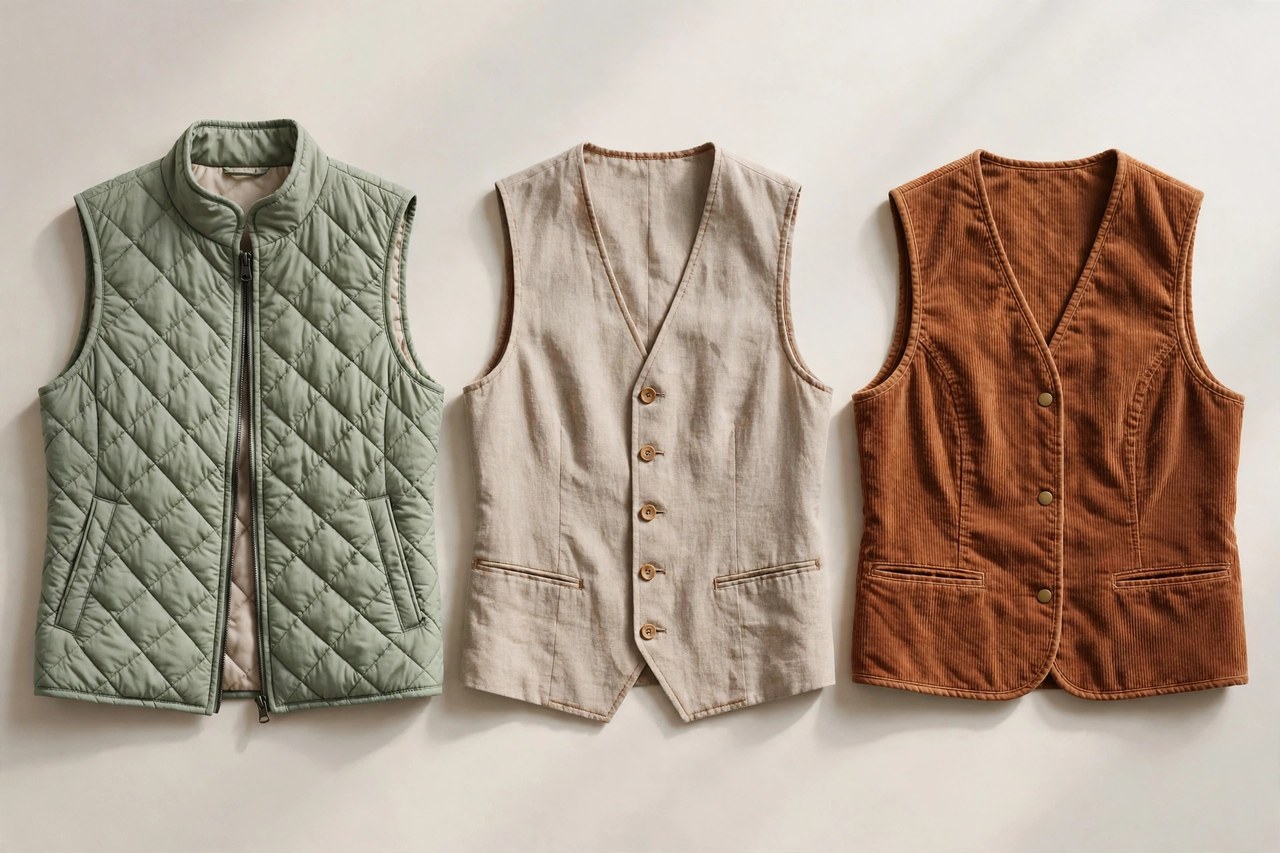
A women's vest is a sleeveless garment worn over a top or dress — tailored waistcoats, quilted and puffer vests, sweater vests, denim and utility vests — opening at the front or pulling on. This guide covers the vest as a layer with a job: core warmth without sleeve bulk, pockets and utility, or a tailored third piece that finishes an outfit, and the length, closure and armhole decisions that decide which job a given vest does well.
This guide covers vests in the order a careful buyer needs it: what the product is made from, how it is constructed, how it should fit, how to choose it for real use, and how to care for it so it lasts. The focus is on measurable details, named materials and checks you can perform in a shop or on a parcel's arrival, rather than general fashion language.
Fabrics and Construction
Vests divide by family: tailored waistcoats in wool, linen and suiting blends with a lining-fabric back; insulated vests with quilted or puffer shells in nylon and polyester over down or synthetic fill; sweater vests in wool, cotton and acrylic knits; and utility and denim vests in canvas, twill and denim. Each family's fabric is its function — polish, warmth, softness or work.
Construction follows the family: waistcoats are canvassed or fused at the front with button closures and a back cinch, insulated vests are baffled or quilted to keep fill in place, and knitted vests are finished with ribbed armholes and hems. A vest's armhole is cut deeper than a jacket's because it must fit over the sleeve of whatever is worn beneath: check that the armhole clears your thickest intended layer without binding. Armholes are bound or lined on better vests of every type, because the armhole edge is where a vest is seen closest.
Fit and Layering Room
A vest is sized over its intended layer, so fit it wearing that layer: a waistcoat over a shirt, a puffer over a fleece. The shoulder should sit at your shoulder, the armhole should clear the layer beneath without binding, and closures should meet without strain across the bust — a vest worn open by necessity has failed its fitting.
Length is the vest's styling dimension: cropped vests end at the waist, classic waistcoats meet the waistband, and long vests reach mid-thigh or beyond. Match length to what is beneath — long over lean, short over full — and check the vest seated, because a vest that fits standing can pull across the back when you sit.
Choosing a Vest by Job
Choose vests by the job in a fixed order: the layer it must fit over, the warmth or polish it must add, closure type for how it will be worn through a day, and only then colour and detail. In practice, rank these checks in the order your own use demands — frequency of wear first, then weather, washing facilities and budget — because that order differs by wardrobe, and it is the real reason two careful buyers can correctly choose differently from the same rail.
Judge price by family standards: canvassing and cloth in a waistcoat, fill power and shell finish in a puffer, fibre and rib recovery in a knit. A vest is a small garment, so its cost concentrates in exactly those qualities — there is nowhere for a maker to hide a shortcut.
Care and Storage
Care follows the family: tailored vests brush and spot-clean like suiting and are pressed, not washed, unless the label allows; insulated vests wash cool and dry with loft restored — down needs a full, warm tumble with dryer balls to reclump its fill, synthetics dry faster and forgive more.
Store waistcoats hung by the shoulder, knitted vests folded, and puffers uncompressed — a puffer stored crushed for a season loses loft it only partly regains. Keep suede and leather vests in breathable covers away from light, and check stored vests for the buckle, button and zip faults that are cheap to fix before the season starts.
Common Questions
What length vest works best over dresses?
A cropped or waist-length vest finishes at the dress's narrowest point and keeps the dress's line, while a long vest over a dress works best in a fluid fabric that moves with the skirt. Mid-thigh tailored vests can cut a flowing dress awkwardly — try the pairing standing and seated.
Are puffer vests warm enough as a main winter layer?
A puffer vest insulates the core, which is where warmth matters most, but leaves arms to the layer beneath. Over a thermal or fleece top it handles cold, active days well; for still, very cold weather a sleeved coat outperforms it because exposed arms lose heat steadily.
How should a tailored waistcoat fit?
Close but not pulling: buttons should close without strain lines, the back should lie smooth, and the hem should meet the waistband of trousers or a skirt without a gap. Waistcoats are commonly altered at the side seams, so buy for shoulder and bust fit and tailor the waist.
Related Women's Guides
Fashion Vests and Utility Vests
Some women's vests are designed for fashion and others for utility. Examples of the utility side are the fishing vest — durable, light in weight, and built with pockets to hold lures and equipment while fishing — high-visibility clothing, a type of personal protective equipment (PPE) with highly reflective properties or a colour easily discernible from any background, and the ballistic or bullet-resistant vest, a piece of personal armour that absorbs impact and reduces or stops penetration.
The fashion side — the denim, leather, down, faux-fur and argyle sweater vests pictured in the gallery below — is the family the rest of this page covers: whatever the type, a vest is a sleeveless garment covering the upper body, made in a wide variety of fabrics, colours, patterns and styles.
Photos


More to Explore on Apparel Search
Looking for Women's Clothing Stores?
This guide helps you choose women's vests. To browse where to buy, visit our women's clothing store directory, where you can find retailers that carry them.