Women's Sweater Vest Guide
A sweater vest is a knitted sweater without sleeves — a V-neck or button-front layer that adds the warmth and pattern of a knit without adding bulk to the arms.
Shop Women's Sweater Vests Now
Shop Women's Sweater Vests on Amazon Shop Women's Sweater Vests on eBayThe Amazon and eBay links on this page are affiliate links. If you make a purchase through them, Apparel Search may earn a commission.
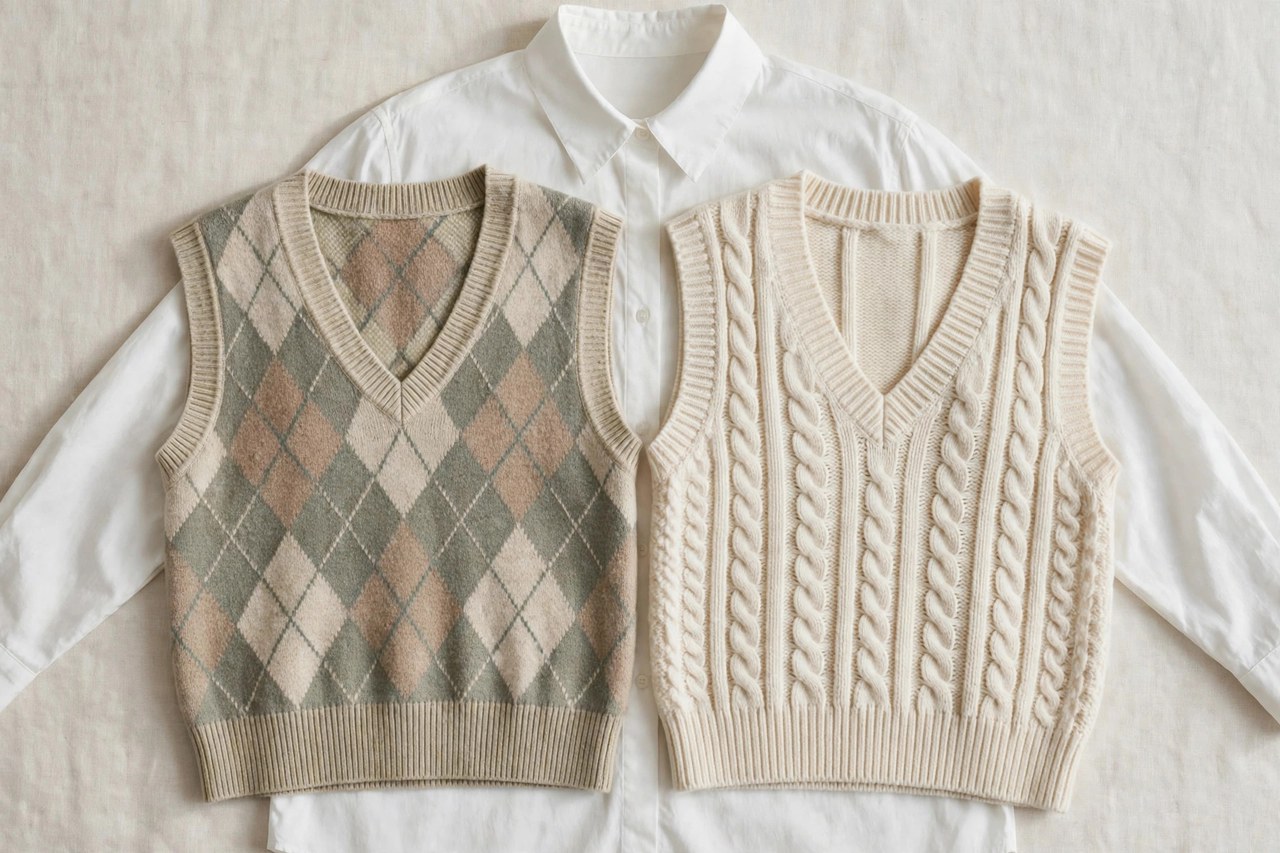
A sweater vest is defined by an absence. A sweater vest is a category of clothing that is knitted, similar to a sweater, but has no sleeves, like a vest — typically with a low-cut neckline, with or without buttons down the front. It is a sweater with the sleeves removed by design: the warmth stays at the core, the arms stay free, and the layer is built to be seen over a shirt.
That makes it a different purchase from both of its relatives in this section. A sweater is a complete top; a sweater dress is a complete outfit; a sweater vest is a deliberate middle layer, bought for what it adds to other clothes. This guide covers its classic patterns, its long association with golf and campus dressing, how to layer it without bulk, and how to judge fit in a garment whose armholes and neckline do most of the work.
Classic Patterns: Argyle Leads
Argyle is the sweater vest's signature pattern, and women's argyle sweaters are the vest's close kin. The diamond pattern with its diagonal cross-checks came to knitwear through Scottish hosiery and golf clothing, and on a vest it has a practical virtue beyond tradition: the full pattern panel sits on the torso, displayed completely, with no sleeves interrupting it. An argyle vest over a plain shirt is the complete, classic statement of the style in one move.
Beyond argyle, the main families are cable-knit vests, which borrow the sweater's most traditional texture and read warm and collegiate; Fair Isle and patterned yoke vests, whose colorwork concentrates near the chest; ribbed and plain fine-gauge vests, which act as quiet, tailored layers; and striped and cricket-style vests with deep V-necks and banded edges borrowed from sport. Chunky, oversized vests are the modern branch, worn as the outer layer. Pattern scale matters: a bold argyle wants plain company, while a plain vest can carry a patterned shirt.
The Golf and Campus Tradition
Sweater vests are popular among women who play golf, and the golf course explains the garment's design better than any fashion history. Golf dressing needed warmth for early tee times, an unencumbered swing — hence no sleeves — and a tidy, traditional appearance that a fleece or windbreaker could not provide. The sweater vest solved all three, and its argyle pattern traveled with the sport. From golf it passed into campus and preppy dressing, where the vest over an oxford shirt became a uniform of studied ease.
Worn straight — fitted vest, collared shirt, tailored trousers — the vest reads classic and intentional. Worn against type, oversized over a plain tee, it reads as a knowing quotation of the classic. Decide which statement you are making, and let the layers agree with it.
Layering Without Bulk
The vest's working partnership is with the collared shirt: a button-down's collar frames the vest's V-neck, its cuffs extend the knit visually, and the shirt's body gives the vest a smooth foundation. The rules of the pairing are simple. The shirt should be slimmer than the vest, the collar should sit outside the neckline, and the shirt's tails should either tuck cleanly or, in longer modern vest styles, be fully covered. A turtleneck under a vest is the cold-weather alternative, removing the collar question and adding the warmth sleeves would have given.
A deep V shows a generous triangle of shirt; a shallow V or crew neck reads more like a sleeveless sweater and can be worn alone in transitional weather — warm core, bare arms. Button-front vests add adjustability. Under a blazer, choose fine gauges only: the vest's selling point is layering without bulk.
Fit and Care
Fit concentrates in three places. The armholes should sit close enough to the body that the shirt underneath does not balloon out, but never bind or cut when you raise your arms — remember, freedom of movement is the vest's founding purpose. The shoulder should cover the shoulder seam of the shirt beneath without slipping toward the neck or the arm. Length runs from cropped modern cuts that end at the waist to classic hip-length vests; the classic rule is that the vest should meet or cover the waistband of what you wear below it, so no band of shirt interrupts the line.
Care is standard knit care with one vest-specific warning: armhole and neckline ribbing do the garment's structural work, so treat them gently. Wash cool and gentle or by hand, reshape the armholes and V while the vest dries flat, and fold for storage rather than hanging — a sleeveless knit on a hanger stretches at the shoulders and droops at the hem faster than a sweater, because there is less garment to distribute the weight. Looked after this way, a good sweater vest is a decades garment, useful every cool day of the year.
Related Women's Guides
Photos


Looking for Women's Clothing Stores?
This guide helps you choose women's sweater vests. To browse where to buy, visit our women's clothing store directory, where you can find retailers that carry them.