Monokini
Clothing Definitions — definitions of garments and clothing terms from Apparel Search
Search Apparel Search
At a Glance
Definition: The monokini is Rudi Gernreich's 1964 topless swimsuit — a brief bottom held up by two straps, with the top omitted by design; the name is now also used for one-piece swimsuits with large cut-outs.
Category: Clothing Definitions
Word Origin
Coined by its designer Rudi Gernreich in 1964 as the counterpart of bikini: mono- (one) in place of the bi- (two) of the two-piece — one piece where the bikini has two. (The bikini's own name comes from Bikini Atoll; the monokini simply borrows its shape.)
The monokini was designed by Rudi Gernreich in 1964, consisting of a brief bottom supported by straps, and it was presented as the topless swimsuit: the design that began modern discussion of topless swimwear. Some manufacturers and retailers also use the name for modern one-piece swimsuits with large cut-out sections that resemble a bikini joined by fabric, and some refer to those designs as a topless swimsuit or topless bikini as well. This page explains the 1964 design and the modern garment that took its name, in plain product terms.
The 1964 Design
Gernreich's monokini consisted of only a brief, close-fitting bottom and two thin straps. The bottom extended from the midriff to the upper thigh and was held up by shoestring laces that made a halter around the neck — the straps did the engineering work of the omitted top, keeping the brief in place. It was the first women's topless swimsuit, and it was revolutionary and controversial in equal measure: photographed worldwide, argued about in newspapers, and, when worn in public in some places, met with arrest, so that its early history is as much legal as sartorial.
Gernreich did not expect the 1964 monokini to become ordinary beachwear, and it did not: only a small number were sold. He had forecast in advance that swimwear would eventually drop the top, and produced the design so the forecast could be photographed and argued about — a statement made as a product. Its importance is as an idea made real, the point from which modern discussion of topless swimwear begins, within the wider influence of swimwear on fashion and on the rules governing dress.
The design's fame rests on a photograph as much as on the garment: Gernreich had the monokini modelled by Peggy Moffitt, his house model, and the resulting images — published internationally in the summer of 1964 — made a swimsuit almost nobody could buy into one of the most discussed garments of the decade. Gernreich was a designer who treated fashion as forecast and argument, and the monokini was his method in its purest form: a real, purchasable product, made in a small edition, whose purpose was to test in public an idea about where dress was going. The argument it started — about toplessness, decency law and the beach — ran for years in courts and newspapers, long after the suit itself had become a museum piece.
The Modern Monokini
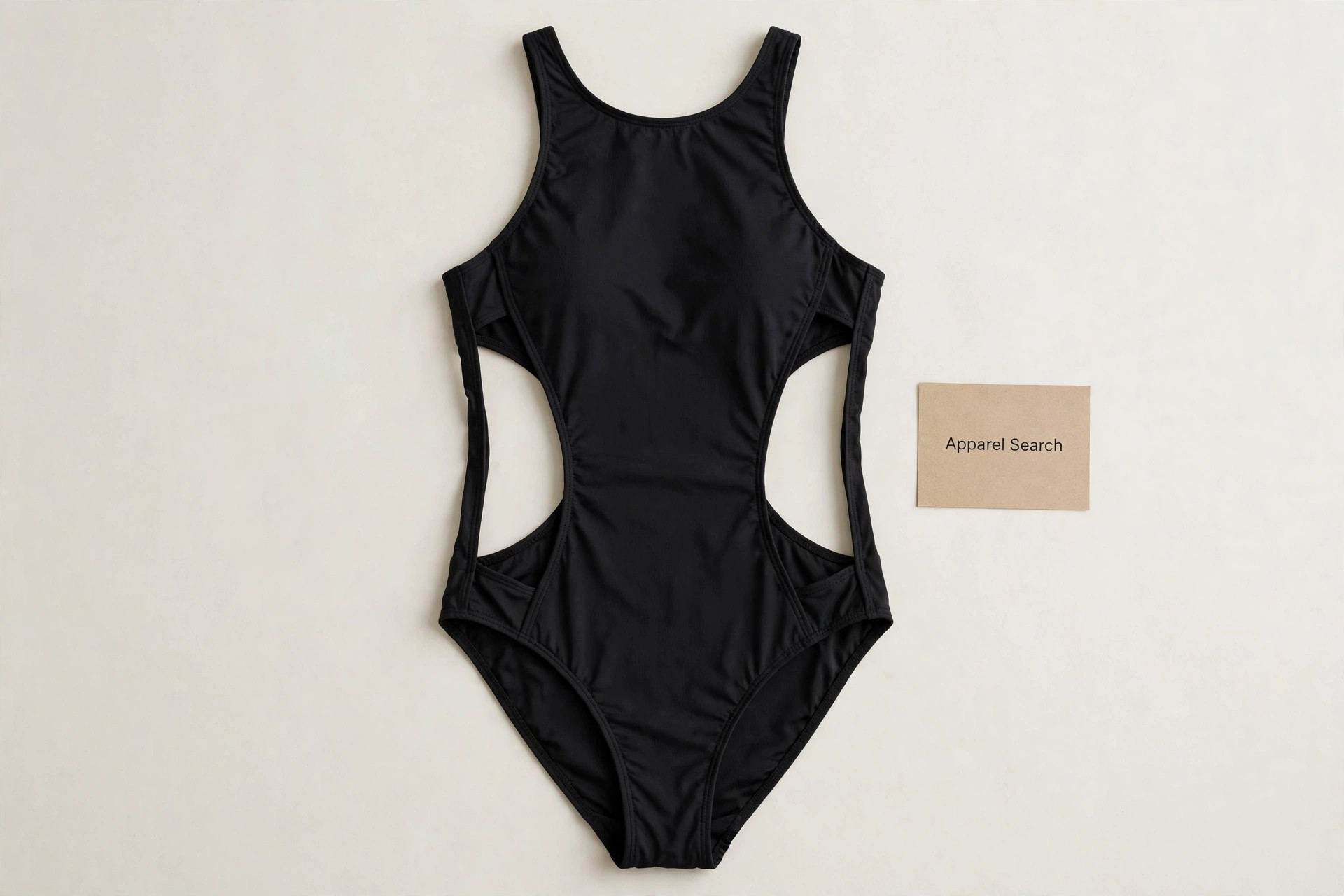
The word's second life is commercial. Unlike Gernreich's original design, current monokini designs are one-piece swimsuits that cover the breasts but typically include large cut-outs on the sides, back or front. The cut-outs are connected with varying fabrics and materials — mesh, chain, and narrow panels of the suit fabric — to link the top and bottom sections together, so that from the back the monokini looks like a two-piece swimsuit while remaining a single garment. Because 'monokini' reads as the counterpart of 'bikini', retailers applied it to these suits, and it is now a standard category of beachwear.
Modern monokinis are made in the usual swimsuit fabrics — nylon and elastane blends — lined, and sized like other one-piece costumes. The two meanings share a name and a family resemblance, minimal coverage from minimal fabric, but they are different products, and product descriptions use the term in the modern sense unless they are discussing swimwear history. In the swimsuit family the modern monokini sits between the one-piece and the two-piece: one garment, cut away until it reads as two.
Buying and Wearing the Modern Monokini
Because the cut-outs remove the fabric that gives a one-piece its structure, fit is the modern monokini's weak point: the connecting panels carry the tension of the whole suit, so a size that fits at the bust and hip can still pull or sag at the joins if the torso length is wrong. Shoppers should check torso length first, then the security of any chain or mesh links, which are decorative engineering rather than structure. Shoppers should also read product descriptions closely, since a suit sold as a monokini today is the cut-out one-piece, never the 1964 design. Care follows other swimwear: rinse out chlorine and salt after wear, dry out of direct sun, and store flat so the cut-out edges — the suit's most stressed seams — are not stretched on a hanger.
Not to Be Confused With
The three names describe three different constructions. A bikini is a two-piece swimsuit: a separate top and a separate bottom. A one-piece swimsuit is a single garment with an uncut torso. A monokini is also a single garment, but cut away at the sides, front or back until it reads as a bikini joined by narrow panels — one piece behaving visually as two. (In swimwear history the word means something else again: Gernreich's 1964 topless design, a brief held by straps, described above.)
Common Questions
What is a monokini?
Originally, the monokini is the topless one-piece swimsuit designed by Rudi Gernreich in 1964: a brief bottom held by straps over the shoulders, with the top omitted by design. The name is now also used for one-piece cut-out swimsuits.
Who designed the monokini?
Rudi Gernreich designed the monokini in 1964. He predicted the design in advance and presented it as a deliberate statement about the future of swimwear, and it received worldwide publicity.
What is a modern monokini swimsuit?
Modern monokinis sold in stores are one-piece swimsuits with substantial side or front cut-outs, so the suit is a single garment that visually resembles a bikini connected by narrow fabric panels.