Bikini
Clothing Definitions — definitions of garments and clothing terms from Apparel Search
Search Apparel Search
At a Glance
Definition: A bikini is a women's two-piece swimsuit made of two separate garments — a top and a bottom — leaving the midriff uncovered between them.
Category: Clothing Definitions
Word Origin
Louis Réard named his 1946 swimsuit after Bikini Atoll in the Marshall Islands, the site of American nuclear weapons tests that same summer, reasoning that the reaction to so small a suit would be explosive. The name outlasted the scandal and became the generic word for the two-piece swimsuit.
The bikini is the most famous swimsuit in the world, and its fame was planned. When the modern two-piece was launched in Paris in the summer of 1946, its designer named it after a nuclear test site, predicting an explosive reaction — and for once the publicity understated the case. The suit was banned, denounced and sung about before it was widely worn, and it took fifteen years to be accepted in the United States. The two-piece idea itself, though, is far older than 1946.
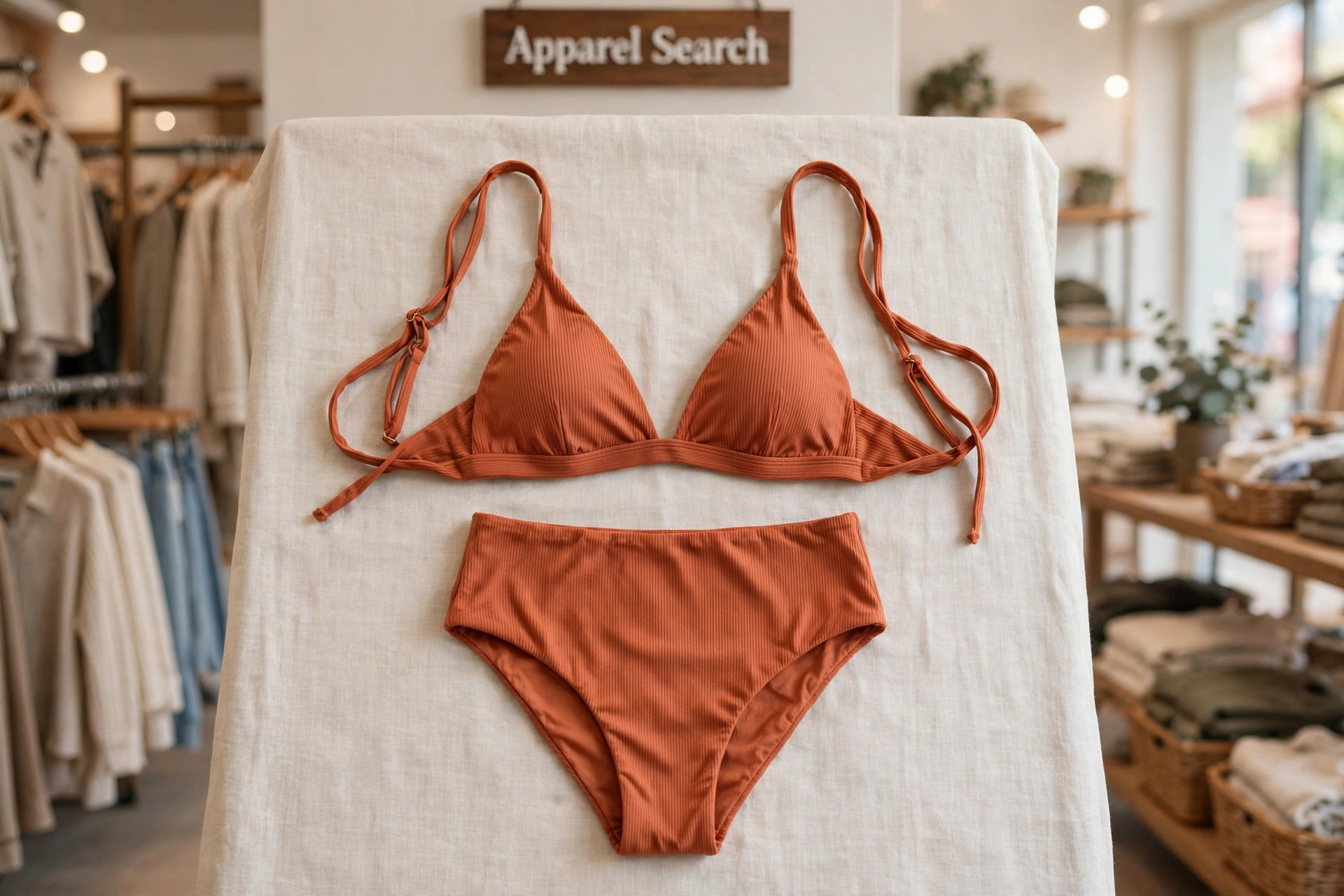
Two Pieces, Fitted Separately
A bikini is defined by its construction: two separate garments rather than one. The top and the bottom are sized, styled and fitted independently, which is the two-piece's lasting practical advantage — most bodies are not the same size top and bottom, and a bikini lets each half be chosen to fit. Top styles vary by support and coverage, from structured underwired cups to simple triangle and bandeau forms; bottoms vary by rise and cut. Between them, the midriff stays bare, which is the silhouette that separates a bikini from a one-piece swimsuit.
Modern swim fabrics are chosen for the water: they must hold their shape when wet, dry quickly and resist chlorine and sunlight, and a well-made suit is lined where needed, with elastic that keeps its tension. Care protects exactly those qualities — rinse in fresh water after swimming, wash gently, and dry out of direct sun, since heat and harsh detergent break down the elastic fibres that give both pieces their fit. Our women's bikini swimwear guide covers current styles, fits and fabrics in shopping detail, alongside the wider beachwear family.
The range now runs far beyond the minimal suit of 1946. Athletic two-pieces built for training and surf favour secure tops and stay-put bottoms; high-waisted bottoms revive a 1950s line; structured tops borrow their engineering from lingerie. All of them remain bikinis by the only test that matters — two separate pieces, independently fitted — which is why the word has survived every change in how much, or how little, the two pieces cover.
An Old Idea, a 1946 Relaunch
Two-piece garments for women are genuinely ancient: Greek urns and paintings show women in two-piece athletic dress as early as 1400 BC, and Roman mosaics show the same idea. What happened in 1946 was not the invention of the two-piece but its reduction to a modern minimum, in a Paris competition between two designers. Jacques Heim launched first, in May 1946: his tiny two-piece was called the Atome, after the atom, and advertised as the world's smallest bathing suit.
Two months later the engineer Louis Réard went smaller. His suit, introduced on 5 July 1946, split Heim's atom further, using so little fabric that no professional model would agree to wear it; Réard hired Micheline Bernardini, a dancer from the Casino de Paris, to present it. The launch is one of the great stories of fashion publicity, and the name he chose — explained in the Word Origin box above — did as much work as the suit itself.
Fifteen Years to Acceptance
Scandal came first. In 1951 bikinis were banned from the Miss World contest, and through the early 1950s the suit was a European beach phenomenon that American opinion treated as beyond the line. The turn came through film and music. Brigitte Bardot's bikini in And God Created Woman in 1957 created an American market for the style; Brian Hyland's 1960 hit 'Itsy Bitsy Teenie Weenie Yellow Polka Dot Bikini' turned it into a joke everyone was in on; and the 1963 film Beach Party, with Annette Funicello and Frankie Avalon, led a wave of beach films that made the bikini a pop-culture symbol rather than a scandal. By the mid-1960s the argument was over, roughly fifteen years after Réard's launch.
The Bikini Family: Tankini, Monokini and Beyond
The two-piece idea kept generating relatives. The tankini pairs a tank top with a bikini bottom, giving two-piece convenience with one-piece coverage. The monokini — a term coined by Rudi Gernreich — began as the name for a one-part topless style, so that where a monokini is worn, 'bikini' can jokingly mean the monokini plus a sun hat. In the 1980s the bottom was cut down to the Brazilian style, with a very narrow back, and designers have continued to experiment at the minimal end of the range ever since. The enduring point is the original one: two pieces, separately fitted, with the midriff between them — a formula flexible enough to run from the athletic two-pieces of the ancient world to whatever next summer brings. See also the bikinis product guide.
Not to Be Confused With
Bikini vs. tankini vs. monokini: a bikini is a separate top and bottom with the midriff bare; a tankini pairs a longer tank top with a bikini bottom for more coverage; a monokini is a one-part style. All three descend from the two-piece idea — see the swimsuit definition for the full family.
Common Questions
What is a bikini?
A bikini is a women's two-piece swimsuit made of two separate garments, a top and a bottom, leaving an uncovered area between them at the midriff. Because the pieces are separate, each can be sized and styled independently.
Who introduced the modern bikini?
The modern bikini was introduced by the French engineer Louis Réard in Paris on 5 July 1946. It refined Jacques Heim's Atome, launched two months earlier as the world's smallest bathing suit; unable to find a model willing to wear his smaller design, Réard hired the Casino de Paris dancer Micheline Bernardini.
What is a tankini?
A tankini is a swimsuit that combines a tank top with a bikini bottom. It keeps the convenience of a two-piece while giving coverage closer to a one-piece suit, and it is one of several styles derived from the bikini, along with the monokini.