Wholesale Apparel, Piece Goods and Notions: Monthly Sales, 1992-2014
Census monthly wholesale sales charts for apparel, piece goods and notions
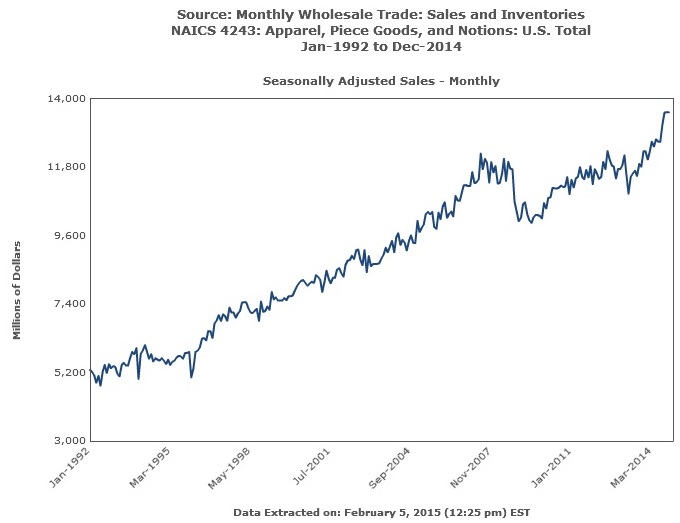
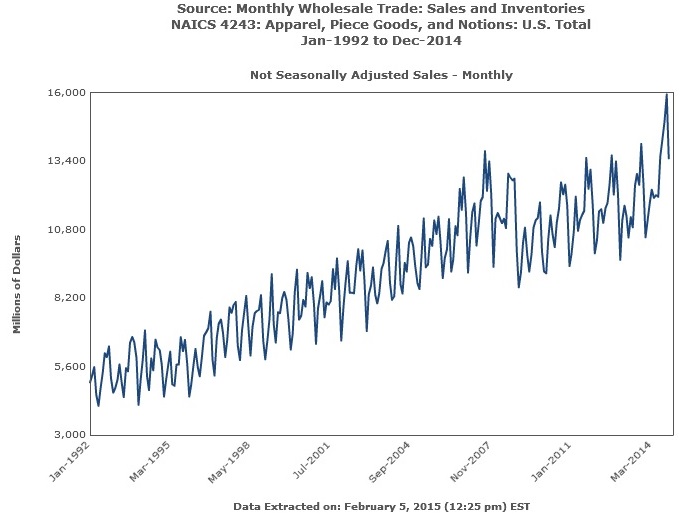
These charts present the Monthly Wholesale Trade sales series for apparel, piece goods and notions — industry 4243, United States total sales, monthly — from 1992 to 2014, built from United States Census data retrieved on February 5, 2015. Wholesale sales measure the middle of the apparel chain: merchant wholesalers selling garments, piece goods and notions onward to retailers, in volumes that lead the retail lines by the length of the delivery pipeline. The charts present the series in seasonally adjusted and not seasonally adjusted form, each with a line presentation, and the survey's notes on reliability and sampling variability are carried with the data. The figures are historical reference; the charts are not updated, and revisions to source data may occur.

Monthly Wholesale Trade: Sales and Inventories
4243: Apparel, Piece Goods, and Notions: U.S. Total
Sales Monthly
Apparel Search has utilized data from the USA Census to create the following historical information to help fashion industry researchers learn more about our industry. The data was retrieved on February 5, 2015.
Revisions to the original source data may occur, but we will NOT be
updating the charts listed on this page. If you wish to utilize this
information, it is important to keep in mind that the data can possibly be
outdated due to potential revisions.
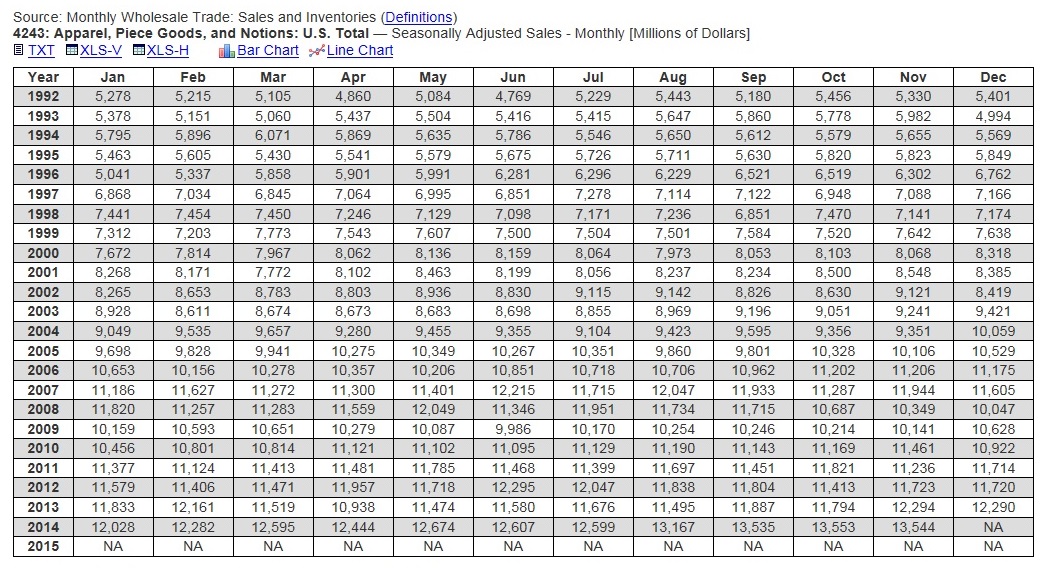
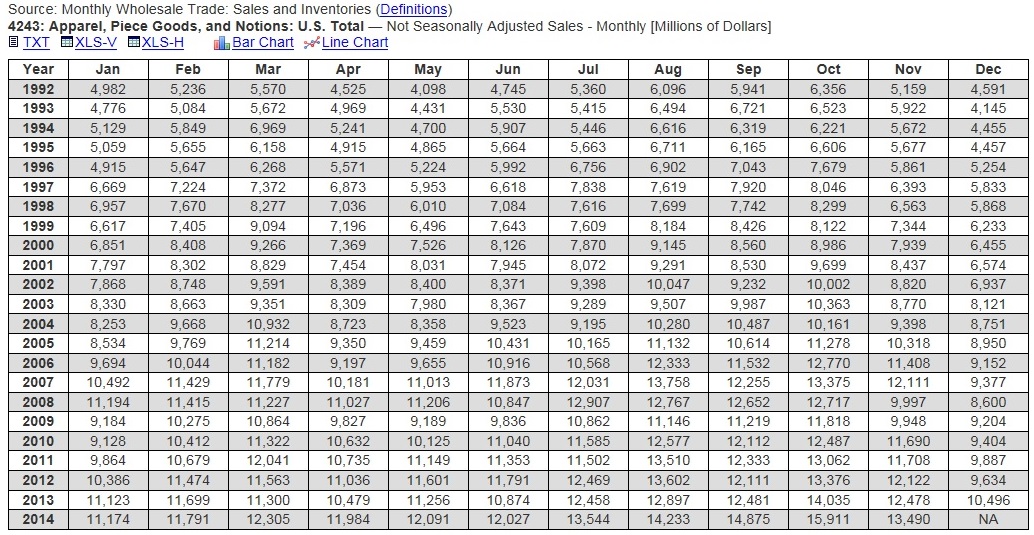
For the Monthly Wholesale Trade Survey, all current month estimates are
preliminary estimates and will be superseded in following months by revised
estimates.
For information on the reliability and use of the data, including important
notes on estimation and sampling variance, seasonal adjustment, measures of
sampling variability, and other information pertinent to this economic
indicator, go to the
Monthly Wholesale Trade Report [PDF], or refer to the
Monthly and Annual Wholesale Trade website, which provides a link to
more
historical data for these reports.
Estimated measures of sampling variability for totals are expressed as
coefficients of variation (CV). Standard errors (SE) are provided for
month-to-month change and ratio estimates.
Estimated measures of sampling variability are based on data not adjusted
for seasonal variation, and should be used when drawing inferences about
both adjusted and not adjusted estimates.
The Y-axis for the line charts may be truncated to prevent flattening of the
lines or to present the complete range of data.
How the Monthly Wholesale Trade Figures Work
All current-month estimates in the Monthly Wholesale Trade Survey are preliminary estimates and will be superseded in following months by revised estimates. The Monthly Wholesale Trade Report and the Monthly and Annual Wholesale Trade website provide the reliability documentation and links to more historical data for these reports. Estimated measures of sampling variability are expressed as coefficients of variation (CV), with standard errors (SE) provided for month-to-month change and ratio estimates, based on data not adjusted for seasonal variation and used when drawing inferences about both adjusted and not adjusted estimates. The line charts' Y-axes may be truncated to prevent flattening of the lines or to present the complete range of data, so values should be read from the data rather than estimated from a slope.
Reading the Middle of the Chain
Wholesale sales are the earliest demand signal in this collection's chain. A turn in this series precedes the corresponding turn in the retail clothing stores series by the time goods take to move from wholesaler to shop floor, and precedes the manufacturers' shipments response by a further step, which makes the 4243 sales line the researcher's leading indicator for the whole 1992-2014 apparel system. Read it beside the companion wholesale inventory series: sales accelerating against flat inventories tightens the pipeline, while sales slowing against rising inventories is the classic prelude to promotional seasons. The wholesale definitions page explains who counts as a merchant wholesaler and how agents and brokers differ — distinctions that decide what this series does and does not capture.
Common Questions
What do these charts measure?
United States total monthly wholesale sales for apparel, piece goods and notions (industry 4243) from 1992 to 2014, from Census Monthly Wholesale Trade data retrieved February 5, 2015.
Why do wholesale sales lead the retail series?
Wholesalers sell onward to retailers, so a turn in wholesale sales precedes the corresponding turn in retail sales by the time goods take to move through the delivery pipeline.
Are the monthly estimates final?
No. All current-month estimates are preliminary estimates and will be superseded in following months by revised estimates.