Cotton Prices
Cotton prices are tracked carefully because cotton is both a textile raw material and a traded commodity. Here is how futures, spot, and monthly reporting fit together.
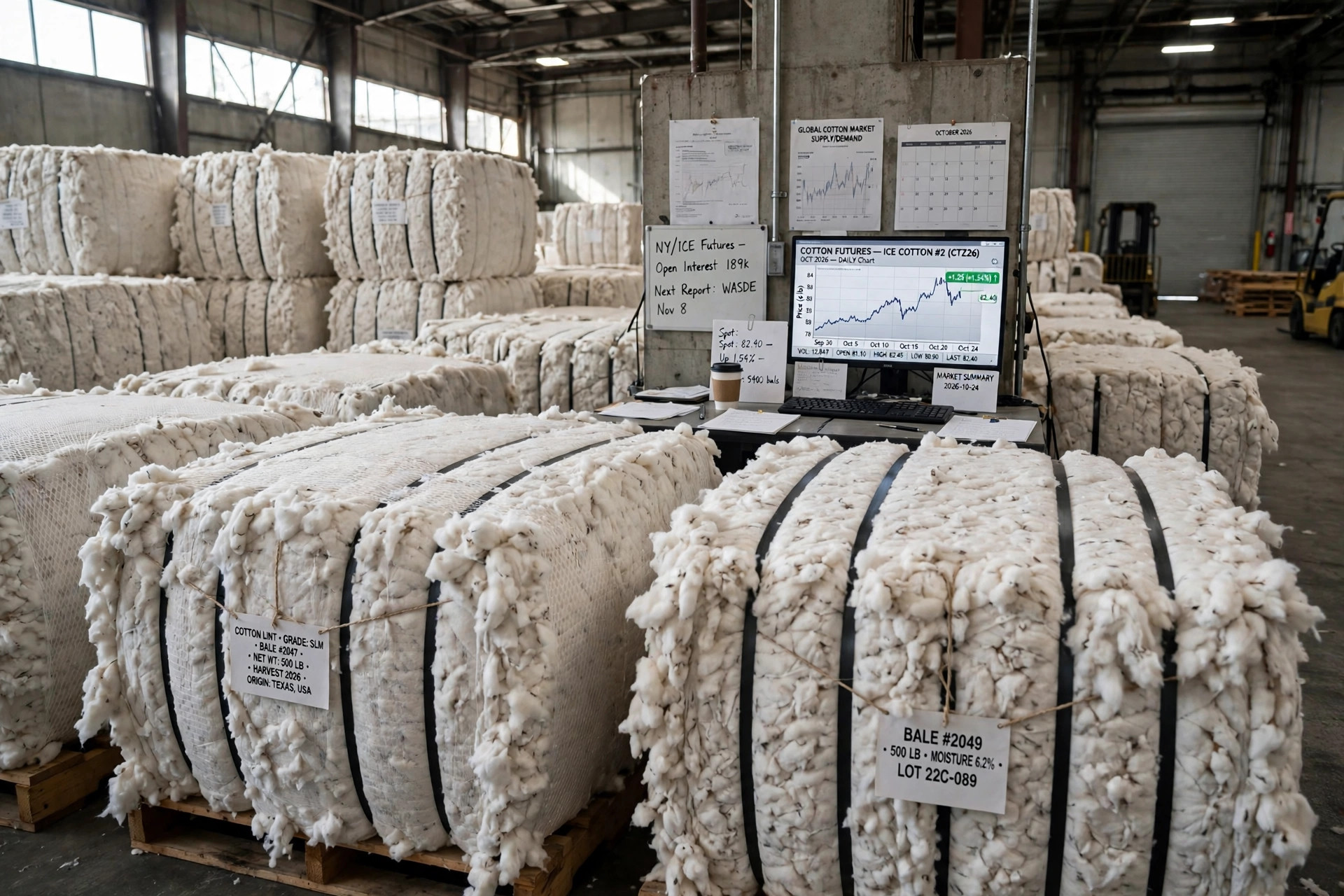
A Fiber That Is Also a Commodity
Cotton prices are tracked carefully because cotton is used for textiles and apparel, but it is also a commodity that is traded by the financial industry. That dual identity explains the variety of price sources. A spinner needs to know what physical lint of a stated grade and staple will cost, delivered in a stated period. A trader needs a standardized futures price that can be bought and sold quickly. A garment maker, further downstream, needs to know the direction and scale of movement, because lint is only one part of a fabric price, which is only one part of a garment cost. Each audience reads a different number, correctly, for its own decision.
If you are a member of the fashion industry, the financial industry, or an investor, it is a good idea to keep your eye on cotton price trends. Trend matters more than any single day's print for most apparel purposes. Contracts for yarn and fabric are negotiated over weeks and seasons, crops are planted and harvested on an annual cycle, and a sharp one-day move may reverse, while a sustained move changes mill offers, retail price architecture, and fiber substitution decisions. The external links here are price sources and exchanges, listed as References, not commercial listings. The sections below explain how to read them.
Futures, Spot, and Monthly Reports
Futures prices come from exchanges, including NYMEX cotton prices through the CME Group and the Zhengzhou Commodity Exchange in China. The Zhengzhou exchange was the first experimental futures market approved by the State Council, is one of the four futures exchanges in China, and is under the vertical management of the China Securities Regulatory Commission. A futures price is a market's current view of a standardized contract for future delivery. It is visible, frequently updated, and widely quoted, which makes it a useful benchmark — but it is not the delivered price of a specific bale, grade, or growth, and the difference between the benchmark and a physical price is a normal part of cotton trading, not an error.
Spot and physical reporting answer the nearer question of what cotton is changing hands for now, by grade and location, while monthly reports add context and history. The National Cotton Council of America publishes cotton price pages and a monthly view; Cotton Incorporated publishes daily cotton prices within its monthly economic letter work, connecting price to supply, demand, and mill use; and IndexMundi collects commodity price history in a form that makes longer trends easy to see. Reading all three together — a live benchmark, a physical report, and a monthly analysis — gives a far steadier picture than watching any one number flash on a screen.
International and Origin Price Sources
Cotton is priced in more than one country because it is grown and spun in more than one country. Sources include India raw cotton prices from the Office of the Textile Commissioner in India, India cotton pricing news from EmergingTextiles, cotton price news from Chinatexnet, and the Plains Cotton Cooperative Association, a grower-owned marketing cooperative whose members' cotton moves through U.S. channels. Each source reflects its market: local currency, local grades and conventions, local policy, and the freight and quality differences that separate one growth from another. Comparing them carelessly, without converting units, currencies, and delivery terms, produces apparent bargains or alarms that vanish on inspection.
Units deserve special care. Cotton lint is commonly discussed in cents per pound in U.S. contexts and in other units elsewhere, yarn and fabric use still other measures, and a bale is a package, not a universal weight across all countries and periods. Before comparing any two prices from this page's References, confirm the unit, the grade or quality basis, the location, and the period each price covers. That checking habit, more than any particular website, is what makes price tracking reliable for sourcing, teaching, or investment research.
What Cotton Prices Do to Clothing
Cotton prices affect both futures traders and the clothing industry, but the effect on clothing is neither instant nor total. A mill holding lint bought earlier, a spinner with yarn inventory, and a brand with garments already priced for a season all buffer the movement, while later orders reprice as new fiber costs work through yarn and fabric. Fiber share also varies by product: a basic cotton T-shirt feels a lint move more directly than a garment dominated by labor, trim, freight, or a blended fiber bill. Knowing the mechanism prevents two mistakes — expecting retail prices to jump the day futures do, and dismissing a sustained fiber move as irrelevant.
Use this guide as a map, not a ticker. Check the futures benchmark for direction, a spot or council source for the physical market, and a monthly letter for the reasoning, then relate what you find to your own yarn and fabric chart using the companion Cotton Fabric Prices and Cotton Yarn Price pages. You can also learn more about cotton fibers on Apparel Search before returning to the numbers.
Common Questions
How are cotton lint prices tracked?
Through three complementary lenses: exchange futures prices for a standardized benchmark, spot and physical reporting for current trading by grade and location, and monthly reports and economic letters for trends and context.
Is the futures price the price a mill pays for cotton?
Not exactly. A futures price is a benchmark for a standardized contract. A specific physical purchase also reflects grade, staple, origin, location, timing, and delivery terms.
Why do sources from different countries show different cotton prices?
Each market uses its own currency, units, grades, conventions, and local supply and policy conditions. Convert units and confirm the quality basis and delivery terms before comparing them.
More to Explore
References & Further Reading
- Cotton Inc. Daily Cotton Prices
- Cotton Price News - Chinatexnet
- Cotton Prices - NCCA
- Index Mundi
- India Cotton Pricing News - EmergingTextiles
- India Raw Cotton Prices
- National Cotton Council of America
- NYMEX (CME Group) - cotton prices
- Plains Cotton Cooperative Association
- The Zhengzhou Commodity Exchange
Looking for Fabric Mills and Suppliers?
For the fabrics and mills that turn priced lint into cloth, browse the main Fabric section on Apparel Search, alongside the Fabric Search cotton price guides.