Pricing Links Guide: Textile Industry Pricing Links of Interest
If you are interested in textile fiber pricing or commodity prices in general, this guide gathers the pricing links of interest for cotton and the wider textile trade — and explains how to use them well.
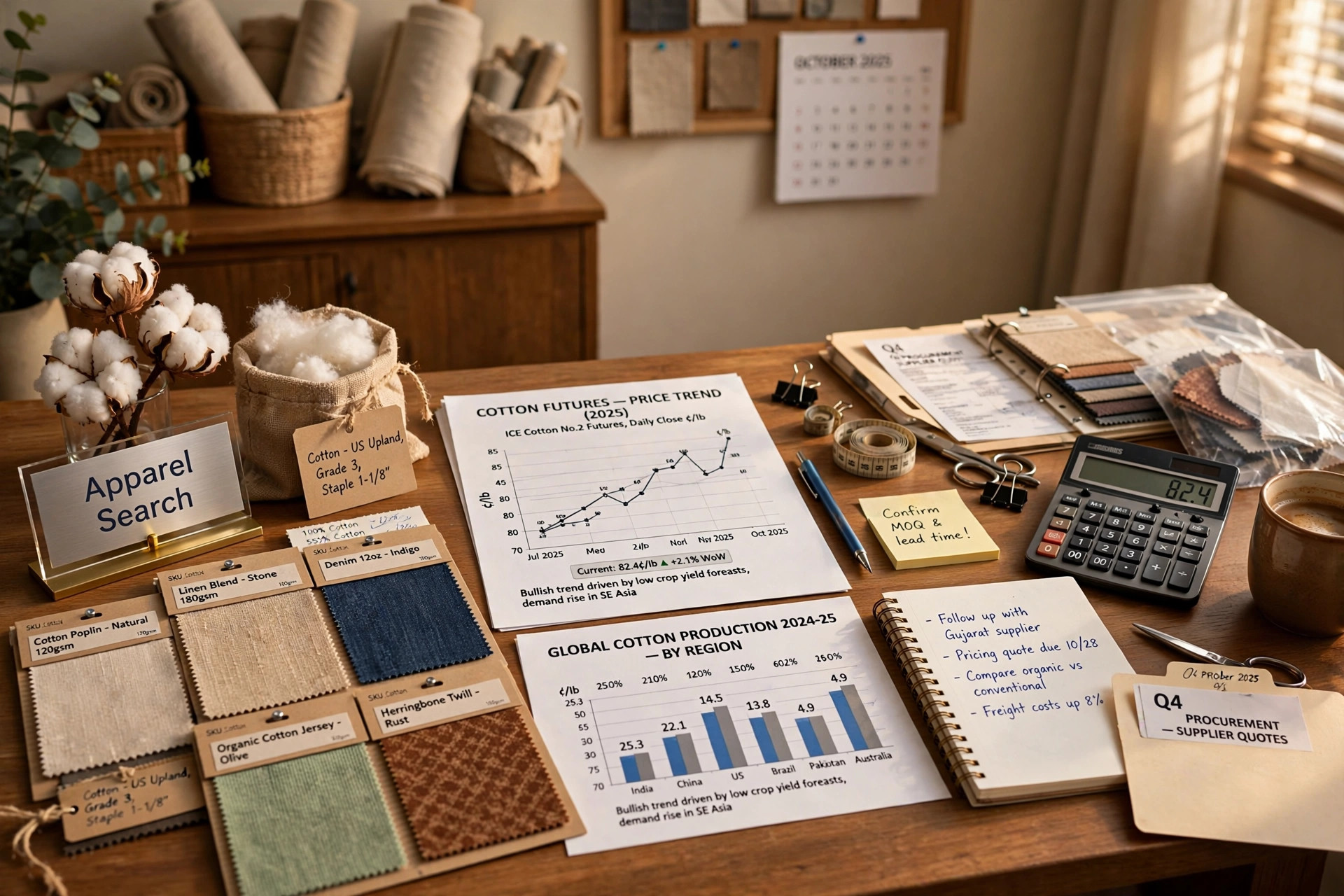
Pricing Knowledge as a Working Advantage
If you are a commodity trader or work in the textile industry or fashion industry, learning about pricing may give you a competitive advantage. That advantage is rarely a secret number. It is the habit of checking a claim against an independent source, knowing which stage of production a price belongs to, and understanding whether a movement is a one-day fluctuation or a season-changing trend. A buyer with that habit negotiates calmer, budgets earlier, and spots a specification change disguised as a price increase. A seller with that habit quotes more defensibly and explains increases in terms a customer can verify rather than simply accept.
This guide is the cotton section's doorway to pricing in general. Its own focus page is Cotton Prices and the fiber, yarn, and fabric guides beneath that hub, but its framing is broader: textile fiber pricing and commodity prices in general. Fibers compete with and substitute for one another, energy and freight press on every mill, and currencies translate world prices into local costs. A pricing links guide earns its place by helping you move between the specific and the general without confusing a cotton lint benchmark with a finished fabric offer.
The Textile Information Around the Prices
Pricing links are more useful with textile information alongside them: Textile Fibers, textile articles and Textile News, and the Textile Industry overview. That pairing is deliberate and worth keeping. A price without industry context invites misreading: a fiber can rise because a crop failed, because a competing fiber rose first, because freight spiked, or because demand shifted between blends. News and industry coverage supply those causes, while fiber background explains the technical limits on substitution — you cannot swap fibers freely when hand, dyeing, care, and labeling all change with the swap.
Work through the material in that order when a price moves sharply. First confirm the move itself in a price source, with its date, unit, and basis noted. Then read the news around it for a stated cause, and check whether that cause is temporary or structural. Then ask what it means at your stage: lint for a spinner, yarn for a knitter or weaver, fabric for a garment maker, or garments for a retailer. Each stage absorbs, delays, or amplifies a movement differently, and the textile information pages help you reason about your own stage instead of importing someone else's conclusion wholesale.
Using Pricing Links Without Being Misled
Every pricing link needs four questions asked of it before its number is used. What exactly is priced — which fiber, grade, count, or construction? In what unit and currency, at what place, and on what delivery terms? For what date or period, and is it a live benchmark, a spot report, a monthly average, or a seller's offer? And who publishes it, with what interest in the market? Exchanges, government market news, trade councils, specialist guides, news services, and marketplaces all publish useful numbers, but they publish different kinds of number. The discipline of this guide is to keep those kinds labeled, so a benchmark is never quoted as an offer and an offer is never mistaken for a market average.
Keep records as you go. A simple log with the date, source, stage, specification, unit, and figure turns scattered link visits into your own pricing history, the same chart discipline the fabric prices page recommends for purchases. Over a season, that log shows whether your supplier's movements track the market's, whether yarn followed lint with the usual lag, and where your costs genuinely diverge. That evidence, gathered from public links, turns a pricing conversation from opinion into comparison.
Where to Go From This Guide
Return to the Cotton Price main page to work the cotton stages in order, or step sideways into the individual guides: Cotton Yarn Price resources for the spinning stage, Cotton Fabric Prices for why cloth has no single range, the cotton definition for the fiber itself, and the cotton information links for the institutions behind the reports. Together those pages form a small, complete pricing library: definition, institutions, lint, yarn, fabric, and this guide's wider commodity frame. Few sourcing questions about cotton cannot be started, and most can be substantially answered, inside that library.
We hope the links to various commodity prices are of help to you. If you have suggestions regarding other helpful websites that should be listed, pricing and market-information resources are the right kind of suggestion for this guide. Name the publisher, the market and stage covered, and how often the resource updates, so other readers can judge it by the same four questions taught above. A curated guide stays valuable by adding sources that survive that scrutiny, not by accumulating every price page on the internet.
Common Questions
Who is this pricing links guide for?
Commodity traders and people who work in the textile industry or fashion industry. Learning how pricing works, and checking it against independent links, can give any of them a competitive advantage.
What should I check before using a price from a link?
What is priced and its specification, the unit, currency, place, and terms, the date and type of price — benchmark, spot, monthly, or offer — and who publishes it.
How does this guide relate to the cotton price pages?
It provides the wider textile and commodity frame, while the Cotton Price hub and its fiber, yarn, and fabric guides carry the cotton-specific detail in stage order.
Looking for Fabric Mills and Suppliers?
For suppliers and mills beyond pricing, browse the main Fabric section on Apparel Search, and use the Fabric Search hub to return to the cotton guides.