Printed Fabric Mills
Printed fabric mills turn plain woven cloth into patterned fabric for apparel and home furnishing. This page explains how printing mills work, profiles the producers preserved from the original guide, and sets out what buyers should verify before placing an order.
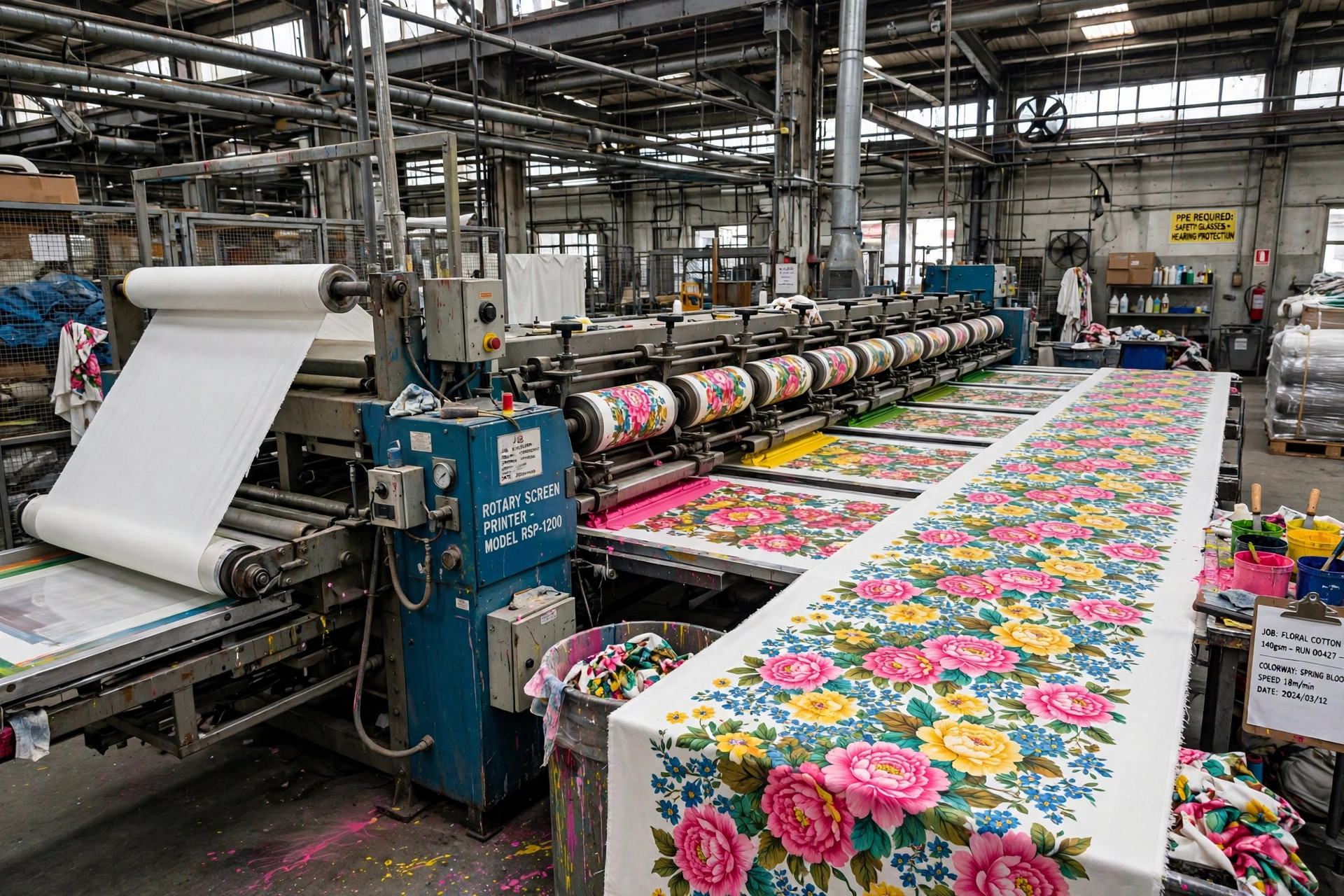
What a Printing Mill Does
Textile printing is the process of applying color to fabric in definite patterns or designs. In a properly printed fabric the color is bonded with the fiber so it resists washing and friction — the rubbing the trade calls crocking. Printing is related to dyeing, but with a crucial difference: in dyeing, the whole fabric is typically covered uniformly with one color, while in printing one or more colors are applied only in certain locations, in sharply defined patterns. A printing mill's skill lies in registration, color matching and fastness, repeated identically across thousands of yards.
Mills print by several methods. Rotary screen printing, the high-volume standard, pushes dye paste through cylindrical screens, one per color. Flatbed screen printing suits shorter runs and large repeats. Digital printing has grown quickly for sampling and short runs because it needs no screens, while older roller and block methods survive in craft and specialty production. Many of the mills listed below combine printing with weaving, dyeing and finishing under one roof, so a buyer can order greige cloth, printing and finishing as a single program.
The Producers in This Guide
The listings preserved below span the geography of the print trade. They include an Indian printing house that describes more than three decades in the business with its own dyeing and printing mill near Delhi, an Indian mill working since 1982 in printed flannel for children's shirts, jackets and home furnishings, and a mill that monitors every production stage from yarn checks through sizing, warping and weaving into bleached, printed and yarn-dyed fabrics and made-ups. Another listed group manages export-oriented textile enterprises supplying large retail chains in North America and Western Europe.
Other listings show the range beyond apparel prints. One Omani mill, established in the late 1980s at the Rusayl Industrial Estate, runs weaving and processing facilities chiefly for its domestic market with export capacity alongside. A fleece specialist is known for an exclusive velour finish and printed and solid fleece fabrics in several weights for warmth and insulation. A producer founded in 1990 concentrates on pashmina shawls, scarves and designer fabrics, while another Indian supplier of more than a decade and a half offers checks, stripes, poplin, printed, oxford, twill, dobby, seersucker, chambray and linen fabrics woven from premium yarns.
What Buyers Should Ask a Printing Mill
Begin with the artwork and the cloth together. Ask which printing methods the mill runs, the maximum number of colors and repeat size each method allows, and whether the mill will print your base cloth or supply its own — and if its own, get the greige specification in writing. Request a strike-off, the printed trial length, and approve it under the lighting your customers will see, because a pattern approved under factory fluorescents can shift under store or daylight conditions.
Then settle the performance and commercial terms: wash and rub fastness results for the chosen dye class on the chosen fiber, minimum yardage per design and per colorway, sampling charges and lead times, and how the mill handles a shade or registration fault discovered after delivery. Printing rewards preparation — Pantone or physical color standards, clean digital artwork at full scale, and a signed approval swatch prevent most disputes before a single bulk yard is printed.
Quality Checks for Printed Cloth
Inspect printed fabric at three moments: the strike-off, the first bulk piece, and incoming goods. Look for sharp design edges, accurate registration where colors meet, even color across the width and along the length, and no screen marks, streaks or repeats that jog at the seam of a rotary screen. Rub the print with a dry and then a damp white cloth to gauge crocking, and wash a measured cutting to check shrinkage and shade change together.
If you know of additional printed fabric mills that should be listed here, please let us know — verified producer listings make this section more useful for every buyer who follows. Marketplace directories that aggregate large numbers of printed fabric manufacturers are carried in this page's References rather than as company listings, since they are portals rather than producers. For weaving and printing capacity across all fabric types, the wider Apparel Search mill guides are a useful next step.
Printed Fabric Mills Listed Here
Company listings preserved from the original guide, with notes drawn from the original descriptions. The Alibaba printed fabric mills directory is carried in References, not as a listing.
Printing Textiles
Textile printing resource listed first in the original printed fabric mills guide; check the site for its current printing services.
Apex Textile Printing Mills
Printing mill under Apex Holdings Limited, whose export-oriented textile enterprises have supplied large retail chains in North America and Western Europe, with a stated philosophy that quality, on-time delivery and competitive price build long-term export relationships.
Baum Textile Mills
Mill known for its WinterFleece velour-finish fleece, described as an anti-pill fleece available in weights including 400 gram single velour and 450 gram double velour, in a large selection of prints and solids for warmth, insulation and breathability.
Central India Textile Mills
Manufacturer and exporter of printed flannel fabric since 1982, offering printed flannel in different prints and colors for children's shirts and jackets, plus flannel garments, home furnishing items and apparel.
K.R.G Textile Mills
Mill that monitors every production stage with quality checks on yarn and raw materials, producing 100 percent cotton grey fabrics, polyester-cotton fabrics, bleached and printed fabrics and made-ups, and yarn dyed fabrics.
M.H. Textiles
Part of the M.H. Group, in the textile business for more than three decades with its own dyeing and printing mill in Faridabad near Delhi and a dedicated team of weavers, emphasizing quality products at competitive prices.
Oman Textile Mills Co. L.L.C.
Omani joint stock company established by early 1988 at the Rusayl Industrial Estate, with weaving and processing facilities producing textile fabrics chiefly for the domestic market with potential to export part of its capacity.
Prince Textile Mills
Established in 1990 to introduce high quality pashmina products, offering designer pashmina shawls, scarves, mufflers and stoles plus designer fabrics including plain, jamawar and printed fabrics made from natural materials.
Royal Fabrics
Indian supplier with more than one and a half decades of experience, offering checks, stripes, poplin, printed, oxford, lycra, twill, dobby, seersucker, chambray, fil-a-fil, linen, lurex and cambric fabrics spun using premium yarns.
Common Questions
How is textile printing different from dyeing?
In dyeing, the whole fabric is typically covered uniformly with one color. In printing, one or more colors are applied only in certain locations, in sharply defined patterns, and bonded with the fiber so the design resists washing and friction.
What is a strike-off and why does it matter?
A strike-off is the printer's trial length of your design on the actual base cloth. Approving it — for color, registration and scale — before bulk printing is the main protection against a full order arriving in the wrong shade or alignment.
What printing methods do mills use?
Rotary screen printing is the high-volume standard, flatbed screen suits shorter runs and large repeats, and digital printing is widely used for sampling and short runs because it requires no screens.
More to Explore
Looking for Fabric Mills and Suppliers?
Compare printing mills with producers of every fabric type in the Apparel Search fabric directory, or start again from the Fabric Search hub.