Woven Fabric: Cloth Formed by Weaving
Woven fabric is cloth made on a loom by interlacing lengthwise warp yarns with crosswise weft yarns. This overview covers how weaving works, the three basic weaves every other weave is built from, and how woven cloth behaves in garments and home textiles.
Shop Woven Fabric Now
Shop Woven Fabric on Amazon Shop Woven Fabric on eBayThese links open the Apparel Search shopping guides for Amazon and eBay, where the product links are kept in one place.
How a Woven Fabric Is Made
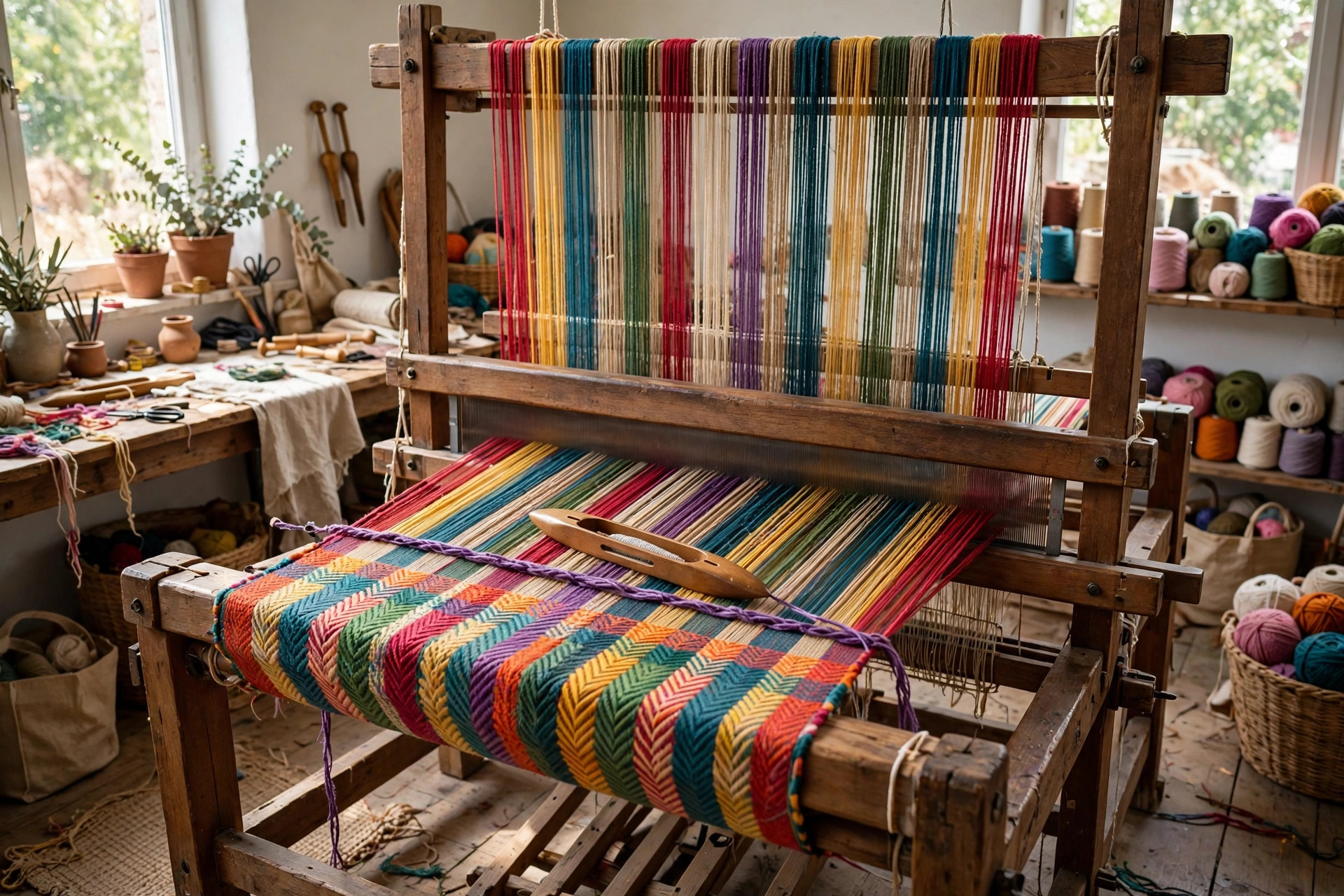
Weaving is the process of forming fabric on a loom by interlacing two sets of yarn at right angles. The warp is the set of yarns running lengthwise, held under tension on the loom, and the weft — also called the filling — is the set inserted across the width, one row, or pick, at a time. Each pick passes over and under selected warp yarns according to the weave pattern, and the rows are pressed together to form a continuous, stable sheet of cloth. Selvedges, the finished edges along each side, keep the fabric from unraveling during handling and finishing.
Looms range from handlooms, still used for specialty and handwoven textiles, to high-speed industrial shuttleless looms that insert weft with air jets, water jets, rapiers or projectiles. Whatever the machinery, the fundamentals stay the same: warp preparation and sizing, shedding to separate warp yarns, weft insertion, and beating the pick into the cloth. After weaving, fabrics are inspected, washed, dyed or printed, and finished for softness, stability, wrinkle resistance or other performance properties before they reach garment makers and home sewers.
The Three Basic Weaves
Every woven fabric, however intricate it looks, is built from one or more of three basic weaves. Plain weave is the simplest, with each weft yarn going over one warp yarn and under the next; it produces flat, balanced cloth such as poplin, broadcloth, chambray and muslin. Twill weave steps the interlacing over by one yarn on each row, creating the diagonal lines seen in denim, gabardine and many workwear fabrics, along with a softer drape and good durability. Satin weave allows yarns to float over several opposing yarns before interlacing, producing the smooth, lustrous face associated with satin and sateen.
From those foundations, mills develop variations and combinations — basket weave, rib weaves, dobby patterns with small geometric figures, and jacquard weaves that can picture complex designs directly in the cloth. Understanding which basic weave a fabric uses helps predict how it will look and behave: how much it will shine, how it will drape over the body, how well it will resist abrasion, and how forgiving it will be to sew. When a fabric description names a weave, it is describing this interlacing architecture, separate from the fiber the yarns are made of.
How Woven Cloth Behaves
Woven fabrics have a predictable grain. Along the warp and weft directions the cloth is comparatively stable, which is why garment patterns are aligned to the grain for consistent fit. True stretch in a standard woven is limited: the fabric gives mainly on the bias, the diagonal between warp and weft, unless elastic yarns such as elastane are woven in, as in stretch wovens for trousers, denim and fitted apparel. This stability is a strength for tailored clothing, shirts, upholstery and home textiles that need to hold their shape.
The trade-off is at the cut edge. Woven cloth typically frays when cut, because yarns can slide out of the open edge, so seams are finished by hemming, binding, overlocking or cutting with pinking shears. Wovens also vary widely in weight and hand depending on fiber and construction — a sheer voile and a heavy canvas are both woven, as are silk charmeuse, wool suiting, linen and cotton sheeting. Checking fiber content, weave type, weight and finish together gives a far better picture of a woven fabric than any one detail on its own.
Finding and Using Woven Fabrics
Woven fabrics serve nearly every corner of the apparel and home markets: shirting and dresses, tailored suits and trousers, denim and workwear, upholstery and drapery, bedding, table linens and technical textiles. Buyers source them at different levels of the trade — mills that weave the cloth, wholesale distributors that stock and resell it in quantity, and retail fabric stores that sell by the yard to home sewers, designers and small makers. The companion pages in this section list woven fabric mills, wholesalers and stores to help with each kind of search.
If you sew or specify fabric, a few habits prevent most disappointments. Order a swatch before committing to yardage, check the fabric in natural light for color and surface, and pre-wash natural-fiber wovens that may shrink. Match the weave and weight to the pattern: crisp plain weaves suit structured shirts, twills suit trousers and jackets, and fluid satin weaves suit garments that need drape. With those basics in hand, the enormous variety of woven fabrics becomes much easier to navigate with confidence.
Common Questions
What is the difference between woven and knit fabric?
Woven fabric is made by interlacing warp and weft yarns at right angles on a loom, so it is stable with little stretch except on the bias. Knit fabric is made by looping yarns together, which gives it natural stretch and recovery in all directions.
Does woven fabric stretch?
Standard woven fabric stretches very little along its length or width and gives mainly on the diagonal bias. Wovens made with elastic yarns, such as stretch denim or stretch suiting, are woven with elastane to add controlled stretch.
Why does woven fabric fray, and how is fraying stopped?
Cut edges fray because yarns can work loose from the open edge of the interlaced structure. Hemming, binding, overlocking seam allowances, or cutting edges with pinking shears are the standard ways to contain fraying.
Looking for Fabric Mills and Suppliers?
For the broader picture of textile types and suppliers, browse the Apparel Search fabric directory or start from the Fabric Search hub.