Vector Conversion for the Fashion Industry
Turning raster artwork into clean, scalable vector files for production.
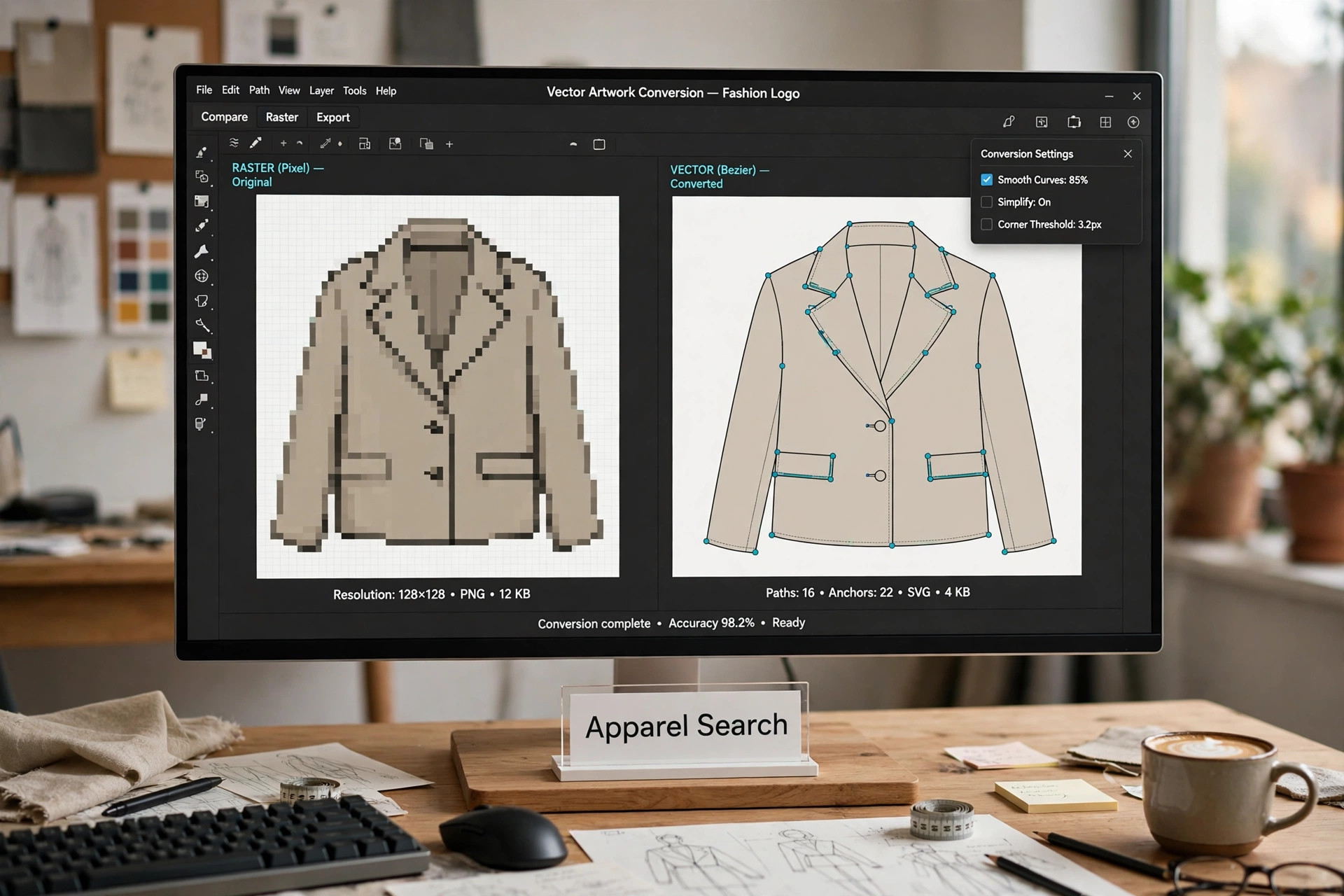
Vector art is created using vector illustration software programs such as Adobe Illustrator or Corel Draw. These programs use mathematic equations and geometric primitives — points, lines, and shapes — to create art that is clean, camera ready, and can be scaled infinitely, without any loss of quality or fidelity. Vector conversion is the bridge that gets existing artwork — a scanned drawing, a low-resolution logo, a customer's bitmap file — into that form.
What is vector conversion? Bitmap images are made up of pixels, and cannot be scaled up effectively. Vector images are created by the numerical coordinates contained within the file: they can be scaled up or down infinitely without the loss of resolution, they are much smaller files compared to bitmap files, and they allow you to change color and edit individual elements with ease. Vector artwork is simply comprised of lines (wireframe) that represent the objects, usually created with a drawing program such as CorelDraw, Adobe Illustrator or Freehand.
Vector Conversion Services
7vector.com
7vector.com is a graphic art company in China specializing in embroidery digitizing and vector artwork conversion, providing a 7 x 24 hour online service for global business. They provide high quality bitmap to vector conversion services at a reasonable price; their raster to vector conversions are manually hand drawn, creating superior image quality as opposed to using automated software. The converted vector logo is a small file, ready for print production and suitable for just about every other use.
VectorWiz
VectorWiz is a vector art conversion service that hand-draws raster images into vector format. They manually redraw logos, hand-drawn artwork and low-resolution images into clean, scalable AI, EPS, SVG and PDF files ready for print production, screen printing, embroidery and signage.
Where Converted Artwork Goes
In a fashion business, the same artwork is asked to do many jobs: a chest print, a woven label, an embroidered cap logo, a shopping bag, a trade show banner. Each job arrives as a bitmap — a photo of a drawing, a JPEG from a client, art pulled from an old catalog — and none of them can be produced from pixels. Conversion is the unglamorous step that makes the artwork reusable everywhere, which is why it sits between the Graphic Designers who create artwork (see the navstrip above) and the printers who produce it.
Hand redraw matters most at the details production exposes: jagged curves become visible at banner size, stray points break embroidery paths, and unseparated colors stall a screen printer. A clean vector file — smooth paths, correct colors, outlined text — is the difference between artwork that is merely viewable and artwork that is ready to manufacture.
Common Questions
What is vector conversion?
Vector conversion is the art of converting raster images to vector format. Bitmap images are made up of pixels and cannot be scaled up effectively; vector images are built from numerical coordinates, scale up or down infinitely without loss of resolution, produce much smaller files, and let you change color and edit individual elements with ease.
Why does fashion artwork need to be vector?
Production does. A logo or print must be enlarged for a banner, shrunk for a label, separated for screen printing and digitized for embroidery — all from one clean file. Vector artwork, comprised of lines that represent the objects, is camera ready at any size.
Is conversion done by software or by hand?
Both exist. Automated tracing is fast but often messy; the services below redraw artwork manually — hand-drawn conversion creates superior image quality, with clean paths that are ready for print production and almost every other use.