Issey Miyake Profiles
The life behind the pleats — Hiroshima, Paris, Tokyo, and the cloth itself.
Issey Miyake (April 22, 1938 – August 5, 2022) was the Japanese designer who founded the Miyake Design Studio in Tokyo in 1970 and rebuilt clothing around technology and the body. Where most designers begin with a sketch, Miyake began with the cloth: how it is woven, knitted, pleated and finished decides what the garment can be. This profiles page tells the career in order: Hiroshima and the Paris apprenticeship, the Tokyo studio, the pleating breakthrough, and the studio system that outlived his own day-to-day designing. Of all the pages in this series, this is the one the others depend on.
The biography searches in the references gather the wider career coverage, and the designer's official website is linked there as well. The collections, runway and news pages in this series file the fashion work the career produced.
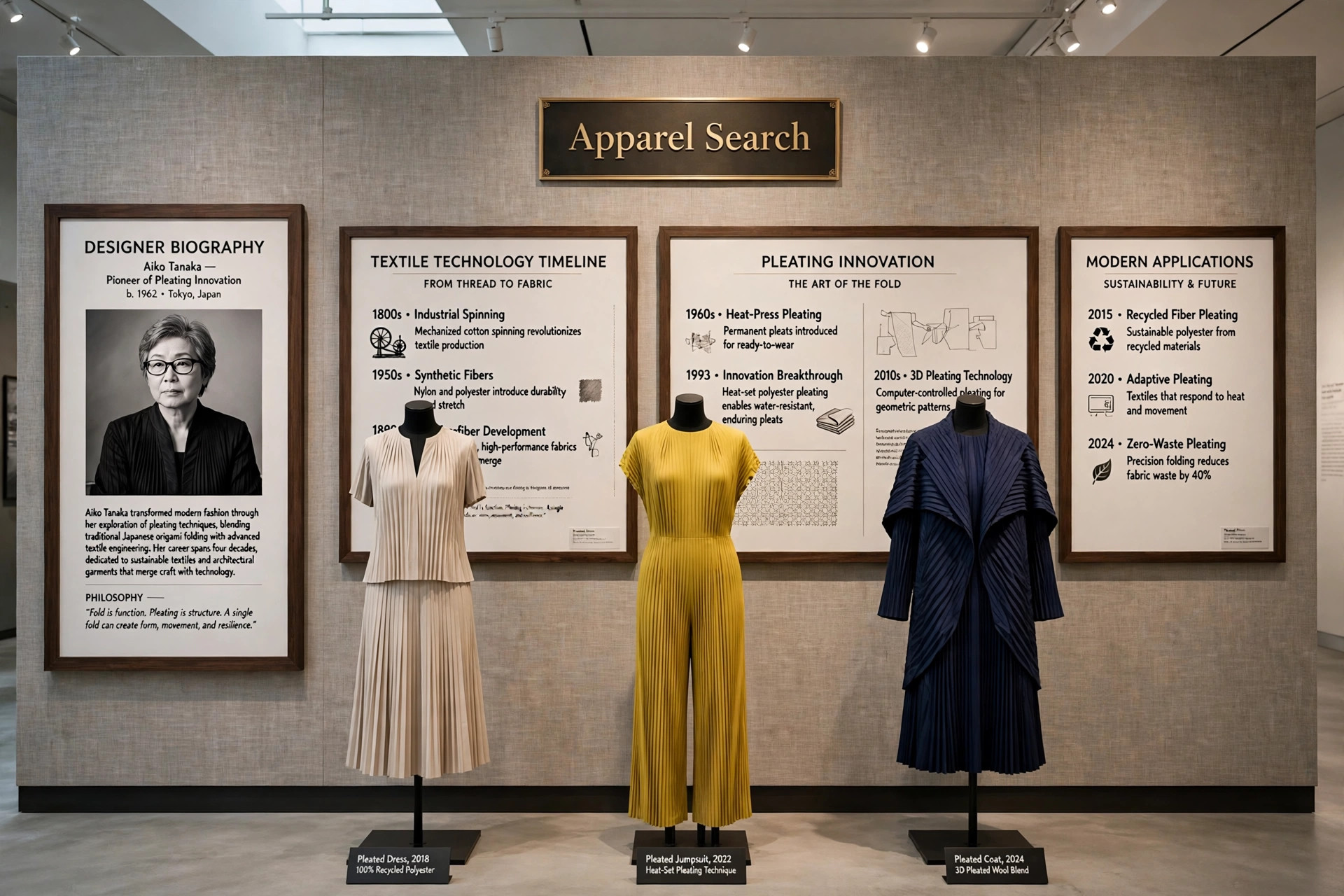
Illustrative image created for this guide — an artistic impression, not this designer's own garments.
News, Photos & VideoCollectionsFall FashionsFashion WeekNewsProfilesRunwaySpring Fashions
Hiroshima, Paris and the Miyake Design Studio
Miyake was born in Hiroshima on April 22, 1938, and survived the atomic bombing of the city as a child — an experience he rarely discussed but which friends and obituarists connected to his lifelong preference for creating over destroying. He studied graphic design at Tama Art University in Tokyo, then went to Paris in 1965, working for Guy Laroche and for Hubert de Givenchy, and on to New York, where he worked for Geoffrey Beene. The apprenticeship triangle — Paris couture, American sportswear, Japanese craft — is the whole of his later method in embryo.
He returned to Japan and founded the Miyake Design Studio in Tokyo in 1970, presenting his first collection in New York in 1971 and in Paris from 1973. From the start the studio worked as a laboratory with textile engineers and traditional Japanese craftspeople alike: sashiko quilting, washi paper yarns and industrial knitting were investigated with the same seriousness, and the body — its movement, its comfort, its freedom from the clothes' construction — was the fixed point every experiment served.
Pleats, A-POC and the Studio After Miyake
The breakthrough the world knows is pleating. Through the late 1980s Miyake's team perfected a process in which garments are cut oversize and sewn first, then pleated between sheets of paper under heat, so the pleats are permanent and the finished garment is a fraction of its cut size. Launched as the Pleats Please line in 1993, it produced clothes that do not wrinkle, pack flat, wash easily and move like water — and it reached its most famous wearer in Steve Jobs, whose black turtlenecks Miyake designed. A-POC followed in 1998: a whole garment knitted as one tube of cloth, finished by the wearer's own scissors.
Miyake stepped back from day-to-day design in the late 1990s, handing his lines to associates while the studio's research continued under his direction — Bao Bao's geometric bags, the 132 5. origami-fold line, and the Reality Lab experiments all belong to the system he built. He died in Tokyo on August 5, 2022. Read with the collections page, the profile completes its arc: a designer who treated clothing as a technology for living, and proved the laboratory could be as creative as the atelier.
Photos

Common Questions
Who was Issey Miyake?
Issey Miyake (April 22, 1938 – August 5, 2022) was the Japanese designer who founded the Miyake Design Studio in Tokyo in 1970 and became fashion's leading technological innovator, famous for permanent pleating and garments made from a single piece of cloth.
What is Pleats Please?
Pleats Please, launched in 1993, is the line built on Miyake's pleating technology: garments are cut and sewn first, then pleated, so the pleats are permanent — the clothes are light, do not wrinkle, and move with the body.
What is A-POC?
A-POC (A Piece of Cloth), introduced in 1998, is Miyake's construction system in which a whole garment is produced from a single tube of knitted fabric, cut by the wearer along woven lines with minimal waste.