Fashion in Film · Iconic Costumes by Era
Screen Style of the 1960s & 1970s: When Film Started Dressing the High Street
The Golden Age studios invented glamour in their workrooms and sold copies in department stores. The 1960s and 1970s reversed the flow. As boutiques, pop and youth culture took over fashion, films began borrowing their clothes from the street — and then, in a handful of extraordinary cases, handing the street a whole new look in return. A beret, a turtleneck, a thrifted tie and an off-the-rack white suit did what the great wardrobe departments once did, faster and for keeps.
At a Glance
- Era
- 1960–1979: the studio system gone, the Production Code replaced by ratings in 1968
- The shift
- Costume stops inventing a dream wardrobe and starts reading the street — boutiques, thrift shops, off-the-rack
- The names
- Theadora Van Runkle, Anthea Sylbert, Patricia Zipprodt, Ruth Morley, Patrizia Von Brandenstein
- Defining films
- Bonnie and Clyde, The Graduate, Bullitt, Rosemary's Baby, Annie Hall, Saturday Night Fever
- The legacy
- The modern costume-to-retail pipeline: screen looks identified, copied and sold within a season
The New Machine
Boutiques, Youthquake and the End of the Wardrobe Department
Three changes made these two decades different from everything before them. First, the studios' permanent wardrobe departments — the factories that had dressed Golden Age glamour — were wound down as the studio system itself collapsed, and costume design became freelance work, hired picture by picture. Second, the Production Code that had policed necklines since 1934 was abandoned in 1968 for a ratings system, and screens filled with the skin, grit and contemporary reality the Code had kept out. Third, and most important for fashion: the center of style moved. London's boutique revolution — Mary Quant's Bazaar and the King's Road — and what Diana Vreeland named the "youthquake" meant that young people now generated fashion themselves, cheaply and fast, and expected films to keep up with them rather than the other way round.
The mod moment shows the new relationship clearly. Films such as Darling (1965) and Blow-Up (1966) were set inside the fashion world itself — models, photographers, boutiques — and their clothes matter less as individual designs than as documentary: hemlines, boots, geometry and attitude recorded at the source, in the cities inventing them. Costume designers increasingly worked the way stylists would later work, assembling looks from real shops and real subcultures. The survey of how individual screen looks escape into everyday dress, in the guide to film costumes that started fashion trends, begins in earnest in these years — because for the first time, the audience and the characters were shopping in the same places.
1967–1968
Bonnie and Clyde, The Graduate and the Van Runkle Year
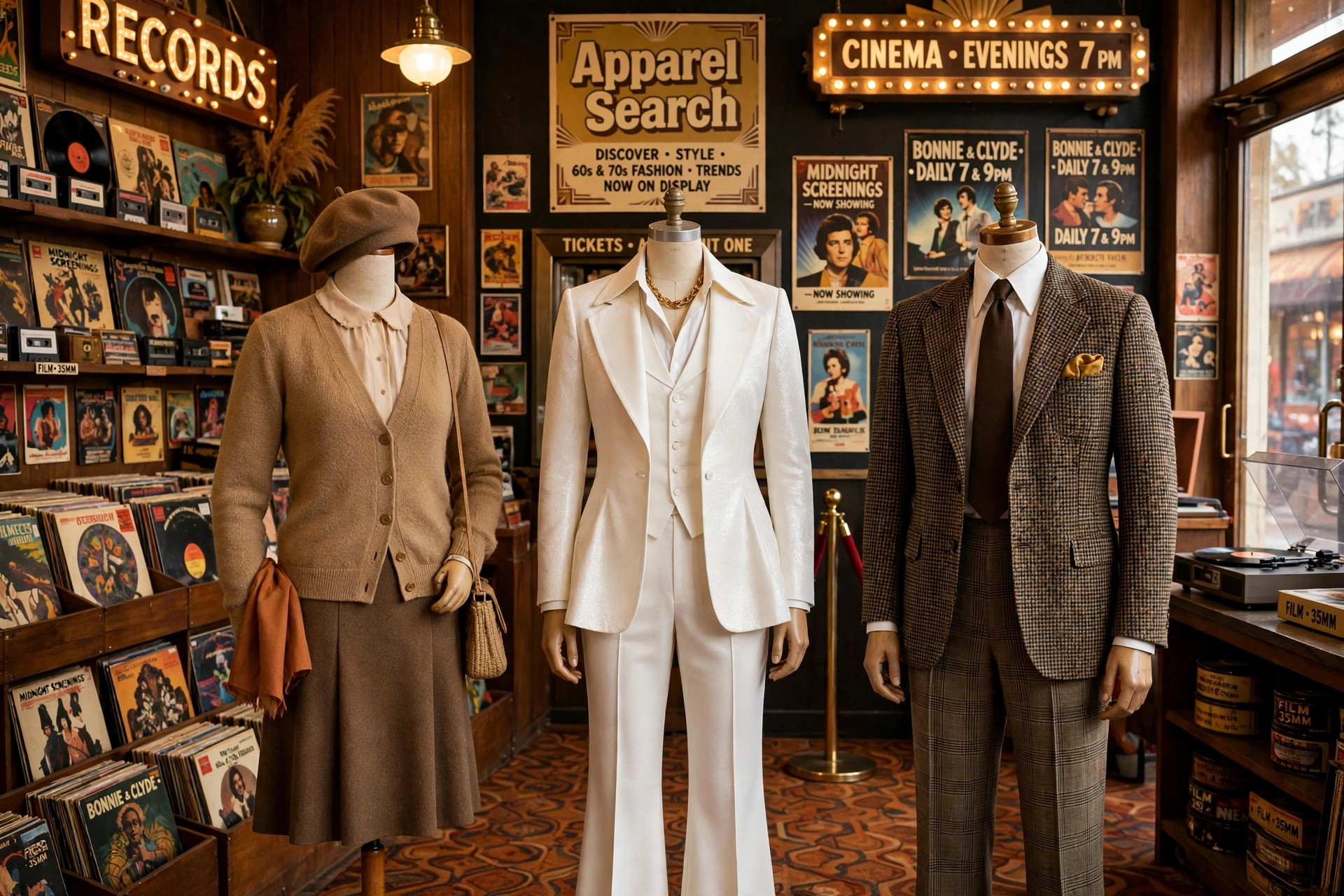
Bonnie and Clyde (1967) is the decade's costume detonation, and it was a debut. Theadora Van Runkle had worked as a commercial illustrator and as a sketch artist under Dorothy Jeakins on Hawaii; when Jeakins had to decline Bonnie and Clyde, she recommended her sketch artist, and the film became Van Runkle's first as costume designer. Her instinct was for the real 1930s — Faye Dunaway's Bonnie in berets, soft cardigans, silk blouses, mid-calf skirts and a neckerchief, Warren Beatty's Clyde in double-breasted suits and fedoras — at the exact moment fashion was wearing the miniskirt. The effect, widely reported at the time and since, ran backwards through retail: the midi length the film revived gained ground against the mini, and the beret-and-cardigan combination became a purchasable look. Van Runkle was nominated for the Academy Award for the film. Treat the strongest versions of the retail story with care — fashion was already nostalgic for the 1930s in places — but no other film of the decade is so consistently credited with moving hemlines.
The same year, The Graduate (1967) dressed a different divide. Its costumes were designed by Patricia Zipprodt — a great Broadway designer, of Fiddler on the Roof and Cabaret, working on film — and her wardrobe draws the film's generational line in cloth: Anne Bancroft's Mrs. Robinson in sleek, predatory glamour, animal prints and black lingerie against Katharine Ross's Elaine in soft, youthful, almost bridal simplicity. A correction worth making, because the two names are often confused: the designer was Zipprodt, not Patricia Norris, whose distinguished film career belongs chiefly to later decades.
Van Runkle's 1968 then set the template for modern screen cool twice over. On Bullitt, Steve McQueen's detective — turtleneck, tweed jacket, shoulder holster worn like an accessory — became the era's most copied menswear image, a working wardrobe rather than a costume. On The Thomas Crown Affair, she dressed Dunaway again, this time in razor-sharp contemporary tailoring and statement accessories, and McQueen as a millionaire in immaculate three-piece suits. The full story of that screen wardrobe tradition is traced in the guide to menswear in film. Meanwhile Rosemary's Baby (1968), designed by Anthea Sylbert, showed the new realism at its most unsettling: Mia Farrow's Rosemary in sweet, contemporary New York clothes — Peter Pan collars, empire-line dresses, pretty maternity wear — whose very normality makes the horror domestic. Sylbert, who went on to Chinatown and Shampoo, understood that by 1968 the most frightening wardrobe was an ordinary one.
| Film | Year | Costume designer |
|---|---|---|
| Bonnie and Clyde | 1967 | Theadora Van Runkle (her feature debut in the role) |
| The Graduate | 1967 | Patricia Zipprodt |
| Bullitt | 1968 | Theadora Van Runkle |
| The Thomas Crown Affair | 1968 | Theadora Van Runkle (shared credits on the production) |
| Rosemary's Baby | 1968 | Anthea Sylbert |
| Annie Hall | 1977 | Ruth Morley, with Ralph Lauren supplying wardrobe and Diane Keaton's own input |
| Saturday Night Fever | 1977 | Patrizia Von Brandenstein |
The Early 1970s
Period Revival and the New Hollywood Designers
Between the 1960s breakthroughs and the twin peaks of 1977, the decade's designers consolidated the new method. Van Runkle became the period specialist of New Hollywood, dressing The Godfather Part II (1974) — whose turn-of-the-century and 1950s wardrobes had to sit invisibly inside one of the most scrutinized films ever made — with the same research-first instinct she had brought to Bonnie Parker's 1930s. Sylbert, meanwhile, defined the look of sophisticated 1970s realism: Chinatown (1974) rebuilt 1930s Los Angeles in cream linen and perfect tailoring, and Shampoo (1975) dressed Beverly Hills at the end of the sixties with a stylist's eye for how the rich actually wore their clothes. Neither designer worked from a studio workroom; both worked the new way, picture by picture, building wardrobes from research, rental houses and real retail.
The period revival running through these films is itself a 1970s signature. A decade unsure of its own silhouette kept returning to the 1930s — in Bonnie and Clyde first, then across New Hollywood — and each return trip sent audiences back to longer skirts, bias lines, berets and brimmed hats. Nostalgia became a renewable fashion resource, mined by costume designers who understood that a period film, done well, is also a contemporary trend report in disguise.
1977
Annie Hall and Saturday Night Fever: The Look Leaves the Shop
Two films in a single year, 1977, completed the reversal — and both wardrobes were substantially bought or borrowed rather than made. Annie Hall's famous look — oversized men's jackets, waistcoats, shirts and ties, baggy trousers, a floppy hat — is also film history's most argued-over credit, and the honest account is a shared one. Ruth Morley was the film's credited costume designer. Ralph Lauren supplied some of Keaton's wardrobe. And Diane Keaton herself brought her own menswear-inflected personal style to the role — by the often-retold production story, Morley initially resisted the outfit, and Woody Allen backed Keaton's instinct. All three contributions are documented; any version that hands the look to one name alone is wrong. What is not disputed is the effect: women adopted the Annie Hall combination in large numbers, heading, as TCM's summary of the phenomenon puts it, not to boutiques but to thrift shops — the costume department's authority formally transferred to the audience's own closet.
Saturday Night Fever, the same year, did the same for young men. Costume designer Patrizia Von Brandenstein dressed Tony Manero from the rack — the clothes of a Brooklyn paint-store clerk who spends his wages on Saturday night — and for the dance competition chose the white three-piece suit that became the decade's defining menswear image. The production story, retold by Von Brandenstein and in TCM's account, is that Travolta originally wanted black, and the designer argued for white because it would catch the disco lights and separate him from the crowd. The suit was an ordinary retail suit, tailored to dance in. That ordinariness was the revolution: a working-class kid's bought clothes, on a poster everywhere, telling every young man watching that the look was already in a shop near him.
The Golden Age sold copies of dresses no one could afford to make. The seventies sold the audience its own wardrobe, one size more confident.
The Pipeline
How the Costume-to-Retail Machine Changed for Good
Put the two decades together and the modern system is visible in embryo. In the boutique era, the lag between a screen look and a shop rail collapsed: Bonnie's beret, Bullitt's turtleneck, Annie's tie and Tony's white suit were all reproducible from existing retail stock, because they had substantially come from it. Designers became editors and amplifiers of street style rather than inventors sealed in a workroom — Van Runkle reading the 1930s through 1967 eyes, Sylbert dressing horror in contemporary day clothes, Morley and Von Brandenstein assembling characters from real shops. Magazines completed the circuit, identifying screen looks and telling readers where to buy equivalents, a service that has only accelerated since.
Something was lost in the trade — the Golden Age workroom's bespoke finish, and the staff designer's long collaboration with a star — and something democratic was gained: screen style stopped being a fantasy of wealth and became a set of instructions anyone could follow with a thrift-store rail and nerve. Every modern argument about a film "starting a trend" runs on the machinery these twenty years built.
The designers' own standing changed with the pipeline. Van Runkle, Sylbert and their peers were freelancers building reputations film by film, closer to the independent designers and stylists of the boutique era than to the salaried heads of the old wardrobe departments — and the best of them, like the best boutique designers, learned to think in terms of the look that could travel: a combination simple enough to remember from a cinema seat, distinctive enough to want, and ordinary enough, in its components, to find on a Saturday shopping trip. That instinct — part anthropology, part merchandising — is the defining professional skill of the period, and it is why these two decades, rather than the more polished ones before them, are where modern screen fashion really begins.
Common Questions
Common Questions
Who designed the costumes for Bonnie and Clyde?
Theadora Van Runkle, in her debut as a feature-film costume designer. Recommended by Dorothy Jeakins, she earned an Academy Award nomination for the film, and its berets, cardigans and longer skirts were widely reported to have moved retail fashion.
Who really created the Annie Hall look?
It was shared work: Ruth Morley was the film's credited costume designer, Ralph Lauren supplied some of Diane Keaton's wardrobe, and Keaton herself brought her own menswear-inflected personal style to the character. Crediting any one of the three alone gets the story wrong.
Where did the Saturday Night Fever white suit come from?
Off the rack. Costume designer Patrizia Von Brandenstein chose the white three-piece suit — reportedly persuading John Travolta away from a black one, because white would catch the disco lights — and bought, rather than bespoke-made, Tony Manero's wardrobe.
In This Series
The Fashion in Film hub, the Golden Age that came before, and the 1990s that followed.
Search Apparel Search