Fashion in Film · Iconic Costumes by Era
Clueless & 1990s Film Fashion: The Decade Style Went to the Movies
In the 1990s the most influential fashion shows in the world were not on runways but on cinema screens. A Beverly Hills teenager in a yellow plaid skirt suit, a sex worker transformed by a red opera gown, two hitmen in thrifted black suits and a coven of goth schoolgirls between them set the way a generation dressed — and proved that costume design had become fashion's fastest trend engine.
At a Glance
- Anchor film
- Clueless (1995), written and directed by Amy Heckerling, costumes by Mona May
- The number
- Around 60 costume changes for Cher Horowitz alone — Dionne had about 45, Tai around 30
- The line
- "This is an Alaïa" — a couturier's name delivered at gunpoint, and a generation's first fashion lesson
- The decade's range
- From Marilyn Vance's Pretty Woman transformation (1990) to Betsy Heimann's thrift-budget Pulp Fiction suits (1994)
- The mechanism
- Screen looks built from buyable, copyable clothes — so the high street could follow within a season
The Anchor Film
Clueless: Plaid Against the Grunge
Clueless arrived in 1995, written and directed by Amy Heckerling as a loose, Beverly Hills retelling of Jane Austen's Emma, with Alicia Silverstone as Cher Horowitz — rich, kind-hearted, and in total command of her computerized closet. The costumes, by Mona May, were not decoration on the film. They were the film's argument: that clothes are a language, and Cher speaks it fluently.
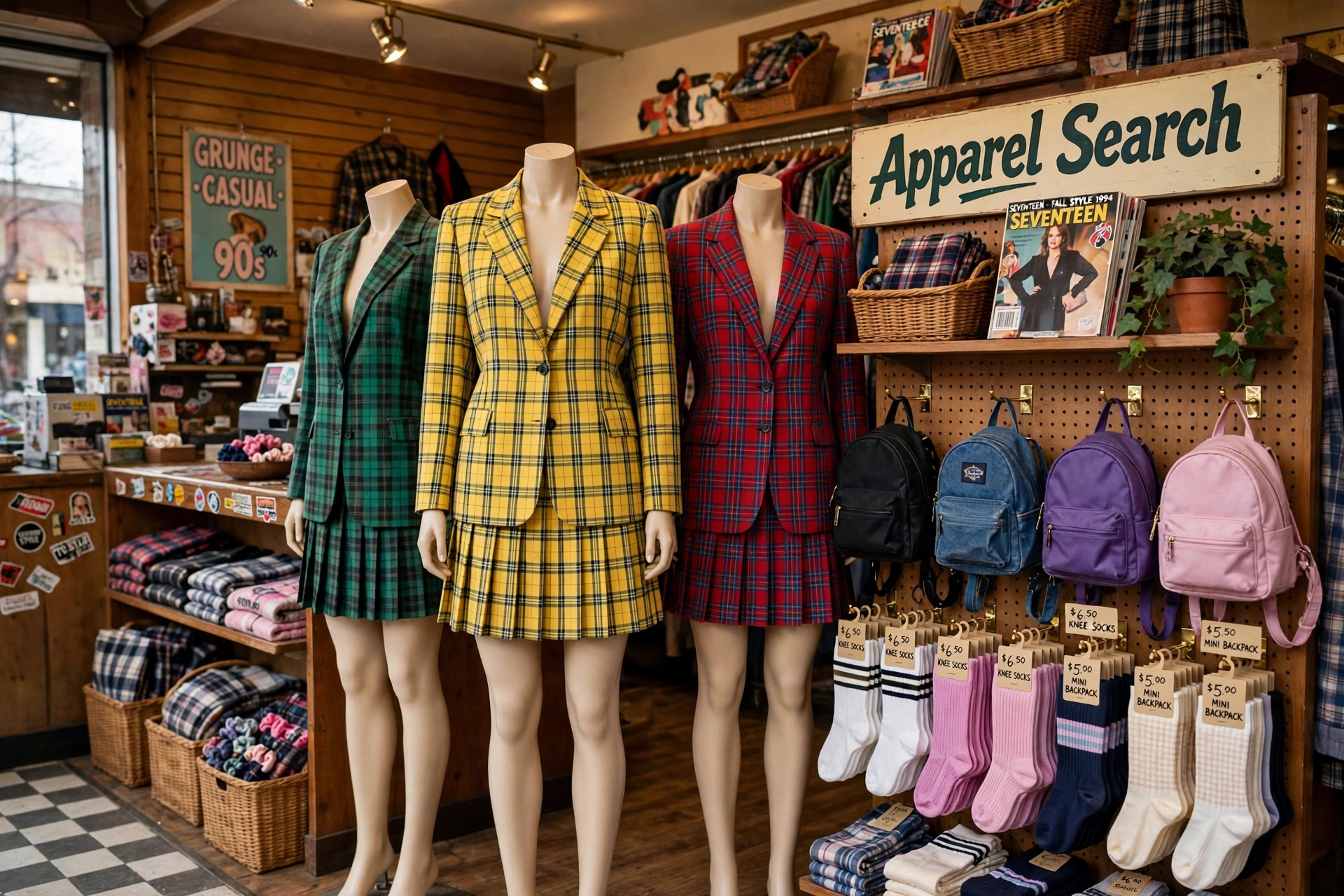
May's starting point was a problem. When she and Heckerling scouted real Los Angeles high schools, the students were dressed in the uniform of the moment — grunge: baggy flannel, oversized shirts, girls dressed, as May has put it, like boys. That was honest, but it was not the film Heckerling wanted to make. Instead May built a heightened version of teenage wealth: girls who had seen the European runways and translated them through high school. Her research ran in three directions at once — the grunge on the street, the collections on the runway, and the Catholic schoolgirl uniform of pleated skirt, knee socks and Mary Janes. Fused together and turned up in candy colors, those sources produced the film's signature: the plaid skirt suit, worn not as uniform but as power dressing for a sixteen-year-old.
The scale of the wardrobe is still startling. Cher had around 60 costume changes — May has cited 60 in most interviews, and 63 in later accounts of the production — against an industry norm she herself puts at roughly 25 for a lead. Dionne had about 45 changes and Tai around 30, on top of a full school of extras, and all of it on a costume budget May has described as modest for the ambition, around $200,000. The clothes were assembled the way teenagers actually assemble them, only better: a few borrowed designer pieces, mall clothes, thrift finds and pieces from Los Angeles boutiques, everything tailored to fit exactly. High and low, mixed without apology — that mixing, routine now, was fresh in 1995.
May fused three sources — street grunge, the European runways and the Catholic schoolgirl uniform — and turned the plaid skirt suit into power dressing for a sixteen-year-old.
The yellow plaid suit Cher wears in the opening sequence became the decade's most copied outfit, but the film's most quoted fashion moment is a red dress. Held up at gunpoint after a party and ordered to lie on the pavement, Cher protests: "This is an Alaïa." The robber's baffled reply — "An a-what-a?" — gets the film's gloss: "Like, a totally important designer." May had persuaded Azzedine Alaïa's house to lend the dress, confessing it would end up on the ground in a parking lot; Heckerling then wrote the exchange around the loan. It is a perfect 1990s moment: a couturier's name, unknown to most of the audience, treated by a teenager as a fact of nature worth more than her safety — and millions of viewers learned the name from her.
The Transformation
Pretty Woman: Costume as Cinderella Story
The decade opened with the purest costume-as-plot film of the era. In Pretty Woman (1990), costume designer Marilyn Vance dressed Julia Roberts' Vivian Ward through a transformation the audience reads entirely in clothes: the cut-out dress and thigh-high boots of her working life giving way, step by negotiated step, to the polished wardrobe of the woman Edward Lewis's world might accept.
Two Vance designs carry the film. For the opera — La Traviata, pointedly, another story of a courtesan — Vivian wears an off-the-shoulder red gown with long white gloves and a ruby-and-diamond necklace. Vance has recounted that the studio wanted black; she tested alternatives and fought for red, judging that black would vanish in the opera house and that red announced Vivian's arrival rather than her camouflage. She was right: the gown became one of the most reproduced dresses in film history. The second design works in the opposite register. At the polo match Vivian wears a brown-and-white polka-dot dress with a matching hat — made, Vance has said, from a limited length of vintage silk found in a Los Angeles fabric shop — and it is the film's most wearable look, the one that told audiences elegance could be daytime, patterned and attainable. Vance and her team made nearly all of Vivian's wardrobe themselves, which is why the transformation coheres: every stage of it was designed, not shopped.
The Low-Budget Masterclass
Pulp Fiction: Iconic on Almost Nothing
If Clueless showed what costume could do with research, Pulp Fiction (1994) showed what it could do with almost no money. Quentin Tarantino's film was made for a commonly cited budget of about $8.5 million, and costume designer Betsy Heimann — who had already built the black-suit look of Reservoir Dogs on a famously tiny costume budget — dressed its killers, fixers and gangster's wife to look expensive anyway.
Heimann's central idea was continuity of character: Jules and Vincent, she proposed, were Reservoir Dogs grown up, and they kept the black suit, white shirt and narrow tie — but individualized. Samuel L. Jackson's Jules, the preacher of the pair, got a suit that would not wrinkle and a very short collar; John Travolta's Vincent, a mess living out of his clothes, got rumpled linen and a bolo tie, the cowboy touch for a man daring to take out the boss's wife. Mia Wallace, Uma Thurman's character, was conceived as a female Reservoir Dog: an oversized white shirt with exaggerated cuffs, black trousers and gold Chanel ballet flats borrowed to signal her husband's money. The trousers became a fashion footnote of their own — standard lengths ran too short on Thurman, and with little budget to solve it properly, Heimann cut them off. Cropped trousers, barely present in 1994 fashion, came back on the strength of that expedient. The look then ran outward into the culture: Mia's white shirt and black bob were copied everywhere, and Chanel's Rouge Noir nail polish — Vamp in the United States — sold out in the film's wake.
| Film | Year | Costume designer | The look that escaped |
|---|---|---|---|
| Pretty Woman | 1990 | Marilyn Vance | The red opera gown; the brown polka-dot polo dress |
| Pulp Fiction | 1994 | Betsy Heimann | Black thrift suits; Mia's white shirt and cropped trousers |
| Clueless | 1995 | Mona May | Plaid skirt suits, knee socks, mini backpacks |
| The Craft | 1996 | Deborah Everton | Goth school uniform: chokers, crucifixes, combat boots |
| Romy and Michele's High School Reunion | 1997 | Mona May | Candy-colored club dresses and matching best-friend dressing |
The Dark Mirror
The Craft and the Goth Schoolgirl
Every era's school film has its shadow version. The Craft (1996), with costumes by Deborah Everton, took the same building blocks May used — the pleated skirt, the uniform, the school corridor — and turned them goth. Its four teenage witches begin in recognizably regulated school dress and loosen it piece by piece as their power grows: uniforms undone and customized, dog collars worn as chokers, layered crucifixes and rosary beads, fishnet, patent leather, pointy boots and dark lipstick.
Everton differentiated the four girls within a shared coven silhouette, so the wardrobe reads as a group identity its members are growing into — costume as initiation. The influence ran long. The film's desecrated-schoolgirl look became the template for a durable strain of alternative dressing, endlessly revived under later labels; long before "dark academia" had a name, The Craft had given it a uniform. Set beside Clueless, the two films make the decade's neatest costume argument: the same schoolgirl source material, one designer turning it toward sunlight and plaid, the other toward black lace and menace, both instantly legible to the teenagers watching.
The Reunion
Romy and Michele: Mona May, Again
May returned to the high-school universe two years later with Romy and Michele's High School Reunion (1997), dressing Lisa Kudrow and Mira Sorvino as two Los Angeles friends who invent successful lives for their ten-year reunion — and whose real talent, the film insists, was always the clothes. Where Clueless dressed wealth, Romy and Michele dressed aspiration on a retail wage: the pair work in discount retail, dream in designer, and sew their own reunion dresses when it matters most.
The wardrobe is a candy store of late-1990s club dressing — metallic mini dresses, marabou and plastic, matching outfits for two women who dress as a unit — with some 35 to 40 costume changes for the leads by May's account. Its fashion moral is the decade's friendliest: the girls who were mocked for loving clothes turn out to have been building a business all along, opening their own boutique in the final reel. Between Clueless and Romy and Michele, May effectively wrote the visual grammar of the 1990s teen comedy — bright, fitted, accessorized, and utterly unembarrassed about caring.
The Pipeline
From Screen to Street in One Season
What made the 1990s different was speed. Earlier film fashions had taken years to filter down; this decade's looks were in the shops while the films were still in cinemas, because designers like May, Heimann and Everton built them from clothes that already existed in the audience's world — skirt suits, slip dresses, thrifted tailoring, school uniforms. Home video extended a film's selling season from weeks to years, teen magazines annotated the outfits, and high-street chains copied the silhouettes at prices a Cher-in-training could pay. The full mechanism — how a costume becomes a trend, and a trend becomes a wardrobe staple — is traced in the series guide to film costumes and the fashion trends they started.
Common Questions
Common Questions
Who designed the costumes for Clueless?
Mona May, working with writer-director Amy Heckerling. May built Cher's world from runway research, real Los Angeles high schools and a deliberate reaction against early-1990s grunge, mixing borrowed designer pieces with mall and thrift finds on a modest budget. Cher alone had around 60 costume changes, with Dionne at about 45.
What is the Alaïa scene in Clueless about?
Held up at gunpoint after a party, Cher protests at being told to lie on the ground because she is wearing a red dress by Azzedine Alaïa — "This is an Alaïa," she tells the robber, "like, a totally important designer." May persuaded the house to lend the dress, and Heckerling wrote the exchange around it; for many viewers it was their first encounter with a couturier's name.
Why did 1990s film fashion reach the street so fast?
Because the decade's costume designers dressed characters in clothes audiences could actually buy or copy: plaid skirt suits, slip dresses, cropped trousers, thrifted black suits. Home video, teen magazines and high-street copies closed the gap between screen and shop within a single season, turning costume design into one of the decade's strongest trend engines.
In This Series
The Fashion in Film hub and the era guides around this one.
More to Explore
Fashion on the small screen, the decade's other great costume showcase.
Search Apparel Search