Fashion in Film · Iconic Costumes by Era
Modern Film Costumes: Marie Antoinette to Barbie
The 21st century turned film costume into a headline art. Designers began treating period dress as a language to be remixed rather than a record to be copied, fashion houses opened their archives to productions, and a single film could repaint the world's shop windows pink. From a teenage queen's macaron-colored court to a doll's dream wardrobe, these are the modern costumes that defined their films — and their summers.
At a Glance
- The era
- 2006–2023: from Marie Antoinette to Barbie
- The method
- Period silhouettes, deliberately modern color, fabric and attitude — accuracy of shape, freedom of surface
- The collaborators
- Manolo Blahnik's shoes, Prada and Miu Miu's archives, Marchesa's gown, Chanel's suits
- The honors
- Costume Oscars for Canonero (Marie Antoinette) and Martin (The Great Gatsby); a Smithsonian acquisition for Crazy Rich Asians
- The phenomenon
- Barbie's pink saturation — a costume palette that became a global retail event
The Turning Point
Marie Antoinette: History in Macaron Colors
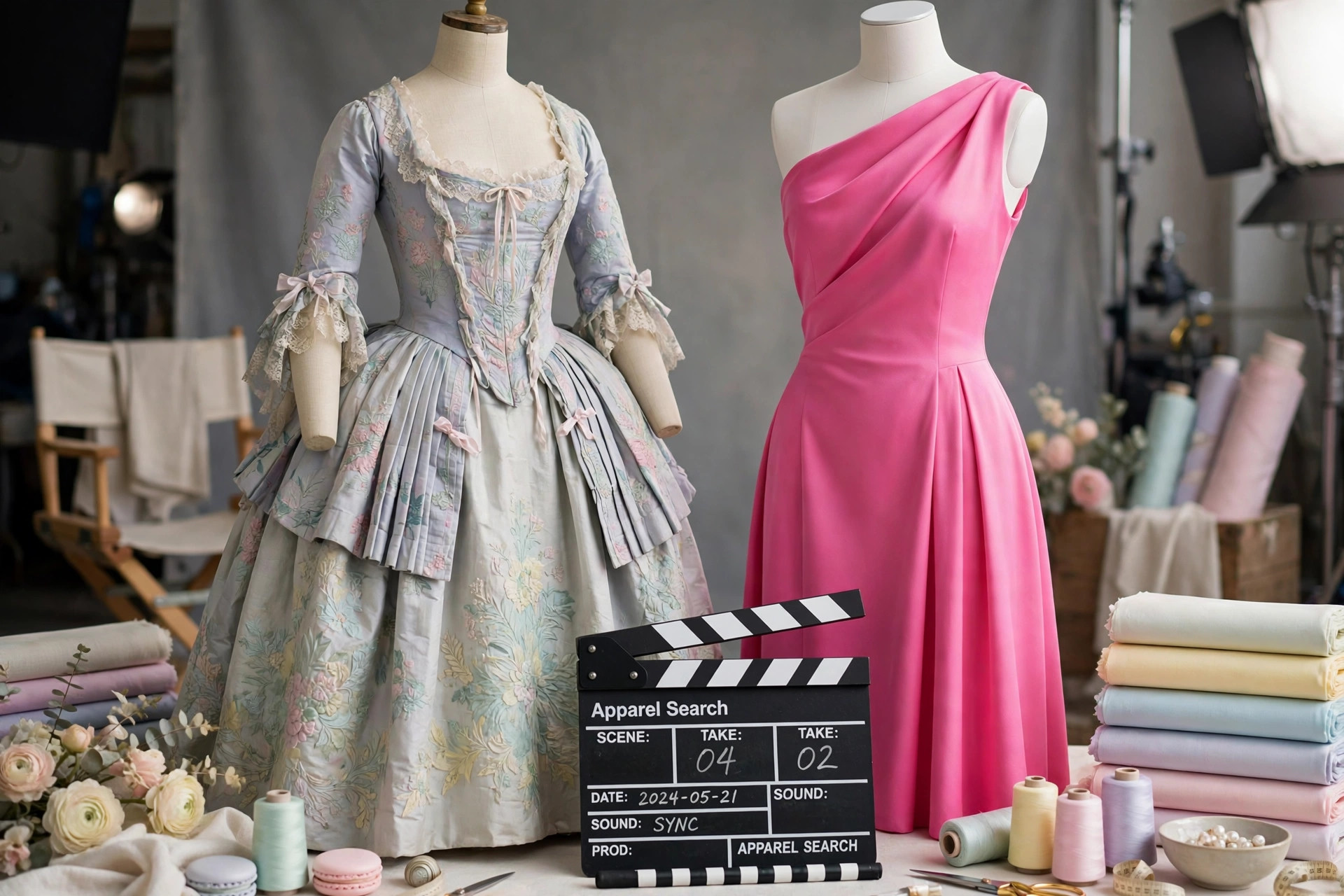
Sofia Coppola's Marie Antoinette (2006) announced the modern approach in its first minutes: an 18th-century court rendered in the colors of a Paris pastry box. Costume designer Milena Canonero — who won the Academy Award for the film, her third of an eventual four, after Barry Lyndon and Chariots of Fire and before The Grand Budapest Hotel — kept the period's shapes and cuts broadly faithful, then stylized everything through ahistorical fabric and color. Coppola's founding gesture, retold in nearly every account of the production, was to hand Canonero a box of Ladurée macarons: pistachio, powder blue, rose pink. The Paris bakery supplied the film's pastries as well, and the costumes took the same palette — court dress as confectionery, which is precisely how the film asks us to see its teenage queen: a girl consuming, and being consumed by, beautiful things.
The production's scale matched the idea. The wardrobe required a crew of dozens and ten rental houses near Versailles, where the film was shot with rare access to the palace itself. The shoes were designed by Manolo Blahnik, who built period silhouettes with a modern lightness — hundreds of pairs of silk pumps, mules and boots in the same sherbet register. And then there is the famous act of sabotage against period purity: in the "I Want Candy" montage, as Bow Wow Wow plays over a tumble of shoes, cakes and champagne, a pair of lavender Converse high-tops sits for a frame or two among the Blahnik heels. Coppola left them in deliberately. The sneakers are the film's thesis in a single image — this queen is a teenager first and a historical figure second, and her century is being dressed from hers, and ours, at once. Modern costume design starts here: research deep enough to earn the right to break the rules on purpose.
The Archive Raid
The Great Gatsby: Prada Dresses the Jazz Age
Baz Luhrmann's The Great Gatsby (2013) took the collaboration between costume design and fashion house further than any film before it. Catherine Martin, Luhrmann's longtime creative partner, won two Academy Awards for the film in a single night — Best Costume Design and Best Production Design — a double she had already achieved once before, for Moulin Rouge!, making her the first designer to accomplish the feat twice.
Martin's brief was a 1920s that would feel to a modern audience the way it felt to Fitzgerald's characters: not sepia nostalgia but something vibrant, sexy and new. Her solution was to dress the decade partly out of the present. Working with Miuccia Prada, she selected 40 dresses from the Prada and Miu Miu archives — looks from the previous twenty years of collections — and adapted them for the film's two great party scenes, twenty for each. The most famous is Daisy's party dress, the crystal "chandelier" gown Carey Mulligan wears to Gatsby's mansion, adapted from a Prada spring 2010 design and reworked into a 1920s silhouette. The method sounds like anachronism and works like translation: Prada's own collections had always mined the 1920s and 1950s, so the archive dresses carried period DNA that tailoring could bring forward. Around the collaboration, Martin built the rest of the world at industrial scale — hundreds of costumes made in-house, Brooks Brothers supplying the men's tailoring, Tiffany & Co. creating the jewelry. The lesson the industry took was commercial as much as artistic: a fashion house's archive could be a film's wardrobe department, and both sides would profit from the credit.
Martin's Gatsby method — period DNA drawn from a modern archive — made the fashion collaboration a standard tool of big-budget costume design.
The New Money Problem
Crazy Rich Asians: Dressing Two Kinds of Wealth
Crazy Rich Asians (2018) gave costume designer Mary Vogt the most sociologically precise brief of the modern era: a Singapore of old money and new money, where the audience must be able to read a family's vintage at a glance. The Youngs, heirs to one of Asia's great fortunes, dress with the quiet of people who have never needed to announce anything — immaculate tailoring, heirloom jewelry, elegance that assumes a room rather than addressing it. Against them, the Gohs, Rachel's friend Peik Lin's flamboyantly new-rich family, wear their money the way they spend it: bright, logo-happy, joyful and loud. Vogt sourced the wardrobe the way the characters would have — an international trawl through designer collections in Hong Kong, London and the United States, mixing her own designs with pieces by houses from Valentino and Dior to Elie Saab and Stella McCartney.
The film's defining costume moment belongs to its heroine. Rachel Chu, a New York economics professor who has been made to feel her ordinariness all film, arrives at the wedding of the year in a sky-blue Marchesa gown — Grecian, flower-appliquéd, made of flowing tulle, adapted from the house's fall 2016 collection. Constance Wu herself found the dress and sent Vogt the photograph; the sample was two feet too long with enormous sleeves, and Vogt's team removed the sleeves and pared the skirt down until the gown left Wu deliberately vulnerable and unmistakably the heroine of the scene. It is the modern Cinderella dress, and its afterlife confirms its status: the Smithsonian's National Museum of American History acquired it for its collection, where it keeps company with the ruby slippers. A costume that began as a borrowed runway sample ended as a national artifact — the clearest sign of how completely film costume now sits inside fashion history rather than beside it.
The Doll Problem
Barbie: A Wardrobe With No Off-Duty
Greta Gerwig's Barbie (2023) handed costume designer Jacqueline Durran a problem no designer had faced at this scale: the leading character is not a person but a doll, and dolls do not have taste — they have outfits, one complete look per job, place and occasion, changed wholesale between scenes. Durran, who came to the film with two Academy Awards for period work — Anna Karenina and Gerwig's Little Women — built Barbieland's wardrobe on exactly that logic. Her team custom-made a large share of the film's roughly thousand costumes in a compressed schedule, recreating decades of the doll's real, Mattel-issued outfits at human scale — the gingham dress, the roller-skating neon, the Western set — alongside original designs, with the house of Chanel contributing suits and accessories that connected the film's Barbie to a real fashion lineage the doll herself had worn in miniature.
The costumes' cultural reach outran the film. Barbie's pink — graded across the wardrobe from bubblegum to hot magenta — became the summer of 2023's default color: audiences arrived at cinemas dressed in it, retailers built ranges around it, and "Barbiecore" entered the trend vocabulary within weeks. The full story of that saturation — how a costume palette became a retail phenomenon — is traced in the series guide to film costumes and the fashion trends they set in motion. Durran's deeper achievement is structural: she showed that a wardrobe built on toy logic could carry a film's emotional argument, as Barbie's clothes move from perfect, sealed ensembles toward the mixed, chosen, imperfect dressing of a human being.
The World-Building Problem
Black Panther and the Designers Behind the Era
No survey of modern costume is complete without Wakanda. Black Panther (2018) required a complete fictional nation's dress — researched across the African continent's real textile and adornment traditions, then pushed into an Afrofuturist future — and won its designer the Academy Award. The work, and the research method behind it, has its own full guide in this series: the Ruth Carter costume designer guide follows Carter's career from her early Spike Lee films to Wakanda in depth.
The modern era's other defining figure works the opposite side of the street: where Carter builds worlds from research, the designer profiled in the Colleen Atwood costume designer guide has spent four decades building them from character psychology, across Tim Burton's gothic fantasies and beyond, collecting four Academy Awards of her own. Between them, Carter and Atwood mark the modern profession's range — and its standing. The costume designer is no longer the wardrobe department at the end of the credits. On the films in this guide, she is a headline collaborator, an Oscar storyline, a museum acquisition and a retail event, all before the reviews are written.
Read together, the five productions in the table below describe the modern method from every angle: remix the period rather than reproduce it, treat the fashion house as a collaborator rather than a supplier, dress the sociology of a scene as carefully as its century, and never forget that a costume now lives a second life — in exhibitions, in museum stores, on social feeds and in the shops — that can run far longer than the film's own release. The designers who learned those lessons earliest are the ones this era will be remembered by.
| Film | Year | Designer | Signature move |
|---|---|---|---|
| Marie Antoinette | 2006 | Milena Canonero | Period shapes in a Ladurée macaron palette; Blahnik shoes |
| The Great Gatsby | 2013 | Catherine Martin | 40 archive Prada and Miu Miu dresses adapted to the 1920s |
| Crazy Rich Asians | 2018 | Mary Vogt | Old money versus new money, read at a glance |
| Black Panther | 2018 | Ruth Carter | A fictional nation dressed from real continental research |
| Barbie | 2023 | Jacqueline Durran | Doll logic: a complete outfit for every occasion |
Common Questions
Common Questions
Did Milena Canonero win an Oscar for Marie Antoinette?
Yes. Canonero won the Academy Award for Best Costume Design for Sofia Coppola's Marie Antoinette (2006) — her third Oscar, after Barry Lyndon and Chariots of Fire, and before a fourth for The Grand Budapest Hotel. Manolo Blahnik designed the film's shoes, and its pastel palette was keyed to Ladurée macarons.
How did Prada contribute to The Great Gatsby?
Costume designer Catherine Martin worked with Miuccia Prada to adapt 40 dresses from the Prada and Miu Miu archives for the film's two great party scenes, reworking looks from the previous two decades into 1920s silhouettes — including the crystal chandelier dress, adapted from a Prada spring 2010 design, that Daisy wears to Gatsby's party. Martin won the costume design Oscar, and a second Oscar that same night for production design.
Who designed the costumes for Barbie?
Jacqueline Durran, a two-time Academy Award winner for Anna Karenina and Little Women. For Barbie she built a wardrobe on doll logic — an outfit for every job and occasion, changed completely between scenes — recreating decades of the doll's real outfits at human scale alongside original designs, with contributions from the house of Chanel. The film's pink saturation helped drive the Barbiecore trend of summer 2023.
In This Series
The Fashion in Film hub and the era guides around this one.
Search Apparel Search