Fashion in Film · The Costume Designers
Ruth Carter: Designing Wakanda and a New Screen History
For four decades Ruth Carter has done something no costume designer before her managed at scale: she has put Black history — researched garment by garment, cloth by cloth — at the center of American film, and then imagined an African future to match. Her reward was a place in the record books: the first Black costume designer to win an Academy Award, and then the first to win it twice.
At a Glance
- Born
- April 10, 1960, Springfield, Massachusetts
- Education
- Hampton University (then Hampton Institute), BA in Theatre Arts, 1982
- Known for
- Research-driven costumes for Black history on screen, and the Afrofuturism of Wakanda
- Academy Awards
- Won Best Costume Design for Black Panther (2018) and Black Panther: Wakanda Forever (2022); nominated for Malcolm X (1992) and Amistad (1997)
- Signature films
- School Daze, Do the Right Thing, Malcolm X, Amistad, Selma, Roots, Black Panther, Coming 2 America
Beginnings
From Springfield Stages to a Meeting with Spike Lee
Ruth E. Carter was born on April 10, 1960, in Springfield, Massachusetts, and raised there in a single-parent household as the youngest of eight children. The route into costume began early and practically: sewing, pattern-reading and the theatre work that carried her to Hampton Institute — now Hampton University — in Virginia, where she graduated in 1982 with a Bachelor of Arts degree in Theatre Arts. Theatre taught her the designer's foundational discipline: a costume is not decoration but information, telling an audience who a character is before a word is spoken.
After Hampton came the apprenticeship years — an internship that took her west, opera and dance work in New Mexico and Los Angeles, and the freelance theatre jobs through which a young Spike Lee first saw what she could do. Lee hired her for his second feature, School Daze (1988), a musical set at a historically Black college, and in doing so set the terms of her career. Designing for Lee meant designing Black American life in its full range — campus, street, church, barbershop — with the accuracy of someone dressing a world she knew from inside, at a moment when Hollywood wardrobes rarely treated that world as worthy of research.
What followed is one of the great director–designer runs in modern film. Carter stayed with Lee through Do the Right Thing (1989), whose heat-wave Brooklyn is dressed in saturated color that seems to radiate off the screen; Mo' Better Blues (1990); Jungle Fever (1991); and on to Malcolm X (1992) — a collaboration that eventually stretched, by Carter's own count in interviews, to some fourteen films together. Each Lee picture asked for a different kind of truth, and Carter's answer was always the same method: research first, then design.
The Breakthrough
Malcolm X and the First Nomination
Malcolm X was the assignment that announced her. The film follows its subject from 1940s Harlem zoot suits through prison, conversion and pilgrimage to Mecca — several distinct eras and worlds inside one picture, each demanding its own silhouette, cloth and level of wear. Carter researched the life as an archive problem, tracing the real man's journey and the streets that made him, and the Academy noticed: the film brought her first nomination for Best Costume Design. She did not win, but the nomination itself was historic ground — she was the first Black designer nominated in the category.
Steven Spielberg's Amistad (1997) brought the second nomination, for a drama of enslaved Africans who seize their ship and are put on trial in America. Between those poles Carter built the wide middle of her filmography: What's Love Got to Do with It (1993), recreating Tina Turner's stage wardrobe across two decades of performance; John Singleton's Rosewood (1997) and Baby Boy (2001); Love & Basketball (2000); and Serenity (2005). The pattern across all of it is consistency of approach rather than of look — Carter has no house style to impose, because the research, not the designer, is supposed to lead.
Carter's signature is not a silhouette. It is a method: learn the world until the clothes have no choice but to be true.
History Work
Selma, Roots and Dressing the Record
The 2010s made Carter the screen's custodian of the civil rights era and the centuries behind it. For Ava DuVernay's Selma (2014), she dressed the 1965 voting-rights marches — a story whose participants survive in famous news photographs, which meant every coat, hat and church dress would be silently compared with the documentary record by anyone who knew it. Accuracy there is not pedantry; it is respect, and Carter's wardrobe holds up under that comparison because it was built from the photographs outward.
The 2016 remake of Roots posed the hardest version of the same task: clothing enslaved people across generations without either prettifying the violence of their condition or reducing them to rags. The work earned Carter a Primetime Emmy nomination for Outstanding Period Costumes for a Limited Series. Add The Butler (2013), which crosses decades of White House service, and Marshall (2017), and a body of work emerges that functions almost as a visual archive — a researched, wearable record of how Black Americans actually dressed through the moments that defined the country's history. It is this archive, as much as any single film, that made her the inevitable choice when Marvel decided to build an African nation that had never been colonized.
| Film | Year | Academy recognition |
|---|---|---|
| Malcolm X | 1992 | Nominated, Best Costume Design |
| Amistad | 1997 | Nominated, Best Costume Design |
| Black Panther | 2018 | Won, Best Costume Design — first Black winner in the category |
| Black Panther: Wakanda Forever | 2022 | Won, Best Costume Design — first Black designer to win twice in the category |
The Method
Research as Design: Building Wakanda from Real Cloth
Carter's research method is the through-line of her career, and Black Panther (2018) is its fullest demonstration. Wakanda is fictional, but Carter refused to invent its clothing from nothing. During months of preproduction, she and her team studied the dress of peoples across the African continent and sent shoppers around the world for authentic material, building each Wakandan tribe's look from a real tradition and then pushing it forward in time — the design question being not "what does Africa look like?" but "what would these traditions have become, uninterrupted, in the most technologically advanced nation on earth?"
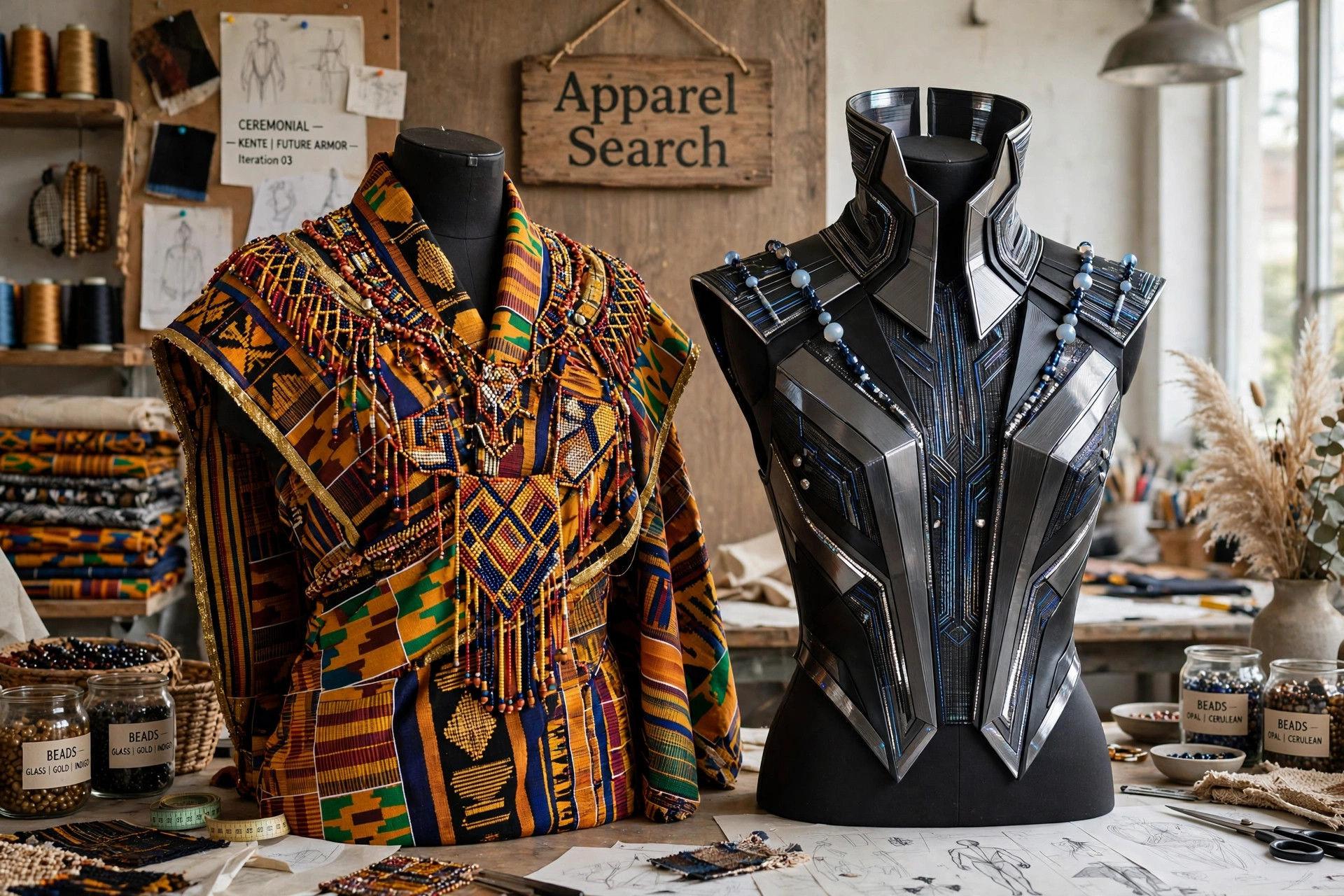
The sources she drew on are documented in her interviews of the period: the stacked neck rings and beadwork traditions of the Ndebele of South Africa; the beadwork of the Maasai of Kenya; the Himba of Namibia, whose red ocher — worn on skin, hair and leather — informed the mining tribe; the Tuareg of the Sahara behind the merchant tribe; and woven traditions such as Ghana's kente cloth, whose strip-woven geometry belongs to the same visual language of pattern-as-meaning that Carter built into Wakanda's textiles — including the triangular "Okavango" pattern she worked into the Black Panther suit itself, a motif she describes as drawn from the sacred geometry found across African art. Nigeria's ceremonial dress tells a parallel story of cloth carrying rank and celebration, traced in the guide to the dashiki and agbada. Textiles for Wakanda were sourced with deliberate care — Carter has described rejecting African prints manufactured in Holland in favor of cloth with a genuine claim to its origins, then creating fabrics that could read, on screen, as both ancient and superheroic.
The research also produced a color language for the whole nation. Carter assigned each Wakandan tribe a palette drawn from its real-world sources: the Dora Milaje, the royal guard, in saturated red with leather harnesses, beaded tabards and the stacked neck rings adapted from Ndebele and Maasai practice; the river tribe in greens; the merchant tribe in the purples and plums associated with Tuareg dress; the mining tribe in the ochres of the Himba. Costume, in other words, did the world-building that exposition could not — a viewer reads Wakanda's peoples, regions and ranks in cloth before anyone explains them. That is the research method at its most complete: sources studied deeply enough to be reorganized into a coherent invented culture, rather than quoted as decoration.
The result won her the Academy Award for Best Costume Design — the first ever won by a Black designer in the category — along with a star on the Hollywood Walk of Fame in 2021 and the Costume Designers Guild's Career Achievement Award in 2019.
The Second Crown
Wakanda Forever, Zamunda and What Comes Next
Between the two Panther films, Carter took on a different African kingdom. Coming 2 America (2021) returned to Zamunda — and here the credits matter, because the beloved 1988 original, Coming to America, was designed by Deborah Nadoolman Landis, not Carter. Carter approached the sequel as an heir rather than an originator: honoring Landis's opulent Zamunda, then modernizing it by bringing in contemporary African designers — reporting on the production counts dozens of independent designers contributing, among them South Africa's Laduma Ngxokolo of MAXHOSA and Palesa Mokubung of Mantsho — so that the sequel's royalty wears the real, present-day African fashion industry, not only a costume department's idea of it.
Black Panther: Wakanda Forever (2022) then asked her to evolve Wakanda under grief — a nation mourning its king — and to invent an entire second civilization, the underwater kingdom of Talokan, alongside it. Queen Ramonda's wardrobe carries the film's statecraft, and its most famous pieces are a collaboration in new technology: working again with Austrian architect-designer Julia Koerner, Carter created 3D-printed crowns and neckpieces for Ramonda — in the first film a 3D-printed crown and shoulder mantle, developed from the isicholo, the Zulu married woman's hat, its algorithms written in Los Angeles and the pieces printed in Belgium. A traditional form, carried into the future by the newest manufacturing method available: that single object is Carter's whole design philosophy made visible.
The Academy agreed a second time. Wakanda Forever brought Carter her second Oscar for Best Costume Design, making her the first Black designer to win the category twice — and, as was widely noted on the night, the first Black woman to win multiple Academy Awards in any category. In 2023 she gathered the career into print with her book The Art of Ruth E. Carter, and her costumes have toured in exhibitions devoted to her work, including Heroes & Sheroes: The Art and Influence of Ruth E. Carter in Black Cinema and Ruth E. Carter: Afrofuturism in Costume Design. Hampton University, where the method began, awarded her an honorary Doctor of Humane Letters in 2023.
The screen history she has dressed — from a Harlem ballroom to a Selma march to a Wakandan throne room — now stands as the standard account, and it was built the slow way: one researched garment at a time. For younger designers, that may be the most useful part of the story. Carter's breakthroughs were not a sudden discovery of talent in 2018; they were the visible summit of thirty years of archive work, most of it on films whose budgets and profiles were far smaller than Marvel's. The research habit came first. The crowns, printed and otherwise, came after.
Common Questions
Common Questions
What did Ruth Carter win her two Academy Awards for?
Best Costume Design, for Black Panther (2018) and Black Panther: Wakanda Forever (2022). The first win made her the first Black costume designer to win the Academy Award in the category; the second made her the first Black designer to win it twice.
Which films brought Ruth Carter her first Oscar nominations?
Malcolm X (1992), directed by Spike Lee, and Amistad (1997), directed by Steven Spielberg. Both were historical dramas, and both nominations rested on the deep research that became her signature.
Did Ruth Carter design the costumes for the original Coming to America?
No. The 1988 original was designed by Deborah Nadoolman Landis. Carter designed the sequel, Coming 2 America (2021), building respectfully on Landis's Zamunda while bringing in contemporary African designers.
In This Series
The Fashion in Film hub, the foundation guide, and a fellow modern masterclass.
More to Explore
The real dress traditions behind the research, and the wider film library.
Search Apparel Search