Traditional Dress by Country · Nigeria
Nigeria — Dashiki and Agbada
A Nigerian celebration announces itself in cloth before a word is spoken: the embroidered neckline of a dashiki, the great sweeping sleeves of an agbada, whole families arriving in one shared fabric. This guide explains the two garments and the world around them — the buba and sokoto beneath the robe, the fila cap, hand-woven aso oke and bold ankara prints, and the aso ebi custom that turns a wedding crowd into a single, deliberate pattern.
The Garments
Two Garments, One Celebration Wardrobe
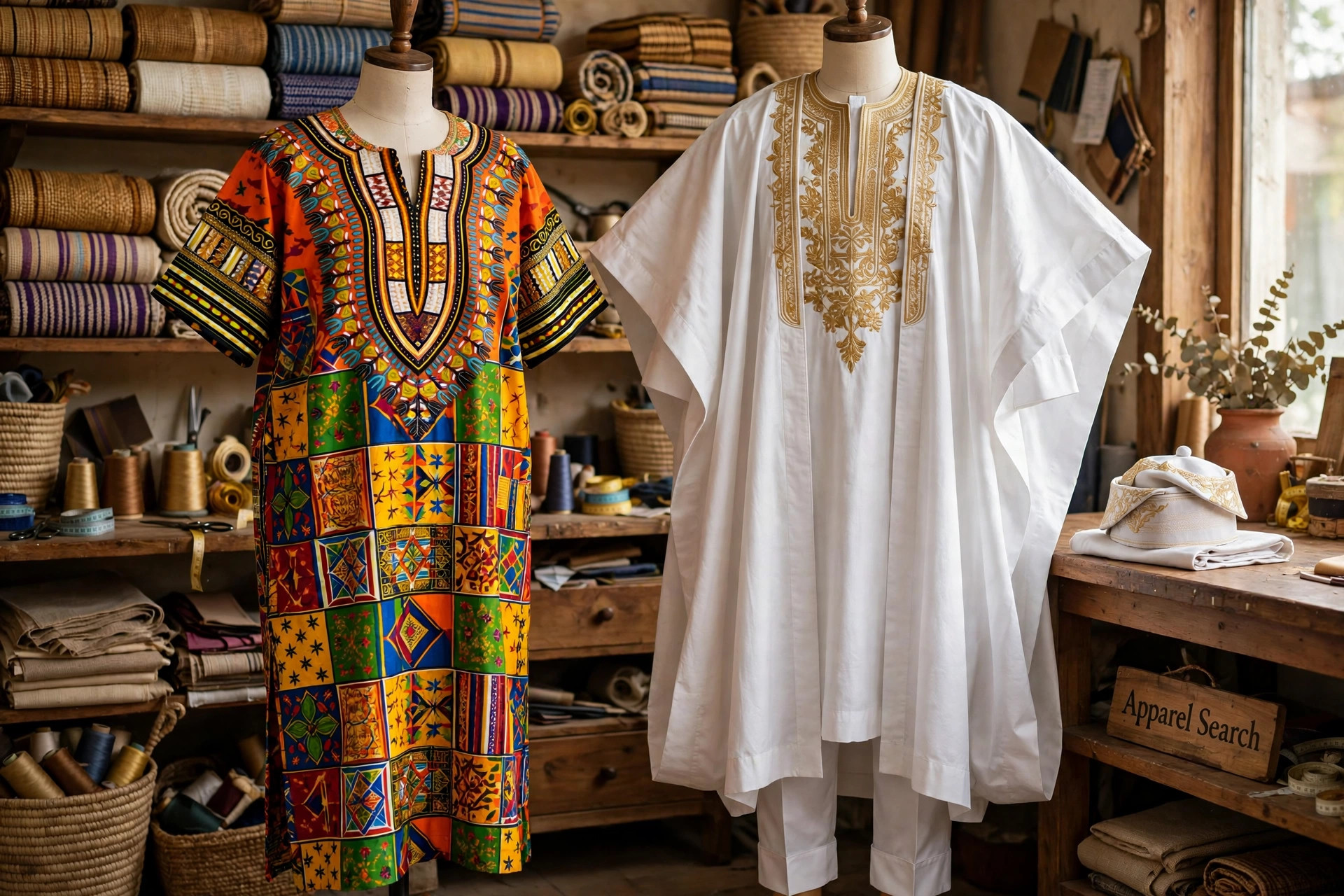
Nigeria is home to hundreds of peoples and many dress traditions, but two garments announce a celebration almost anywhere in the country — and far beyond it. The dashiki is a loose pullover tunic, hip- or knee-length, recognised at once by its ornate embroidered neckline: a deep V or round opening worked in contrasting thread, with matching embroidery at the cuffs and sometimes down the front. The agbada is its grand counterpart — a wide, flowing robe with enormous sleeves, worn open over a long top and trousers, its embroidery concentrated at the neck and chest. Where the dashiki is relaxed and democratic, the agbada is deliberate theatre: it takes up space, moves slowly, and is meant to.
The dashiki's name tells its own history. It comes from the Yoruba dàńṣíkí, itself borrowed from the Hausa dan ciki — literally an inner garment, a short tunic worn under larger robes. The Yoruba danshiki was originally a work garment sewn from hand-woven strip cloth, with deep-cut armholes and gussets that flared the hem. From those practical roots the tunic spread across West Africa, and in the 1960s it travelled further still, becoming a symbol of African heritage in the diaspora. In Nigeria today it sits comfortably at every level: a printed cotton dashiki for an ordinary day, an embroidered one for a party, a tailored dashiki suit — tunic, drawstring sokoto trousers and a matching cap — for a groom.
The agbada belongs to a wider family of grand robes worn across West Africa, known in French-speaking countries as the grand boubou. In northern Nigeria the Hausa babban riga is its close relative, and Yoruba tailors made the agbada a signature of southwestern celebration dress. A full agbada outfit is an ensemble, not a single garment: the great robe over a long-sleeved top called a buba, drawstring trousers called sokoto beneath, and a soft folded cap — the fila — on the head. The robe's wide sleeves are so generous that wearers habitually gather or throw them over the shoulder to free their hands, a gesture every Nigerian recognises.
Anatomy
The Parts of the Outfit
A formal Nigerian outfit is built in layers, each with its own name. From the inside out:
- Buba — the top
- A loose, long-sleeved top worn under the agbada by men, and by women as a blouse with a wrapper. Under a grand robe it is mostly hidden, but its sleeves show at the wrist and its quality is felt rather than seen.
- Sokoto — the trousers
- Loose drawstring trousers, tapering toward the ankle, worn under both the dashiki suit and the agbada. Because the robe covers them, sokoto are usually made from a plainer cloth than the robe above them.
- Dashiki — the embroidered tunic
- A pullover tunic with an ornate V-shaped or round neckline, embroidered at the neck and sleeve edges and often finished with patch pockets. Worn alone with trousers for everyday and semi-formal dress, or as part of a matched suit.
- Agbada (boubou) — the grand robe
- The wide-sleeved outer robe, often ankle-length, open at the front and heavily embroidered around the neck opening and chest. Its volume is the point: a fine agbada uses a great deal of cloth and announces the wearer's presence before he says a word.
- Fila — the cap
- The soft Yoruba cap that completes a man's outfit, folded and worn tilted or straight in named styles. A fila made from aso oke to match the robe is the finishing touch of a wedding outfit.
- For women — iro, buba and gele
- The classic Yoruba women's ensemble pairs a wrapper (iro) with a loose blouse (buba), a shoulder sash (ipele) and the gele, a head tie folded and sculpted into elaborate shapes — an art in itself, and one many women hand to a specialist for a big wedding.
Formality
From Everyday Print to Grand Robe
Nigerian dress reads formality through cloth and embroidery rather than through cut. A printed cotton dashiki is everyday wear. The same tunic in lace, brocade or aso oke, with dense hand-guided embroidery, becomes party dress. The agbada ladder climbs the same way: a plain agbada for a family visit, an embroidered one for a wedding guest, and a fully worked aso oke agbada — robe, fila and all — for a groom, a chief or the father of the bride. White and cream agbada are wedding classics; deep colours and metallic embroidery thread carry evening celebrations. Among Hausa dress in the north, the babban riga with its embroidered cap follows the same logic of cloth, embroidery and occasion.
Cloth and Pattern
Aso Oke, Ankara and the Language of Cloth
Two cloths dominate this wardrobe. Aso oke — “top cloth” in Yoruba — is hand-woven by Yoruba weavers on narrow looms, in strips roughly a hand's width across that are sewn together into full cloth. It is Nigeria's prestige fabric, kept for weddings, naming ceremonies, chieftaincy occasions and festivals, and made into agbada, wrappers, gele and fila. Its classic types are still named and recognised:
| Aso oke type | Character |
|---|---|
| Etu | Deep indigo-blue cloth with fine light stripes — among the oldest and most respected types |
| Sanyan | Beige-brown cloth woven with silk from the cocoons of the Anaphe moth — quiet, costly and highly prized |
| Alaari | Rich red cloth, traditionally made with silk or glossy thread |
Ankara — the bold printed cotton known across Africa as wax print — is the wardrobe's everyday glory. Its history is a trade story: machine-made cloth inspired by Indonesian batik, produced in the Netherlands and Britain from the late nineteenth century, found its true market in West Africa, where traders and customers shaped the patterns to local taste. The crackled wax effect, the saturated colour and the named, proverb-laden designs made ankara thoroughly West African, and today it is cut into dashikis, dresses, buba and wrapper sets and modern tailoring of every kind. Other cloths complete the picture: adire, the indigo resist-dyed cloth of Yoruba women dyers, and fine lace, long a celebration staple.
Over both cloths sits aso ebi — “family cloth.” For a wedding or a milestone birthday, a family or group of friends chooses one fabric and everyone has it made up in their own style. The matching cloth is a visible show of unity and support for the celebrant, and choosing, selling and sewing aso ebi is a small industry of its own around every big Nigerian celebration.
Living Dress
When Dashiki and Agbada Are Worn Today
Weddings are the great showcase. A Nigerian traditional wedding is a parade of agbada and gele: the groom in an embroidered agbada and fila, the bride in aso oke or lace with a sculpted gele, and rows of guests in aso ebi. Naming ceremonies, milestone birthdays, chieftaincy installations, festivals and funerals of elders all call for the same wardrobe, each occasion with its own colours and mood. Friday prayers bring out fine robes in the north and south alike, and the dashiki remains ordinary good dress across the country — the garment a man reaches for when he wants to look like himself, only better.
The garments also travel. The dashiki became a heritage symbol in the African diaspora in the 1960s and has never entirely left; agbada appear at diaspora weddings from London to Houston, ordered from Nigerian tailors and carried home in suitcases. Within Nigeria, designers cut the old forms in new ways — cropped dashiki tops, agbada-inspired robes for women, ankara tailoring for the office — while the classic celebration outfit changes very little. Nigeria has no single country page of its own on Apparel Search; our Africa clothing industry page covers the continent's apparel and textile sector as a whole. For the garments as clothing to wear today, see our women's dashiki guide and our men's boubou and agbada guide.
Wearing
Wearing Basics
An agbada is worn, not just put on. The robe goes over the buba and sokoto, the fila is folded and set at a slight, confident angle, and the great sleeves are managed all day — gathered up, folded back or thrown over one shoulder so the wearer can eat, greet and dance. New wearers are often surprised by the weight and warmth of a full aso oke robe; choose the cloth for the season and the length of the event. A dashiki needs less ceremony: it should fall loose and straight, its embroidered neckline sitting flat, worn over plain trousers so the tunic carries the outfit. For guests, the golden rule is the aso ebi rule — if the family has chosen a cloth, wearing it is the compliment; your own style of making it up is where your personality goes.
Keeping
Care and Storage
Aso oke is an heirloom cloth and is treated like one: families keep wedding aso oke for decades and hand pieces down. Wash it rarely and gently — cool water, mild soap, no wringing of the woven strips — and dry it in shade, since strong sun fades indigo etu quickly. Embroidered agbada are best dry-cleaned or hand-washed by someone who knows embroidery, and stored folded with the embroidery protected, not hung, because a heavy robe stretches on a hanger. Ankara cotton is hardier — it is everyday cloth — but its saturated colours last longest washed cool, inside out and out of harsh sun. Gele cloth, especially stiff aso oke, keeps its sculpting quality stored flat and dry.
Acquiring
Buying and Collecting
Most fine Nigerian dress is made to measure. The classic route is to buy cloth — aso oke from weavers and cloth merchants, ankara by the yard in the market — and take it to a tailor, who cuts the dashiki, agbada or iro and buba to your body and the occasion. When buying aso oke, handle it: genuine hand-woven cloth shows its narrow strips and their seams, has weight and a slightly irregular hand that printed imitations lack. Printed “aso oke style” fabrics exist at every price; they are fine cloth, but they are not woven aso oke, and the price should say so. For a ready-made dashiki, judge the embroidery — dense, even stitching at the neckline is the garment's whole point. And if you are invited to a celebration with aso ebi, buy the family's cloth early: tailors' books fill up fast in wedding season.
Common Questions
Common Questions
What is the difference between a dashiki and an agbada?
The dashiki is a loose pullover tunic with an embroidered neckline, worn on its own with trousers for everyday and semi-formal dress. The agbada is a grand, wide-sleeved outer robe — the West African boubou — worn over a long top (buba) and trousers (sokoto) with a fila cap, reserved for celebrations and formal occasions. One is a shirt; the other is an entrance.
What does the word dashiki mean?
Dashiki comes from the Yoruba dàńṣíkí, borrowed from the Hausa dan ciki, meaning an inner garment or shirt — a short tunic originally worn under larger robes. The Yoruba danshiki was a practical work tunic of hand-woven strip cloth before it became West Africa's best-known embroidered shirt.
What is aso oke?
Aso oke, “top cloth” in Yoruba, is Nigeria's prestige hand-woven fabric, woven on narrow looms in strips that are sewn together into full cloth. Its classic types are etu (deep indigo with fine stripes), sanyan (beige silk from Anaphe moth cocoons) and alaari (rich red). It is made into agbada, wrappers, head ties and caps for weddings and ceremonies, and kept as an heirloom.
What is aso ebi?
Aso ebi means “family cloth.” For a wedding or celebration, a family or group of friends chooses a single fabric and everyone has it made up in their own style, so the guests arrive visibly united in support of the celebrant. The cloth might be ankara, lace or aso oke — the sharing, not the fabric, is the custom.
Can visitors wear a dashiki or agbada?
Yes — these are welcoming garments, and a guest who wears the celebration's aso ebi cloth is paying the family a compliment. Have the outfit made or fitted properly, wear the agbada with its full ensemble of buba, sokoto and fila, and let your host or tailor show you how to manage the robe's wide sleeves.
Keep Exploring
More to Explore
In This Series
Traditional Dress by Country
The series hub — every country guide, from the kimono of Japan to the galabeya of Egypt, as each is published.
Visit the hub ↑Africa Clothing Industry
Apparel Search's Africa clothing industry page — the continent-wide directory for the region Nigeria's weavers and tailors work within.
Explore ↑Go Deeper on the Dashiki and Agbada
Search Apparel Search