Apparel Search Guide Series
Traditional Dress by Country
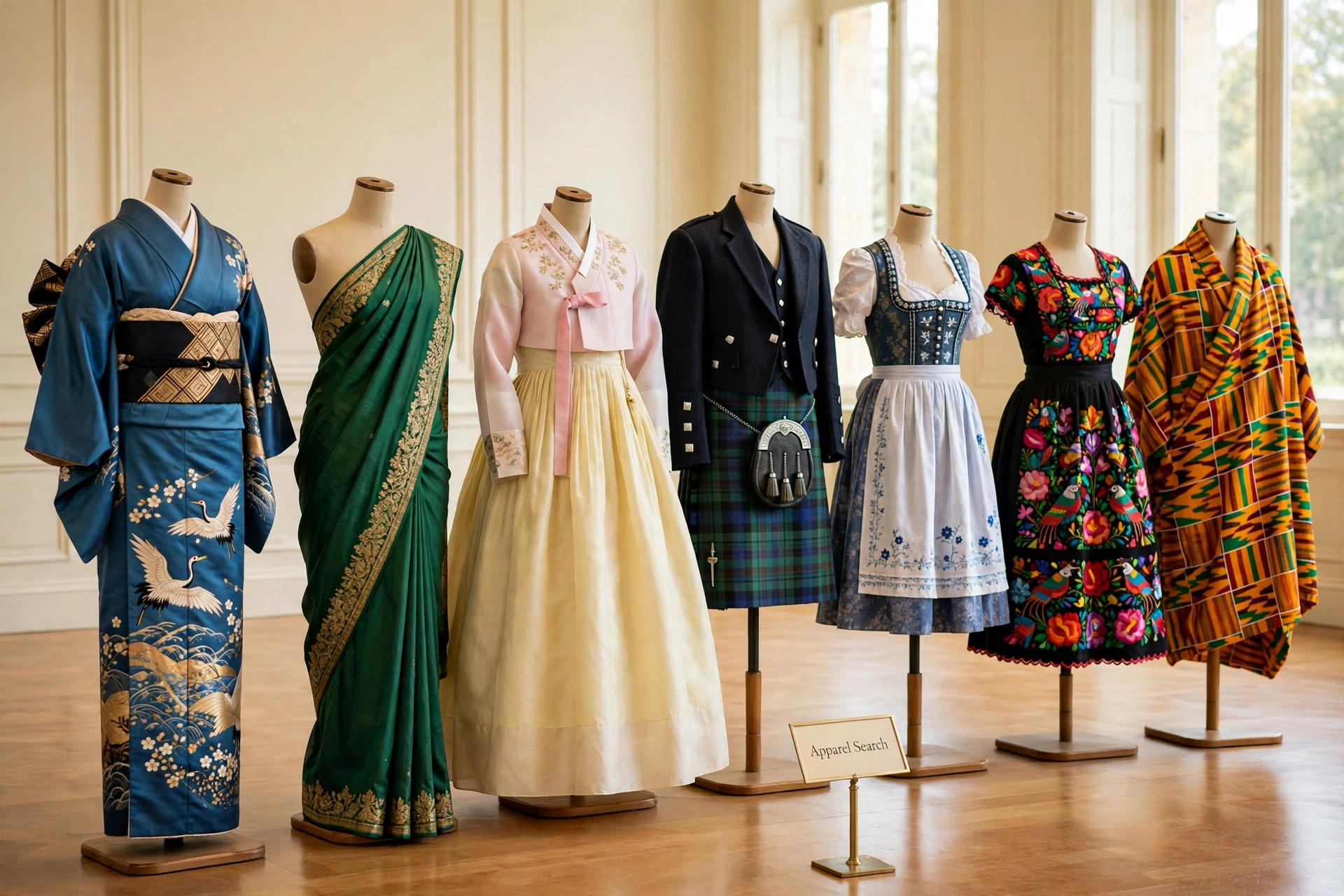
Every country has clothing it invented for itself — shaped by its fibers and looms, its climate, its ceremonies and its sense of beauty. This series takes one country at a time and explains its traditional dress properly: the garments and their parts, how they are made, what their patterns mean, and when they are worn today.
Search Apparel Search
Start Here
How to Use These Guides
Start with a country whose clothing catches your eye, and read its guide the way you would walk through a museum gallery with a good label writer. Each guide names the garments and every important part of the outfit — the sash, the under-robe, the pleated skirt — in the language they come from, because the names carry the knowledge. Each explains how the clothing is constructed, which fabrics and techniques its makers are known for, and how a wearer knows what is right for a wedding, a festival or a formal visit.
These are living garments, not museum pieces. The kimono is still Japan’s formal dress; the sari is everyday and ceremonial clothing for millions of women; the kilt is made by working Scottish kiltmakers to order. Where a garment has become rare, or survives mainly at festivals, the guide says so honestly.
Every guide is also woven into the rest of Apparel Search. It links to the matching country page in our World Clothing Industry directory — and that country page links back — so you can move between a country's traditional craft and its modern apparel industry. Where a garment also has a definition or a fashion guide elsewhere on the site, the country guide points you there too.
The Guides
Asia
Japan — The Kimono
A wrapped silk robe worn with a broad obi sash, in forms that range from the long-sleeved furisode of a young woman’s celebration to the black tomesode of a wedding’s closest relatives. Our first guide in the series.
Read the guide ↑Korea — The Hanbok
A short, high-waisted jacket (jeogori) over a full wrapped skirt (chima) for women, and wide trousers (baji) with a vest or jacket for men — worn for holidays, weddings and family celebrations.
Read the guide ↑India — The Sari
One long, unstitched length of cloth, draped over a fitted blouse and petticoat in dozens of regional styles — everyday dress and heirloom silk in a single garment.
Read the guide ↑China — Qipao and Hanfu
The close-fitted qipao (cheongsam) of the last century, and the revived hanfu — the flowing, cross-collared robes of Han Chinese dress from dynasties long before it.
Read the guide ↑Vietnam — The Ao Dai
A long, side-split tunic worn over loose trousers, for women and men — Vietnam’s elegant answer to formal dress, school uniform and wedding wear alike.
Read the guide ↑Thailand — The Chut Thai
Thailand’s formal national dress in its named forms, from the shoulder-cloth sabai and wrap skirt of the traditional styles to the formal silk ensembles worn at royal and state occasions.
Read the guide ↑Indonesia — Kebaya and Batik
The fitted lace kebaya blouse worn with a batik sarong, and batik itself — wax-resist cloth so central to Indonesian identity that it has its own national day.
Read the guide ↑Philippines — The Barong Tagalog
A sheer, embroidered formal shirt worn untucked, woven from pineapple-leaf piña or banana silk — the Philippines’ national garment for weddings and state occasions.
Read the guide ↑The Guides
Europe
Scotland — Highland Dress
The tailored kilt in clan or district tartan, with its jacket, sporran, hose and brogues — a complete formal system, still made to order by Scottish kiltmakers.
Read the guide ↑Germany & Austria — Dirndl and Lederhosen
Alpine dress for feast days and folk festivals: the dirndl’s bodice, blouse and apron for women, and leather lederhosen with braces for men.
Read the guide ↑Russia — The Sarafan
The long, flowing pinafore dress worn over a blouse, with the kokoshnik headdress — the silhouette at the heart of Russian folk dress.
Read the guide ↑Ukraine — The Vyshyvanka
The embroidered linen shirt whose stitched patterns vary by region and carry protective and family meanings — now a worldwide symbol of Ukrainian identity.
Read the guide ↑Greece — The Fustanella
The white pleated skirt of the Greek evzone guard, worn with an embroidered waistcoat — and the varied island and mainland folk dress behind it.
Read the guide ↑Spain — The Flamenco Dress
The ruffled, polka-dotted traje de flamenca of Andalusia’s ferias — a folk dress that, unusually, changes with fashion every single year.
Read the guide ↑The Guides
Africa and the Middle East
Nigeria — Dashiki and Agbada
West African dress at two registers: the bright, embroidered dashiki tunic, and the grand, wide-sleeved agbada robe worn for weddings and celebrations.
Read the guide ↑Ghana — Kente
Strip-woven silk and cotton cloth from Bonwire, its woven patterns named and meaningful — draped as a robe for chiefs, kings and honored graduates.
Read the guide ↑Morocco — Caftan and Djellaba
The ornate, belted caftan of Moroccan celebrations, and the hooded djellaba robe worn by women and men in daily and formal life.
Read the guide ↑The Gulf — Thobe and Abaya
The white ankle-length thobe (dishdasha) worn by men across the Gulf, and the black abaya worn by women — garments of climate, custom and faith.
Read the guide ↑Egypt — The Galabeya
Egypt’s loose, ankle-length robe for women and men, from the embroidered dresses of Siwa Oasis to the everyday galabeya of the Nile Valley.
Read the guide ↑The Guides
The Americas
Mexico — Charro Suit and China Poblana
Mexico’s two famous outfits: the embroidered, silver-buttoned charro suit of the horseman, and the sequined china poblana dress of Puebla.
Read the guide ↑Peru — Andean Dress
Highland dress of the Andes: the woven poncho, the layered pollera skirt, and the montera hat — garments spun, dyed and woven from alpaca and sheep’s wool.
Read the guide ↑Two Ways to Explore
Traditional Craft, Modern Industry
Traditional dress does not sit apart from the clothing business — it is where much of it began, and in many countries the same regions still weave the cloth and sew the garments. That is why every guide in this series is linked, in both directions, with Apparel Search’s World Clothing Industry directory: read the Japan guide, then visit the Japan clothing industry page to see the mills, makers and fashion companies carrying that heritage forward — and come back the same way.
Common Questions
Common Questions
What counts as traditional dress?
Traditional dress is the clothing a culture developed for itself over generations — garments shaped by local materials, climate, craft traditions and ceremony, and still worn today for festivals, weddings, formal occasions or daily life. It is not a costume: in most of the countries in this series the garments are living clothing, made by working artisans and worn by real communities.
How is this section organized?
By country. Each guide covers one country's best-known traditional garments: what the pieces are called, how they are made, how formality and occasion work, what the patterns and colors mean, and when the clothing is worn today. All twenty-one country guides are published and linked from this page.
How do these guides differ from the garment guides in the clothes section?
The clothes section guides look at a garment as modern fashion — styling, shopping and wearing it today. These guides look at the same garment in its home culture: its history, its parts and their proper names, its rules of formality, and its place in the country's clothing industry. The two kinds of guide link to each other, so you can move between the cultural picture and the fashion picture.
Do these pages connect to the country clothing industry pages?
Yes — in both directions. Every guide in this series links to its country's page in the World Clothing Industry directory, where you can explore that country's apparel and textile industry, and every one of those country pages links back to the guide. Traditional craft and modern industry are two halves of the same story.
Keep Exploring