Traditional Dress by Country · India
The Sari of India
The sari is India’s traditional dress and the world’s great unstitched garment — one long cloth, woven with its borders and decorated end complete, that becomes clothing only when its wearer drapes it. This guide explains how that works: the field, border and pallu of the cloth, the blouse and petticoat it is worn with, the regional drapes from Nivi to the nine-yard nauvari, the silk of Kanchipuram and Banarasi and the gold thread called zari, and the sari’s life from everyday dress to bridal heirloom.
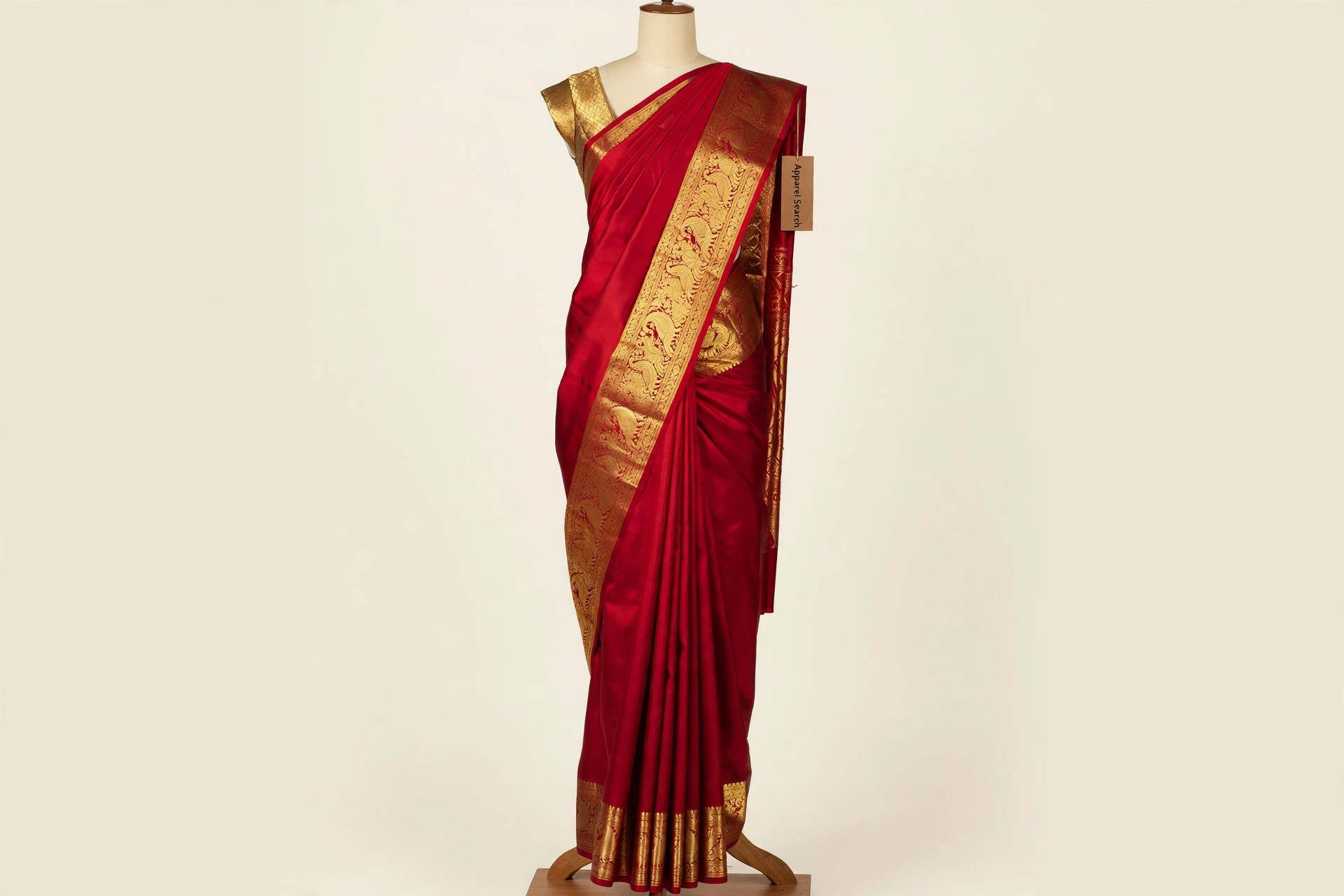
The Garment
What a Sari Is
The sari (also spelled saree) is the great unstitched garment of India: a single long cloth — most often between five and nine yards — that is wrapped, pleated and draped around the body with no seams, no fastenings and no tailoring at all. Everything that makes it a garment happens in the wearing. The same length of cloth fits any body, at any age, and can be arranged in well over a hundred documented drapes, each belonging to a region, a community, an occupation or an occasion. For the short dictionary version, see Apparel Search’s definition of sari (saree).
Draped, uncut cloth is the oldest form of dress in South Asia. Sculpture from the Indus Valley civilisation onward shows wrapped lower garments and shoulder cloths that dress historians read as the sari’s ancestors — the antariya, worn around the waist and legs, and the uttariya, draped over the upper body. The one-piece sari developed from those paired cloths over centuries. Unstitched cloth also carries ritual meaning in several Indian traditions, which is one reason the draped garment held its place in temple and ceremony even as stitched clothing spread.
The sari outfit most people picture today — pleats at the front, the decorated end over the left shoulder, a fitted blouse and an underskirt — is, surprisingly, a nineteenth-century standardisation. Earlier generations wore the sari in regional ways, with breast bands or upper cloths rather than tailored blouses. In Bengal, Jnanadanandini Debi of the Tagore household popularised a drape worn over a blouse and petticoat that would be respectable in colonial-era drawing rooms; taught, photographed and later carried across India by cinema, that assembly became the modern default — while the older regional drapes lived on beside it.
Anatomy
The Parts of the Outfit
A sari has no parts in the tailor’s sense — but the cloth itself is designed in three zones, and the outfit adds two stitched companions. Knowing the zones is knowing how to read any sari:
- The field — the body of the cloth
- The main expanse of the sari, plain, patterned all over, or scattered with small woven motifs (buti). The field does the quiet work of the garment; its colour sets the outfit’s mood.
- The borders — the long edges
- Both long edges of the cloth are woven with borders, usually in a contrasting colour and often in gold thread. The border is the signature of a regional sari — the broad gold border of a Kanchipuram, the red-and-white contrast of a Bengali tant — and it frames the drape from hem to shoulder.
- The pallu — the decorated end
- The final length of the cloth, woven more densely and richly than the rest, which is thrown over the shoulder or drawn across the chest so its design is displayed. The pallu is where weavers put their finest work, and how it is worn is the clearest regional signal in the whole outfit.
- The blouse — choli
- The fitted, cropped upper garment worn beneath the drape, with short sleeves in its classic form. Blouses are tailored to the wearer and increasingly treated as a design element in their own right — contrasting, embroidered or elaborately backed — though the sari itself remains unstitched.
- The petticoat — the underskirt
- A plain drawstring underskirt, worn in a matching or neutral colour, into which the sari’s pleats are tucked. The petticoat’s firm waistband is what the whole drape anchors to in the modern styles; older drapes such as the nine-yard nauvari need no petticoat at all.
The Drapes
One Cloth, Many Drapes
Ask how a sari is worn and the honest answer is: where? The drape is a map of India. These are the styles a reader is most likely to meet:
| Drape | Region | How it is worn |
|---|---|---|
| Nivi | Andhra Pradesh; now pan-Indian | Pleats tucked at the front waist, pallu over the left shoulder and falling behind — the modern standard, spread by office dress and cinema |
| Bengali (atpoure) | West Bengal | Broad box pleats at the front; the pallu comes over the left shoulder and back over the right, displayed across the chest — the white-and-red drape of Durga Puja |
| Gujarati (seedha pallu) | Gujarat and Rajasthan | The pallu is brought from the back over the right shoulder and spread across the front, so its design faces the viewer — made for showing off a worked pallu |
| Nauvari (kashta) | Maharashtra | A nine-yard sari passed between the legs and tucked at the back like a dhoti, giving trousers-like freedom of movement; the dress of Lavani dancers and, historically, of women who rode and worked |
| Madisar | Tamil Nadu | Another nine-yard drape, worn by Tamil Brahmin women for ritual occasions, with versions differing between communities in pleating and fastening |
| Coorgi (Kodava) | Kodagu, Karnataka | Pleats tucked at the back and the pallu pinned at the right shoulder — a practical drape for steep coffee-estate country |
Length follows drape: the standard sari is around five and a half to six and a half yards, while the trouser-forming drapes need the full nine yards their names promise. A shorter cloth, four to five yards, serves simpler wraps and working dress.
Cloth and Pattern
Fabric, Pattern and Meaning
The first division of the sari world is fibre. Cotton is the cloth of daily life — cool, washable, and woven in every region, from Bengal’s fine tant to the sturdy handloom cottons of the south. Silk is the cloth of ceremony, and two silk traditions stand above the rest. Kanchipuram saris, from the temple town of Kanchipuram in Tamil Nadu, are woven in pure mulberry silk with the border and pallu made separately and then interlocked with the body — a joint so strong, weavers say, that the cloth would tear before the seam parts. Banarasi saris, from Varanasi, are silk brocades worked with floral and vine patterns descended from Mughal art. Around those two giants circles a whole atlas of named weaves: Patola double ikat from Gujarat, Jamdani’s floating motifs from Bengal, Paithani’s peacock pallus from Maharashtra, Bandhani tie-dye from Kutch.
What makes the great saris glitter is zari — thread of gold or silver, traditionally real metal wrapped around a silk core, today often metal-coated or tested substitutes in everyday cloth. Zari is woven, never printed, into borders and pallus, and its weight and density are a large part of what separates a bridal silk from a festive imitation. Motifs carry the usual auspicious language of Indian textiles — mango (ambi) paisleys, lotus, peacocks, temple towers along a Kanchipuram border — and colour does its own work, red above all for brides and festivals.
Silk gets the attention, but the sari’s soul is arguably its handloom cotton. India’s weaving clusters produce cottons of extraordinary refinement by hand — cloth so fine it was historically described as “woven air” in the muslins of Bengal — and hand-spun, hand-woven khadi carries its own national symbolism from the independence movement. A handloom sari in either fibre is the product of days of work at the loom: warping, dyeing, and the weaving-in of border and pallu as a single act of design. That is why two saris of identical colour and pattern, one power-loomed and one hand-loomed, are different objects — in hand, in drape, and in the life they will live.
Because the design is woven in rather than applied, technique and fabric are the same decision in a sari: choose a weave and you have chosen its weight, its shine, how it pleats and how it must be draped. Our silk sari guide looks at the silk end of that choice in more detail.
Living Dress
When the Sari Is Worn Today
The sari is not occasion dress that happens to survive — it is, for millions of women, ordinary daily clothing: worn to market, to fields and offices, to teach and to travel, in cotton and easy-care synthetics, draped in minutes by practised hands. In many cities younger women now reserve it more often for festivals and formal days, but the garment’s centre of gravity remains everyday life in a way few traditional dresses can match.
Its ceremonial life is correspondingly rich. Festivals have their colours — white and red in Bengal for Durga Puja, new silks at Diwali and Pongal. Weddings call for the heaviest silks a family owns or buys: a red Banarasi in the north, a Kanchipuram in the south, worn by the bride and answered by silk on mothers and guests. Saris pass down as heirlooms, given at weddings and milestones, kept for decades and re-draped by daughters and granddaughters — the cloth outlives fashion because it was never cut to a season’s shape. Behind the wearing stands one of the world’s great handloom industries; our India clothing industry page profiles the mills, handloom clusters and exporters of that sector.
Draping
Wearing Basics
The Nivi drape, step by step, is the foundation skill. Put on the blouse, the petticoat — tied firmly at the waist — and your footwear first, so the hem length comes out right. Tuck the plain end of the cloth into the petticoat at the right side and wrap it once around the body. Form the front pleats — five to seven even folds — and tuck them in at the centre front, letting them fall straight. Wrap the remaining cloth around once more, then bring the pallu up across the back and over the left shoulder, arranging its fall and pinning it to the blouse at the shoulder if the day will be active. Heavy silks want fewer, wider pleats and patience; pins belong on the inside, and never through zari if you can avoid it. Every regional drape is a variation on the same principles: anchor firmly, pleat evenly, and let the pallu do the talking.
Keeping
Care and Storage
Cotton saris ask little: wash, starch lightly if you like the traditional crispness, and dry in shade to protect dyes. Silk is another matter. A fine silk sari is dry-cleaned by a cleaner who knows zari, or washed only with great care; it should never be left folded on the same creases for years, because silk cracks along fold lines and zari tarnishes where it is pressed. Experienced owners refold their silks every few months, shifting the creases, and store them wrapped in plain cotton or muslin — never in plastic, which traps moisture — in a dark, dry place, with the heaviest brocades rolled or laid flat rather than hung. Perfume and deodorant go on before dressing, never sprayed near the cloth, and a sari is aired after wearing before it returns to the shelf.
Acquiring
Buying and Collecting
Buying a sari well means buying the weave, not the photograph. Learn the names — Kanchipuram, Banarasi, Patola, Jamdani, Paithani — and what each should feel like: a true Kanchipuram is heavy with silk and zari and its interlocked border can be felt at the join; a real Banarasi’s brocade is woven through, its reverse nearly as finished as its face. Handloom saris carry small irregularities that are the signature of the loom, and many named weaves are protected by Geographical Indication tags — worth asking for, alongside a clear statement of fibre and whether zari is real, tested or imitation. Collectors keep wedding silks as family capital, and a well-kept Banarasi or Kanchipuram holds both its beauty and its value across generations. For a first sari, a mid-weight silk or a good cotton from a reputable handloom seller teaches the drape kindly — and drapes far more forgivingly than a stiff bridal brocade.
Common Questions
Common Questions
What is a sari?
A sari is India’s traditional garment for women: a single long strip of unstitched cloth, usually five to nine yards, that is wrapped around the waist, pleated at the front and draped over the shoulder. It is worn with a fitted blouse and usually a petticoat. Because it is never cut or sewn, the same sari fits any wearer and can be draped in over a hundred regional styles.
How long is a sari, and why does the length vary?
A standard sari is about five and a half to six and a half yards long. Drapes that pass the cloth between the legs to form trousers — the Maharashtrian nauvari and the Tamil madisar — need a full nine yards, while shorter cloths of four to five yards serve simpler wraps and working dress. The length follows the drape, not the wearer’s size.
What is worn with a sari?
In the modern standard outfit, a fitted cropped blouse (choli) and a drawstring petticoat underskirt: the sari’s pleats tuck into the petticoat’s waistband and the pallu may be pinned to the blouse. The pairing is a nineteenth-century standardisation — older regional drapes used breast bands or upper cloths, and the nine-yard drapes need no petticoat at all.
What is zari?
Zari is the gold or silver thread woven into a sari’s borders and pallu. Traditionally it was real metal — gold or silver wire wrapped around a silk core — and it gives Kanchipuram and Banarasi silks their weight and glitter. Everyday saris often use imitation or “tested” zari of metal-coated thread. Zari is always woven in on the loom, never printed on.
Is the sari only worn for special occasions?
No. For millions of women the sari is everyday clothing — cotton or easy-care synthetics worn for work, markets and home, draped in minutes. Silk saris are kept for festivals, weddings and ceremonies, and the finest become family heirlooms. In some cities younger women wear saris mainly on festive days, but the garment’s centre of gravity is still daily life.
Keep Exploring
More to Explore
In This Series
Traditional Dress by Country
The series hub — every country guide, from the kimono of Japan to the kilt of Scotland, as each is published.
Visit the hub ↑India Clothing Industry
India’s apparel, mill and handloom industry directory — the sector behind the sari’s weavers.
Explore ↑Go Deeper on the Sari
Search Apparel Search