Traditional Dress by Country · Philippines
Philippines — The Barong Tagalog
The barong tagalog solves a problem no other national dress attempts: how to be fully formal in a tropical climate. Its answer is a shirt of cloth so fine it is translucent — woven from pineapple leaf fibre, embroidered by hand with openwork — worn untucked over an undershirt, cool as a breeze and yet correct at a wedding, a state dinner or the opening of Congress. This guide explains the barong’s fibres and embroidery, its Spanish-era making, how it is worn today, and the women’s dress — the terno and baro’t saya — that shares its cloth and craft.
The Garment
What a Barong Tagalog Is
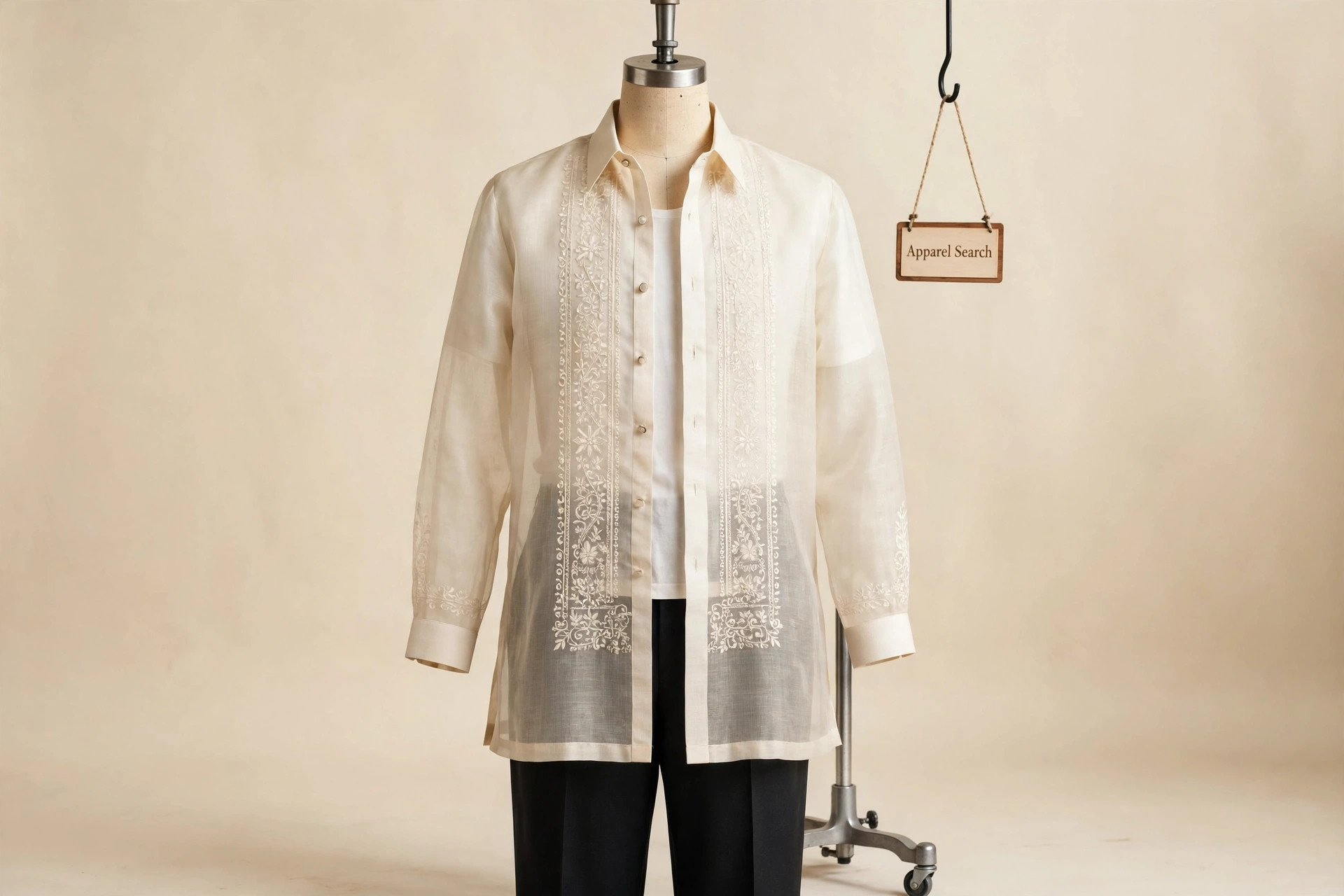
The barong tagalog takes its name from baro ng Tagalog — “the dress of the Tagalog” — and at first sight it is disarmingly simple: a long-sleeved shirt, buttoned down the front, worn loose and untucked. Look closer and everything about it is extraordinary. The cloth, called nipis, is sheer: woven from plant fibres to a gauze that shows the undershirt beneath. Down the chest runs the pechera, a panel of embroidery, and in fine examples the embroidery is calado — openwork made by pulling threads from the cloth itself and stitching the remainder into lace. The barong is formal dress engineered for heat: where a suit wraps the body in wool, the barong lets air move through pineapple fibre. For the short dictionary version, see our definition of barong tagalog.
Its ancestry is double. Before Spanish colonisation, men and women in the islands wore a collarless upper garment, the baro, woven from native fibres such as abacá. Across more than three centuries of Spanish rule, that shirt absorbed European elements — long sleeves, buttons, a collar, fine embroidery in the Spanish taste — while Filipino weavers kept it sheer and cool, and Filipino embroiderers made its decoration a high art. The result is neither a native shirt with foreign trim nor a Spanish shirt in local cloth, but a genuinely fused garment, and Filipinos read it exactly that way: as the country’s history, worn.
In the twentieth century the barong became the uniform of Filipino public life — promoted by presidents, standard at weddings and in Congress — and in 1975 it was formally proclaimed the national attire, with a Barong Tagalog Week celebrated each June. It remains what it was designed to be: the most formal thing a man can wear in the Philippines, and the coolest.
Anatomy
The Parts of the Outfit
A barong outfit has few pieces, and each has a name and a standard:
- The barong itself
- A long-sleeved shirt with a collar (a dress-shirt collar or, in some styles, a collarless neckline), buttoning fully down the front or in the half-open “pechera” style that pulls partly over the head. It has no pockets, side slits at the hem, and is always worn untucked with the hem — often embroidered — fully visible.
- Pechera — the chest panel
- The embroidered front panel is the barong’s field of honour: geometric and floral designs run down either side of the buttons, or in the all-over sabog (“scattered”) pattern across the whole shirt. The density and fineness of the pechera is the quickest guide to a barong’s quality and price.
- Camisón / camisa de chino — the undershirt
- Because nipis is sheer, a plain undershirt is always worn beneath: white for formal occasions, traditionally the collarless, cuffless camisa de chino. It is part of the outfit, not an afterthought — its clean white is the ground the embroidery is read against.
- Trousers and shoes
- Dark, belted dress trousers — black is the wedding and state standard — and polished dress shoes. The barong replaces the jacket and tie, not the rest of formal dress.
- Salakot and hats
- Historically the barong could be finished with the salakot, the traditional wide-brimmed helmet hat, or in the colonial period a buntal straw hat; today hats are seen mainly in folk and ceremonial dress, and the modern barong is worn bareheaded.
Cloth and Craft
Piña, Jusi and the Art of Calado
The barong’s fibres are its glory. Piña is woven from the leaves of the pineapple plant: the leaves are scraped to extract fine, hair-like fibres, which are knotted end to end by hand into thread and woven on looms, most famously in Aklan province on Panay. The cloth is naturally ivory, light, stiff enough to hold embroidery, and faintly lustrous; a length of fine piña represents months of work before an embroiderer touches it, which is why piña barongs are heirloom purchases. Jusi, the other classic nipis, was originally woven from abacá — banana fibre — and is today commonly a silk or synthetic blend with the same sheer, smooth character at a gentler price. Modern barongs also come in organza and polyester blends; they copy the look, but connoisseurs judge a barong first by its fibre.
Embroidery turns cloth into regalia. Three techniques matter most. Calado, the signature: threads are drawn out of the woven ground and the rest bound into open, lace-like patterning — the design is quite literally made of holes, held together by stitching. Sombrado works shaded embroidery in layered threads for soft gradations of tone. And fine surface embroidery in floral and geometric designs fills the pechera and cuffs. The centres of the craft are Lumban in Laguna — the country’s embroidery capital, where whole streets work at frames — and Taal in Batangas. A hand-embroidered piña barong passes through the hands of weaver, embroiderer and sewer in sequence; machine embroidery exists at lower prices and is honestly sold as such, but the hand work has a softness and irregularity that machines imitate and never match.
The Women’s Dress
The Terno and the Baro’t Saya
The barong’s counterpart is the women’s baro’t saya — “blouse and skirt”: a sheer blouse (camisa) with wide sleeves, a long skirt (saya), a starched shoulder cloth (pañuelo) over the blouse, and an overskirt (tapis). In the nineteenth century this ensemble grew grander as the Maria Clara gown — named for the heroine of José Rizal’s novel Noli Me Tángere — with bell sleeves and rich embroidery. In the twentieth century the blouse and pañuelo fused into the terno, a single gown distinguished by its butterfly sleeves: stiff, upright arcs of cloth that rise from the shoulder and are Filipino dress’s most famous silhouette. The terno shares the barong’s materials and makers — piña and jusi, calado and hand embroidery — and the two are worn together at weddings and state occasions, a matched statement of the same craft. Women also wear barong-style shirts themselves, cut for women, as modern formal dress.
Living Dress
When the Barong Is Worn Today
The barong is not kept for folklore; it is the working formal dress of a nation. Weddings are its home ground — the groom in piña, fathers and sponsors in barongs of descending splendour, the bride often in a terno of the same cloth. Government and state life runs on it: officials take oaths in barongs, and at the annual State of the Nation Address the chamber is a show of piña and embroidery, legislators’ barongs and ternos reviewed like a fashion parade. Business and the professions accept the barong wherever a suit would go, and many offices treat the formal barong as the correct alternative to jacket and tie. Graduations, christenings, formal dinners and Independence Day ceremonies complete the calendar.
Behind the garment stands a chain of rural and small-town craft — piña farmers and weavers in Aklan, embroiderers in Laguna and Batangas, tailors in every city — within the wider industry profiled on our Philippines clothing industry page. And for the barong as menswear to buy and wear now, see our men’s barong guide.
Wearing
Wearing Basics
The rules are few and absolute. Wear the barong untucked, always, with its hem free and its side slits open. Wear a clean, plain undershirt beneath — white for formal occasions — since it will be seen through the cloth and forms part of the effect. Button it fully for formality; the half-open style is pulled on and its placket settled straight so the pechera panels align. Trousers dark and pressed, belt and shoes formal, nothing in the (nonexistent) pockets. Fit matters as much as fabric: a barong should fall loose and straight from the shoulder, neither blouse-tight nor billowing, with sleeves ending at the wrist bone. If you are a guest, match your fibre to your role — piña and hand embroidery for the wedding party, jusi or a good blend for guests — and never outshine the groom at his own wedding, a courtesy as old as the garment.
Keeping
Care and Storage
Piña and calado are strong for their fineness but unforgiving of rough treatment. Hand-wash a barong gently in cool water with mild soap, supporting the embroidery rather than scrubbing it; never wring — roll in a towel to press out water — and dry flat or on a padded hanger in shade. Many owners dry-clean heirloom piña pieces, and that is the safer course for heavily embroidered shirts; ask the cleaner about experience with nipis. Iron cool, from the reverse, with a press cloth over calado so the iron cannot snag the openwork. Store hung on a padded hanger in a breathable garment bag, away from light; folding sheer piña sharply creases it, and storing it dirty invites stains to set into the fibre permanently. Jusi and blends are hardier but deserve the same habits — the embroidery, whatever the cloth, is always the fragile part.
Acquiring
Buying and Collecting
Buy a barong by fibre, embroidery and fit, in that order. Piña is the heirloom grade: check that the cloth is true piña — fine, slightly stiff, with the fibre’s natural variation — and that embroidery described as hand calado really is openwork drawn from the cloth, not appliqué lace sewn on top. Lumban and Taal are the towns to buy embroidery in; Manila’s department stores and specialist shops carry the full range from machine-embroidered blends to master-work piña, and made-to-measure is widely available and worth it, since the garment’s effect depends on its fall from your shoulder. Vintage barongs survive well and are collected for their embroidery; examine the pechera and cuffs for broken threads, the underarms for staining, and the cloth for brittleness before judging a price. A fine barong is bought the way a good suit is bought in colder countries — once, carefully, and for decades of ceremonies.
Common Questions
Common Questions
What is a barong tagalog?
The barong tagalog — usually shortened to barong — is the Philippines’ national dress for men: an embroidered, long-sleeved formal shirt traditionally made of sheer nipis cloth woven from piña (pineapple leaf) or jusi fibre. It is worn untucked over a plain undershirt, with dark trousers and dress shoes, and serves as full formal dress at weddings, state functions and ceremonies. Our definition of barong tagalog gives the short version.
Why is the barong worn untucked?
Untucked is simply how the garment is made to be worn: the barong is cut as an outer shirt — its older Spanish name was camisa fuera, “outer shirt” — with side slits and a finished hem designed to be seen. Tucking it in would hide the embroidery at the hem and break the line of the pechera, the embroidered chest panel. A popular story claims Spanish rulers forced the style so weapons could not be concealed, but historians treat that explanation as legend rather than documented fact.
What are piña and jusi?
Piña is cloth woven from the fibre of pineapple leaves — fine, stiff, naturally ivory and slightly glossy, most famously woven in Aklan on Panay island. Jusi is a silk-like sheer cloth originally woven from abacá (banana) fibre and today usually made from silk or synthetic blends. Both belong to the family of sheer fabrics called nipis; piña is the most prized and the most costly.
What is calado embroidery?
Calado is the signature openwork embroidery of the barong: threads of the woven cloth are drawn out and the remaining threads are bound and stitched into lace-like patterns, so the decoration is created from the fabric itself. It is done by hand, notably in Lumban, Laguna — known as the embroidery capital of the Philippines — and in Taal, Batangas, and it can take weeks on a single shirt.
When is the barong worn today?
The barong is standard Filipino formal dress: grooms and male wedding guests, officials and professionals at formal functions, graduates, and politicians — members of Congress wear barongs for the State of the Nation Address. In 1975 the barong was formally proclaimed the national attire, and it remains the correct alternative to a suit and tie in the Philippine climate.
Keep Exploring
More to Explore
In This Series
Traditional Dress by Country
The series hub — every country guide, from the kimono of Japan to the kilt of Scotland, as each is published.
Visit the hub ↑Philippines Clothing Industry
The Philippines’ apparel and textile industry directory — from piña weavers in Aklan to the embroiderers of Lumban.
Explore ↑Go Deeper on the Barong
Search Apparel Search