Traditional Dress by Country · Korea
The Hanbok of Korea
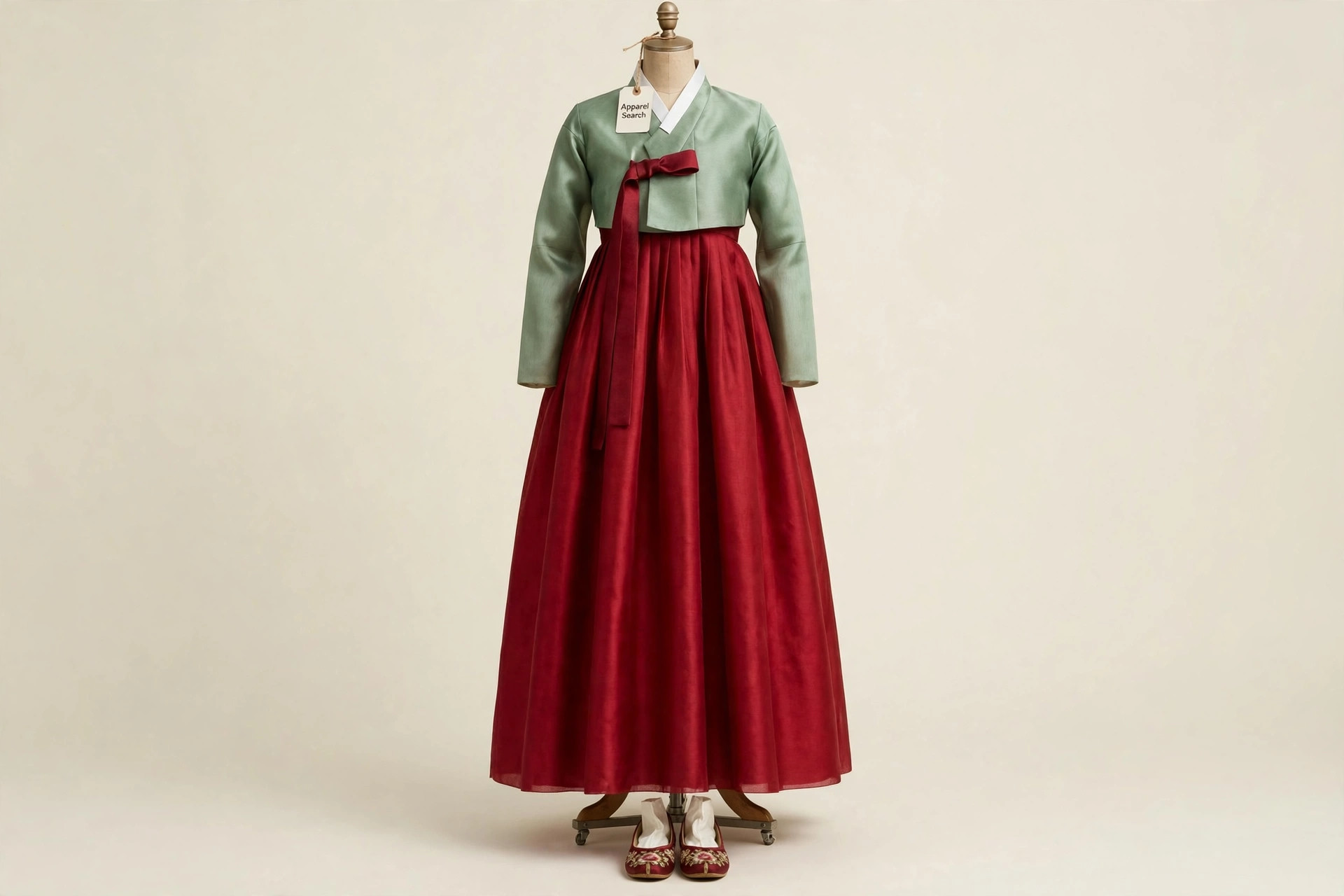
The hanbok is Korea’s traditional dress — a short, ribbon-tied jacket worn over a long, high-waisted skirt or wide trousers, in colours drawn from a five-hundred-year-old symbolic palette. This guide explains the whole outfit: the jeogori, chima and baji, the white dongjeong collar and the goreum bow, the black gat and embroidered flower shoes, how silk, ramie and colour set an outfit’s formality, and the holidays, weddings and palace visits where the hanbok is worn today.
The Garment
What a Hanbok Is
Hanbok (한복) means simply “Korean clothing,” and in everyday use it names a two-part outfit of remarkable poise: a short jacket worn with either a long, full skirt or wide, roomy trousers. The silhouette is the first thing a viewer notices — the jacket ends high, the skirt begins almost at the chest, and the whole outfit falls in one long, unbroken line from a high waist to the floor. Nothing is cut to hug the body. The jeogori wraps and ties rather than buttoning, the chima wraps and ties, and the grace of the outfit comes from volume, colour and movement rather than from fit.
The basic layout is ancient. Tomb murals of the Goguryeo kingdom (37 BCE–668 CE) already show the separate top and bottom, the wrapped jacket and the long skirt that a Korean viewer would still recognise today. The form that modern hanbok follows most closely settled during the Joseon dynasty (1392–1910), when Confucian ideals of modesty and order shaped dress: garments covered the body fully, sleeves were generous, and decoration was concentrated in colour, woven pattern and embroidery rather than in exposed shape. Joseon dress also coded its wearers carefully — rank, age, marital status and occasion could all be read from the cut and colour of an outfit.
By the late nineteenth and twentieth centuries Western dress took over Korean daily life, and the hanbok moved from everyday clothing to ceremonial dress — the garment of holidays, weddings and rites of passage. That shift preserved it. Because a hanbok is worn at the moments families most want to honour, its making remained a living craft of silk weavers, embroiderers and specialist tailors, and in recent decades designers have carried it further, into simplified “daily hanbok” (saenghwal hanbok) cut for ordinary modern wear.
Anatomy
The Parts of the Outfit
A hanbok is an ensemble of named pieces, layered in a set order. The core is the same for everyone; coats, hats and ornaments are added for weather, rank and occasion. From the body out:
- Jeogori — the jacket
- The short upper garment worn by men and women alike, its front panels crossing and tying closed. Its anatomy has names of its own: the collar band is the git, the overlapping front panel the seop, and the sleeves the somae — often finished with contrasting cuffs (kkeutdong) on women’s formal jackets. A woman’s jeogori is cropped and close; a man’s is longer and looser.
- Dongjeong — the white collar
- A band of plain white cloth set along the edge of the jeogori’s collar, framing the face with a crisp line. The dongjeong is removable — it can be taken off, washed or replaced while the jacket itself is cleaned less often — and it symbolises cleanliness and purity. That small white edge is one of the quickest ways to recognise a hanbok at a glance.
- Goreum — the ribbon ties
- The long fabric ribbons that fasten the jeogori, tied at the front in a single-loop bow. In their modern form the goreum are wide and decorative, falling in long ends over the skirt — as much ornament as fastening, and often made in a contrasting colour to the jacket. Learning to tie a neat goreum bow is the finishing skill of dressing in hanbok.
- Chima — the skirt
- The women’s lower garment: a long wrap skirt of gathered or pleated panels, tied high on the body, above the natural waist and almost to the chest, so that it falls in a full bell shape to the ankles. Underneath, layered underskirts (sokchima) build the volume that gives the chima its floating outline. The pairing of jacket and skirt is so standard that women’s hanbok is often called chima jeogori.
- Baji — the trousers
- The men’s lower garment: very loose, roomy trousers, tied at the waist and gathered at the ankle with bands called daenim. The cut is practical clothing for a floor-sitting culture — full enough to sit cross-legged in comfort — and women also wore baji as an underlayer beneath the chima.
- Durumagi and po — the overcoats
- Po is the general word for an outer robe, and the durumagi is its best-known form: a long coat, closed all around, worn over jeogori and baji or chima when going outdoors and for formal occasions. Men also wear the sleeveless jokki vest and the buttoned magoja jacket over the jeogori, both late-Joseon additions that arrived as Western dress began to influence Korea.
- Gat — the hat
- The wide-brimmed black hat of Joseon-era men, woven from bamboo and horsehair and lacquered, worn with a chin strap. The gat marked the adult, respectable man — above all the yangban scholar-official — and it completes the classic male silhouette of coat, trousers and tall dark hat.
- Beoseon and kkotshin — socks and shoes
- White padded socks (beoseon), sewn with a distinctive upturned toe, are worn by men and women. Over them, women wear kkotshin — “flower shoes” — silk shoes embroidered with flowers, clouds and other lucky motifs, their toes curving up to match the line of the socks. Hair ornaments complete a formal outfit: the binyeo pin that holds a married woman’s chignon, the daenggi ribbon at the end of a braid, and the norigae, a decorative pendant hung from the jeogori ties or the skirt waist.
Formality
Types and Formality: Fabric and Colour Do the Talking
A hanbok has no single “formal version” the way a suit has black tie. Instead, formality is dialled up or down through fabric, colour and layering. A holiday outfit and a wedding outfit may share exactly the same cut; what separates them is that one is cotton and the other is silk, embroidered and worn with a ceremonial coat. The traditional ladder, in rising order:
| Level | Fabric and colour | Worn for |
|---|---|---|
| Everyday and daily hanbok | Cotton, hemp (sambe) or ramie (mosi) in quiet colours; modern simplified cuts | Daily wear, work, casual outings |
| Holiday dress | Silk or fine ramie in clear, cheerful colours; neat goreum and full accessories | Seollal and Chuseok family gatherings |
| Wedding and celebratory | Rich silk, embroidery and gold stamping (geumbak); brides in ceremonial robes | Weddings, first birthdays (doljanchi), sixtieth birthdays (hwangap) |
| Ceremonial and court | The layered robes of Joseon court and ritual dress — hwarot and wonsam for brides and noblewomen | Traditional wedding rites, re-enactments, museum and state occasions |
Two garments crown the wedding wardrobe. The hwarot is a bride’s heavily embroidered ceremonial robe, traditionally red outside with a blue lining — the pairing of opposites in balance — its long sleeves striped and finished with white cuffs. The wonsam, another ceremonial overcoat once reserved for royalty and noblewomen, serves as a slightly less formal alternative. A groom’s formal set answers them in deeper tones: jeogori, baji and vest under a long coat, with a hat or a scholar’s cap for the traditional rites.
Children are the glorious exception to every rule of restraint. A child’s hanbok is deliberately bright, and its sleeves are often made in saekdong — bands of rainbow striping sewn from many colours — believed to wish the child vitality and a long, lucky life.
Cloth and Colour
Fabric, Pattern and Meaning
Silk is the prestige hanbok fabric, woven plain, patterned, or stamped with gold, and embroidered for the great occasions. But Korea’s textile tradition is just as proud of its plant fibres: ramie (mosi), fine and cool with a soft sheen, is the classic summer cloth, and hemp (sambe) the sturdy everyday weave, with cotton for warmth in between. A knowledgeable buyer reads a hanbok first by its cloth — the same colours in silk and in ramie are two different levels of dress.
Colour carries the meaning. Traditional Korean colour thinking rests on obangsaek, the five cardinal colours drawn from yin-yang and Five Elements philosophy, each tied to a direction and an element:
| Colour | Direction and element | Associations |
|---|---|---|
| Blue (cheong) | East · wood | Youth, freshness, new beginnings |
| Red (jeok) | South · fire | Joy, passion, good fortune; worn by brides, and believed to drive away evil |
| Yellow (hwang) | Centre · earth | The centre of the world; historically linked to royalty |
| White (baek) | West · metal | Purity and honesty — the everyday colour of common dress for centuries |
| Black (heuk) | North · water | Wisdom and authority; the colour of the scholar’s gat |
Those five colours surface everywhere in the garment — in saekdong sleeves, in the green jeogori and red chima traditionally paired for a bride, in contrasting goreum and cuffs. Embroidery and gold stamping add a second language of motifs: peonies for wealth and honour, lotus for purity, cranes and the “ten symbols of longevity” (sipjangsaeng) — sun, mountains, water, clouds, pine, deer, tortoise, crane, herb of immortality and bamboo — wishing the wearer a long life.
Living Dress
When the Hanbok Is Worn Today
For most Koreans the hanbok now comes out on the days that matter most. At Seollal, the Lunar New Year, families gather in hanbok and children perform sebae — a deep formal bow to their elders — receiving blessings and gift money in return. Chuseok, the autumn harvest festival, brings the same dressing-up for family gatherings and ancestral rites. Weddings remain the hanbok’s grand stage: even when the main ceremony is Western in style, the couple often change into wedding hanbok for the paebaek, the family bowing rite, and the mothers of the couple wear hanbok as honoured guests. A baby’s first birthday (doljanchi) and a parent’s sixtieth (hwangap) are likewise hanbok occasions, the guest of honour dressed in the brightest colours of all.
The garment also has a public, everyday second life. Seoul’s palaces admit visitors wearing hanbok free of charge, and rental shops around Gyeongbokgung and the Bukchon Hanok Village dress thousands of visitors — Korean and foreign alike — for a day among the palace courtyards. Simplified daily hanbok, with shorter skirts, easier jackets and modern fabrics, has its own loyal following for ordinary wear. Behind all of it stands a modern industry of textile makers, designers and manufacturers; our Korea fashion and textiles page profiles that wider industry, and if you are looking for the hanbok as clothing to buy and wear, our women’s hanbok guide covers modern hanbok styles in the clothes section.
Dressing
Wearing Basics
A hanbok is put on in layers, and the order matters. Underlayers and underskirts go on first to build the silhouette — the chima’s bell shape comes from what is beneath it as much as from the skirt itself. The chima is wrapped and tied high, well above the natural waist; the jeogori is then crossed over and closed with its goreum, tied into a single-loop bow that sits just off centre, its long ends falling straight. The white dongjeong should show as an even band along the collar, and the beoseon socks and shoes go on last. For men, the baji are tied at the waist, gathered at the ankle with daenim bands, and the jeogori, vest and durumagi follow in that order, with the gat set straight and level. The two checks in the mirror: the skirt’s hem level all the way around, and the goreum bow neat — a crooked bow is the hanbok equivalent of a crooked tie.
Keeping
Care and Storage
Silk hanbok are specialist garments. Embroidery, gold stamping and silk dyes do not belong in a washing machine; a good hanbok is cleaned by a cleaner experienced with traditional dress, and many owners spot-clean and air a garment after each wearing, since it is worn over underlayers and rarely touches the skin directly. The removable dongjeong is the exception — it is designed to be taken off and washed on its own, which is precisely why it exists. Ramie and hemp summer hanbok are hardier and can be washed gently, which is part of their traditional appeal.
Store a hanbok folded, not hung: the soft construction stretches on a hanger. Fold along the garment’s natural lines, pad the folds with plain acid-free paper to prevent sharp creases in silk, and keep the outfit in a breathable box or wrapped in clean cotton cloth, away from light and damp. Air the pieces on a dry day before returning them to storage, check embroidered and gold-stamped areas for wear, and keep the kkotshin and accessories with the outfit so the set stays complete.
Acquiring
Buying and Collecting
A made-to-measure silk hanbok from a specialist shop is a significant purchase, and the market is organised accordingly: fine hanbok are ordered from hanbok tailors who measure, choose silk and embroidery with the customer, and fit the outfit across more than one visit. Ready-made and rental hanbok serve everyone else, and renting is the normal way to dress for a single wedding or a palace visit — a good rental shop fits the layers properly and ties the goreum for you, which teaches more than an hour of photographs.
When buying, judge the cloth before the colour: real silk, fine ramie and honest embroidery hold their value and their looks, while printed polyester imitations of both date quickly. Check that the chima is full enough to fall in a true bell, that the dongjeong is clean and replaceable, and that any gold stamping is crisp rather than flaking. Vintage hanbok are collected for their embroidery and weaving; inspect silk for brittleness and light damage, and remember that a wedding hwarot is ceremonial dress — magnificent, but not a substitute for a guest’s holiday hanbok.
Common Questions
Common Questions
What is a hanbok?
A hanbok is Korea’s traditional dress: a short jacket called a jeogori, wrapped and tied with long ribbon ties (goreum), worn with a long wrap skirt (chima) by women or loose trousers (baji) by men, and finished with coats, hats and ornaments according to the occasion. Its shape settled in the Joseon dynasty, and today it is worn mainly for holidays, weddings and ceremonies.
What are the jeogori, chima and baji?
They are the three core pieces. The jeogori is the upper garment worn by everyone — a short jacket with a white collar band (dongjeong) and ribbon ties. The chima is the women’s long, high-waisted wrap skirt. The baji are the men’s wide, comfortable trousers, tied at the ankle. Together, jacket plus chima or baji makes the basic hanbok.
When do people wear hanbok today?
Mainly on the great family occasions: Seollal (Lunar New Year) and Chuseok (the harvest festival), when families gather and children bow to their elders; at weddings, where the couple and their mothers wear their finest; and for first and sixtieth birthdays. Visitors also rent hanbok to visit Seoul’s palaces, which admit wearers free.
What do hanbok colours mean?
Traditional colour follows obangsaek, the five cardinal colours: blue for the east and youth, red for the south, joy and good fortune — the bride’s colour; yellow for the centre, once linked to royalty; white for purity, long the everyday colour; and black for wisdom and authority. Children’s rainbow-striped saekdong sleeves combine the colours as a wish for a long, lucky life.
Can visitors to Korea wear a hanbok?
Yes — and it is encouraged. Rental shops near Seoul’s palaces and the Bukchon Hanok Village fit visitors of every nationality with complete outfits, and the palaces waive entry fees for visitors in hanbok. Let the shop staff handle the layering and tie the goreum for you, and wear the outfit with the respect due to a garment Koreans reserve for their happiest days.
Keep Exploring
More to Explore
In This Series
Traditional Dress by Country
The series hub — every country guide, from the kimono of Japan to the kilt of Scotland, as each is published.
Visit the hub ↑Korea Fashion & Textiles
Korea’s fashion and textile industry — the modern mills, makers and designers behind the traditional craft.
Explore ↑Go Deeper on the Hanbok
Search Apparel Search