Traditional Dress by Country · Japan
The Kimono of Japan
The kimono is one of the most carefully coded garments on earth. A few centimetres of sleeve, the placement of a pattern, the number of small white crests — each tells a knowledgeable viewer the wearer’s age, status and the weight of the occasion. This guide explains the whole system: the parts of the outfit, the types from casual komon to the black tomesode of a wedding’s closest family, what the cranes and pines on the cloth mean, and how the kimono is worn, cared for and collected today.
The Garment
What a Kimono Is
The word kimono means, plainly, “a thing to wear.” The garment it names is a T-shaped robe built from straight panels of cloth, wrapped around the body and held by cords and a wide sash. Unlike Western tailoring, a kimono is not cut to the body’s curves. It begins as a single standard bolt of fabric — a tanmono, roughly 36–38 cm wide and 12–13 metres long — and is sewn into a robe of straight seams that the wearer then adjusts to fit with folds and ties. Taken apart, it returns to flat rectangles of cloth; that is why antique kimono silk can be unpicked, washed panel by panel and resewn, and why vintage kimono are sold as textiles as readily as as clothes.
The kimono descends from the kosode, a small-sleeved garment worn as underwear in the Heian period (794–1185), when court ladies appeared instead in the layered jūnihitoe, a stack of silk robes whose colour combinations were an art in themselves. Over the following centuries the kosode moved outward to become everyone’s main garment, and in the Edo period (1603–1868) it flowered: wealthy merchants, barred from open displays of rank, poured their fortunes into dyeing and embroidery instead. The yūzen technique — hand-painted resist dyeing associated with the Kyoto artist Miyazaki Yūzensai — let dyers paint pictures across the cloth, and shibori tie-dyeing and fine embroidery reached their peak. The modern kimono is that Edo garment, essentially unchanged in construction.
Two rules govern the wearing of it. The robe is always wrapped left panel over right; right over left is reserved for dressing the dead, and is the one mistake every beginner is warned against. And for women, the extra length of the robe is folded up at the waist in a tuck called the ohashori, hidden beneath the sash, so the hem falls exactly to the ankle whatever the wearer’s height. For the short dictionary version, see Apparel Search’s definition of kimono.
Anatomy
The Parts of the Outfit
A kimono is never worn alone. It is an ensemble of a dozen named pieces, each with a job, and a full formal outfit can take an experienced dresser half an hour to assemble. From the skin out:
- Nagajuban — the under-kimono
- A light, kimono-shaped under-robe that keeps the kimono itself away from the skin and gives the outfit its clean collar line. Its removable collar cover, the haneri, shows as a band of colour or embroidery at the neck — a small, changeable accent that can refresh an outfit.
- Koshihimo and datejime — the ties
- Thin cords (koshihimo) and a wider sash (datejime) do the real work of holding the robe and its waist fold in place. They are completely hidden in the finished outfit.
- The kimono itself
- The main robe, its sleeves varying with the type: the long, swinging sleeves of a furisode can approach a metre in length, while a married woman’s tomesode has short, practical sleeves.
- Obi — the sash
- The wide belt tied at the back in a decorative knot (musubi). The obi is mainly display — the ties underneath do the holding — and its width, fabric and knot set the formality of the whole outfit. A small board (obiita) keeps its front smooth, a small pillow (obimakura) shapes formal knots, a scarf-like obiage tucks above it and a cord (obijime) ties across its middle.
- Tabi and footwear
- White split-toe socks (tabi) are worn with formal and everyday kimono, with zōri sandals; wooden geta go with the casual yukata, worn barefoot. Our definition of geta covers the wooden sandal in more detail.
- Haori and hakama — the outer layers
- A haori is a loose jacket worn over the kimono. Hakama are wide, pleated trouser-skirts: for men they complete formal dress, and women wear them over kimono at graduation ceremonies. See the definition of hakama.
The obi alone comes in a formality ladder of its own:
| Obi type | Character | Worn with |
|---|---|---|
| Maru obi | The most formal, patterned on both sides, now mostly bridal and ceremonial | Wedding kimono, highest formality |
| Fukuro obi | Formal brocade, often with gold or silver thread | Furisode, hōmongi, tomesode, iromuji |
| Nagoya obi | Semi-formal, partly pre-shaped for easier tying | Everyday and semi-formal kimono |
| Hanhaba obi | Narrow “half-width” obi, casual and easy to tie | Yukata and casual kimono |
Formality
Kimono Types, from Casual to Ceremonial
Kimono formality is read at a glance from the sleeve length, the pattern’s placement, and the number of family crests (kamon) dyed or embroidered on the back, chest and sleeves — five crests is more formal than three, three more than one, and none is everyday dress. The main types for women, in rising order:
Komon — the everyday kimono, patterned all over with a small repeating design. For shopping, visiting friends and informal outings. Yukata, the unlined cotton summer kimono, sits below even this in formality; it is covered in its own right in our definition of yukata.
Iromuji — a kimono in a single colour with no pattern. Quiet and versatile, it is the classic choice for the tea ceremony, and with one crest it can rise to semi-formal occasions.
Tsukesage and hōmongi — the visiting kimono. Their designs are dyed as one continuous picture flowing across the seams — over the shoulders, down the sleeves, around the hem — so the garment becomes a single painting when worn. The hōmongi is the more formal and brilliant of the two, worn by married and unmarried women alike to parties, ceremonies and formal visits.
Tomesode — the most formal kimono for married women, its pattern kept below the waist and its sleeves short. In black (kuro-tomesode), with five crests, it is worn by the mothers of the bride and groom and closest married relatives at a wedding — the Japanese equivalent of the most formal evening dress. Coloured iro-tomesode serve other formal occasions.
Furisode — the most formal kimono for young unmarried women, unmistakable for its long, swinging sleeves and bright, all-over patterns. It is the dress of Coming of Age Day, when twenty-year-olds celebrate adulthood, and of formal parties and weddings attended as a guest.
For men, formal dress is sober by design: a crested black or dark silk kimono with a haori jacket and striped hakama — the montsuki hakama ensemble worn at weddings and formal ceremonies. For brides, tradition offers the pure white shiromuku or the richly embroidered, trailing uchikake over-gown in red or bright colours, heavy with cranes and pines.
Cloth and Pattern
Fabric, Pattern and Meaning
Silk is the classic kimono fabric, and a formal wardrobe is a silk wardrobe — but kimono are also made in wool and cotton for everyday wear, and in modern easy-care synthetics. What transforms cloth into art is the dyeing. Yūzen dyeing paints the design onto the fabric by hand or stencil, using rice-paste resist to keep each colour in its field, producing the flowing, painterly scenes of a hōmongi. Shibori is shaped-resist tie-dyeing, its thousands of tiny knots leaving dotted patterns that can cover a whole robe. Weaving has its own masters: the brocades of Kyoto’s Nishijin district supply the finest obi, and regional crafts — Ōshima tsumugi silk pongee, Yūki tsumugi, kasuri ikat — are prized by collectors by name.
The patterns (wagara) are a language. Motifs are chosen for the season first — a kimono should anticipate the season slightly, never lag behind it — and for their meanings:
| Motif | Meaning |
|---|---|
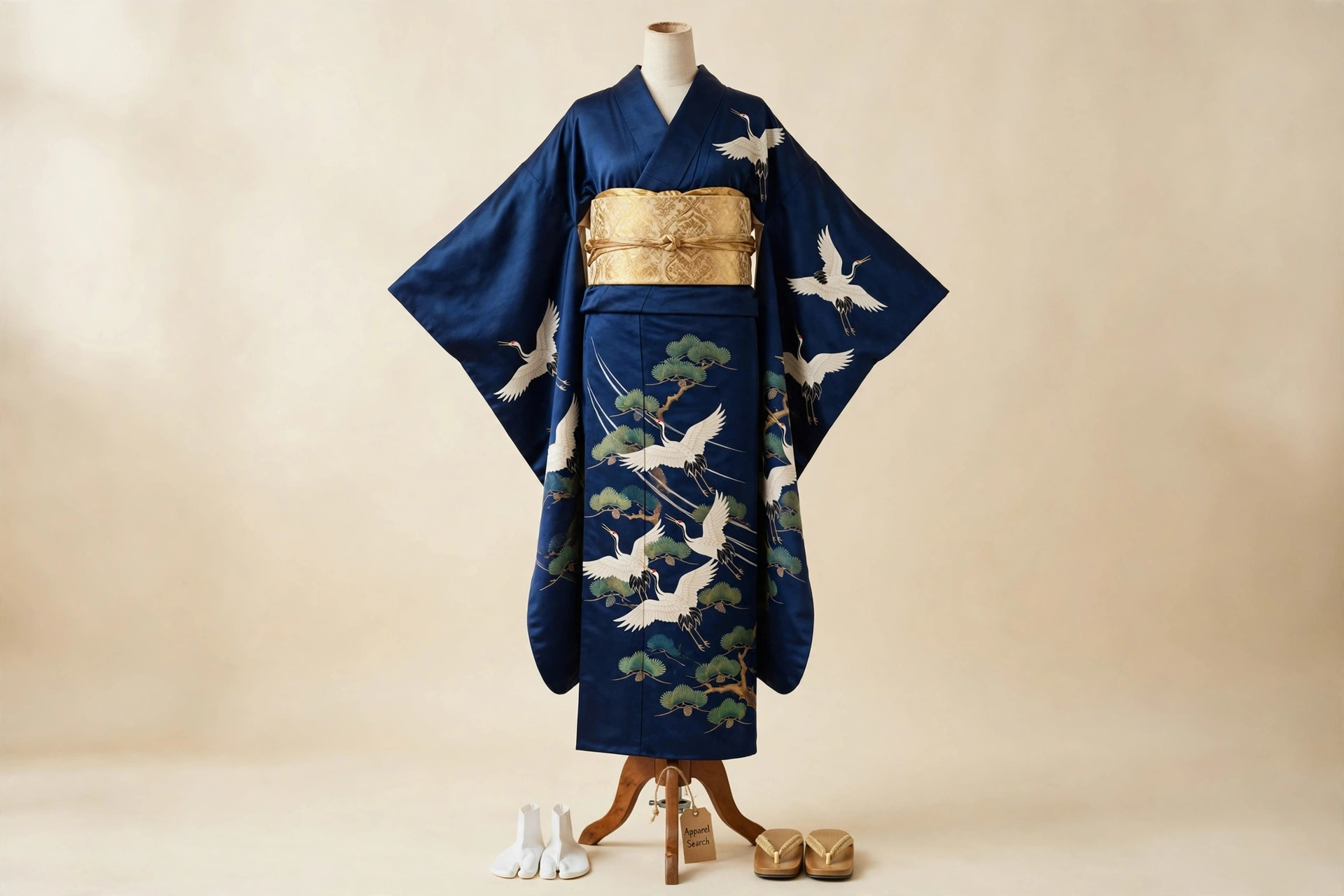
| Crane (tsuru) | Longevity and good fortune; cranes mate for life, so they also bless marriages — a favourite on wedding kimono |
| Pine, bamboo and plum (shōchikubai) | The “three friends of winter”: endurance and resilience, since all three stay strong in the cold |
| Cherry blossom (sakura) | The beauty of brief things; spring and new beginnings |
| Chrysanthemum (kiku) | Longevity and nobility — the flower of the Imperial family |
| Peony (botan) | Wealth, honour and feminine beauty |
| Seigaiha waves | Overlapping blue waves: peace, good fortune and a wish for a calm future |
| Kikkō tortoiseshell | The hexagon of the tortoise’s shell: stability and long life |
Colour speaks too. Purple was historically the colour of nobility, its dye once rare and costly; deep indigo, the colour of our hero photograph’s robe, is Japan’s everyday classic, long associated with cotton work clothes as well as silk. A knowledgeable wearer coordinates kimono, obi and the small accessories as one composition of season, colour and meaning.
Living Dress
When Kimono Are Worn Today
Most Japanese people today own Western wardrobes, and the kimono has become occasion dress — but the occasions are real and regular. On Coming of Age Day each January, young women in brilliant furisode fill the streets and shrines. Shichi-Go-San dresses children of seven, five and three in miniature formal kimono for shrine visits each autumn. Weddings still call for tomesode on the mothers and often a full traditional costume for the couple. Graduations pair women’s kimono with hakama; the tea ceremony asks for the quiet iromuji; New Year visits, formal parties and traditional arts — calligraphy, flower arranging, dance — all keep kimono in use.
Summer belongs to the yukata, worn at festivals and firework displays and provided as loungewear by hot-spring inns. And the kimono has found a second life through rental: shops in Kyoto and Tokyo’s Asakusa dress visitors and young Japanese alike for a day’s sightseeing, which is why you will see more kimono on the street in those districts than anywhere else in the country. Behind the ceremonies stands a whole industry of dyers, weavers, specialist retailers and professional dressers (kitsuke teachers hold licences in the art of putting kimono on others). Our Japan clothing industry page profiles the wider apparel and textile sector that this traditional craft sits within — and if your interest is the kimono as modern fashion, our women’s kimono guide covers kimono and kimono-inspired styles as clothing to buy and wear today.
Kitsuke
Wearing Basics
The art of dressing in kimono is called kitsuke, and it is taught, examined and licensed like other traditional arts. The full sequence runs to many steps, but its logic is simple and a beginner should hold on to five points. Dress in order: undergarments, then the nagajuban, then the kimono itself, then the ties, then the obi. Wrap left over right, always. Set the collar so it sits away from the nape of the neck in a graceful curve, with the white or coloured edge of the haneri showing evenly on both sides. For women, form the ohashori waist fold and check the hem falls straight at the ankle all the way around. And finish by smoothing the front of the obi flat — a crisp, uncreased obi front is the sign the dressing was done well. Formal dressing, with its shaped knots and padding, is best learned from a teacher or left to a professional dresser; most Japanese wearers do exactly that for weddings.
Keeping
Care and Storage
Kimono were designed to be maintained, and their construction is the secret: because a kimono is sewn with simple straight stitches, it can be taken apart completely. The traditional full wash, arai-hari, does exactly that — a specialist unpicks the garment, washes the flat panels, stretches them on boards to dry, and sews the robe back together. It is still the correct treatment for a valuable silk kimono, and one reason old kimono survive in wearable condition for a century or more. Modern owners more often use a cleaner experienced with kimono for spot cleaning and pressing, and never put silk kimono in a washing machine.
Storage follows a few firm rules. Kimono are folded along their seams — the construction makes the folds obvious — and kept flat in tatōshi, soft paper wrappers that let the silk breathe, in a drawer away from light and damp. They should be aired once or twice a year on dry days to discourage mould and insects, checked for stains before they set, and kept from long hanging, which stretches the shoulders. Cedar and traditional paulownia-wood chests (tansu) are the classic storage furniture for a reason: the wood breathes and deters insects.
Acquiring
Buying and Collecting
A new formal silk kimono, made to order with its obi and accessories, is a major purchase — which is why a strong secondhand and rental culture surrounds the garment. Vintage and antique kimono are widely traded, and collectors value them by fabric, technique and condition: a hand-painted yūzen hōmongi or a fine Ōshima tsumugi holds its appeal in a way a printed polyester robe does not. When buying vintage, check the measurements against your body — the key figures are the robe’s length and the yuki, the measurement from the centre back to the wrist that decides sleeve fit — and inspect the lining and underarm areas for stains, since silk shows its history there first. Note the crests: a five-crest black tomesode is a magnificent garment, but it is formal mourning-adjacent wedding dress, not a party outfit, and wearing the right type matters as much as wearing a beautiful one. For a first experience, renting from a good shop — where staff dress you correctly — teaches more in an hour than any amount of reading.
Common Questions
Common Questions
What is a kimono?
A kimono is Japan's traditional garment: a T-shaped, straight-seamed robe wrapped around the body and secured with a wide sash called an obi. It is sewn from a single bolt of cloth, worn over a matching under-robe, and its fabric, pattern, sleeve length and family crests set its level of formality. The word itself simply means “a thing to wear.”
What is the difference between a kimono and a yukata?
A yukata is the kimono's unlined cotton relative, worn casually in summer — at festivals and fireworks, and as loungewear at hot-spring inns. It is worn without the under-robe, usually with a narrower, simpler obi and bare feet in geta sandals. A silk or lined kimono, worn with nagajuban, tabi socks and a formal obi, belongs to a higher level of dress entirely.
Why is a kimono always wrapped left over right?
By long-standing convention the left panel crosses over the right for the living. Right over left is used only when dressing the dead for funerals, which is why getting the wrap backwards is considered a serious mistake — it is the first thing a beginner should check in the mirror.
What is an obi, and why does it matter?
The obi is the wide sash tied at the back that completes a kimono outfit. The cords and bands underneath do the actual holding; the obi covers them and carries much of the outfit's formality — a formal brocade fukuro obi can cost as much as the kimono itself, while a narrow hanhaba obi signals relaxed, casual dress.
Can visitors to Japan wear a kimono?
Yes. Kimono rental shops in Kyoto, Tokyo's Asakusa district and other historic areas dress visitors every day, with staff who fit the garments properly, and wearing one respectfully is welcomed. Choose a reputable shop, let the staff handle the dressing, wrap left over right, and take care with food, rain and crowded trains.
Keep Exploring
More to Explore
In This Series
Traditional Dress by Country
The series hub — every country guide, from the hanbok of Korea to the kilt of Scotland, as each is published.
Visit the hub ↑Japan Clothing Industry
Japan’s apparel and textile industry directory — the modern industry behind the traditional craft.
Explore ↑Go Deeper on the Kimono
Definition of Kimono
The short Apparel Search definition of the kimono and its key terms.
Read ↑Women’s Kimono Guide
The kimono as modern fashion — styles, robes and kimono-inspired clothing to wear today.
Read ↑Definition of Yukata
Japan’s casual cotton summer kimono, defined.
Read ↑Definition of Hakama
The pleated trouser-skirt worn with formal kimono, defined.
Read ↑Search Apparel Search