Traditional Dress by Country · China
Qipao and Hanfu of China
China’s traditional dress has two living heirs, and this guide covers both. The qipao — the cheongsam — is the fitted, high-collared dress created in 1920s Shanghai from a Manchu robe. Hanfu is the older system it never replaced in memory: the cross-collared robes and skirts of dynastic China, worn today by a revival movement of millions of young people. Mandarin collars and frog buttons on one side; cross collars, sashes and the horse-face skirt on the other — here is how each is built, patterned, worn and kept.
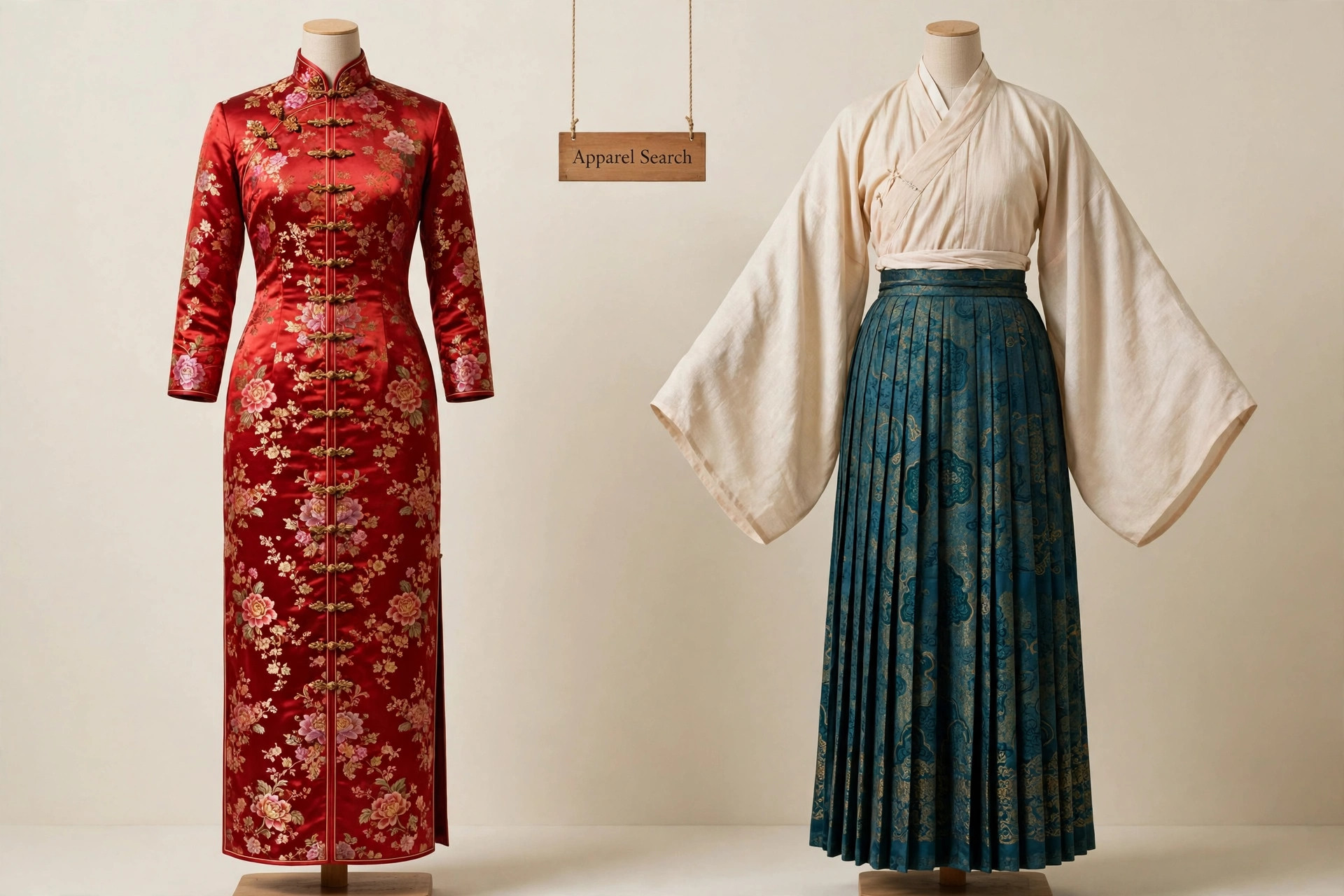
The Garments
Two Traditions: The Qipao and Hanfu
China is the one country in this series whose guide must carry two garments, because its traditional dress has two living heirs. The qipao — better known in the West by its Cantonese name, cheongsam — is the fitted, high-collared dress that the world recognises at a glance. Hanfu is something else entirely: the flowing, cross-collared robe system worn in China for millennia before the qipao existed, brought back in the twenty-first century by a grassroots revival. The two garments share silk, brocade and a country; in cut and in spirit they could hardly differ more. Apparel Search defines each name separately — see the definition of qipao and the definition of cheongsam.
Hanfu means “clothing of the Han people,” the Han Chinese majority, and it names not one dress but a whole wardrobe system that developed from antiquity through the Ming dynasty (1368–1644). Its constants are a crossed collar closing left over right — jiaoling youren — generous sleeves, and garments built from flat panels and sashes rather than buttons and darts. In 1644 the Manchu-led Qing dynasty took power and imposed Manchu dress and the queue hairstyle on Han men; Han women in many regions quietly kept their jacket-and-skirt dress, but hanfu as the clothing of public life was broken off — which is why its modern wearers speak of revival, not survival.
The qipao grew from the other side of that divide. Its ancestor is the straight, loose robe of Manchu Banner women in the Qing dynasty — the name qipao itself refers to the Banners (qi). The garment the world knows was created in 1920s Shanghai, where tailors took that loose robe and rebuilt it with Western cutting — darts, set-in sleeves, a shaped waist — for a generation of modern, educated women. By the 1930s the Shanghai qipao, floor-length, close-fitting, high-collared and slit at the sides, had become the defining image of Chinese elegance, and it has remained formal dress ever since.
Anatomy
The Parts of the Outfits
Read the two garments side by side and their parts tell their histories — the qipao’s from the tailor’s shop, hanfu’s from the loom and the sash:
- Mandarin collar — the qipao’s signature
- A short, stand-up collar that closes at the throat, inherited from Manchu dress and kept through every Shanghai reinvention. Its height varies with fashion and formality, but a qipao without it is not a qipao.
- Pankou — frog buttons
- The hand-made knotted buttons of corded silk or fabric that fasten the qipao’s collar and diagonal chest opening. Pankou are functional fastenings and jewellery at once, knotted into flowers, butterflies and auspicious shapes on fine dresses; a row of well-made frogs is the mark of a serious qipao.
- Side slits — the qipao’s movement
- A close dress in woven silk cannot be walked in without openings; the slits at one or both sides are the qipao’s engineering, rising higher in fashionable 1930s and modern dress, lower in modest and uniform versions.
- Jiaoling youren — hanfu’s cross collar
- The defining construction of hanfu: the collar panels cross over the chest, the left panel always wrapping over the right — the same “left over right for the living” rule met elsewhere in East Asian dress. The crossed collar appears on robes, jackets and dresses across every dynasty’s styles.
- Ru and qun — top and skirt
- The classic hanfu pairing for women: a ru, a short cross-collared top, with a qun, a long wrap skirt tied at the waist — an ensemble called ruqun. Tang-dynasty fashion tied the skirt high, even above the bust (qixiong ruqun); later dynasties settled it at the waist.
- Mamianqun — the horse-face skirt
- The Ming dynasty’s great skirt, and the modern revival’s favourite garment: a wrap skirt with two flat, unpleated front and back panels — the “horse faces” — and deep pleats at the sides, so the front reads as one smooth field of brocade while the wearer moves freely. It is worn today with Ming-style jackets and, increasingly, with modern tops.
- Shenyi — the deep robe
- The oldest formal silhouette in the system: a one-piece robe in which top and skirt are joined, its wrap crossing and re-crossing around the body. The shenyi carried Confucian symbolism — the unity of heaven and earth in a single garment — and it was a homemade shenyi, worn in a Zhengzhou street in 2003, that famously launched the Hanfu movement.
- Beizi and sashes — hanfu’s layers
- Over the basic top and skirt, hanfu adds open overcoats such as the Song-dynasty beizi, a long, straight-collared layer, and closes everything with tied sashes rather than buttons — the soft architecture of the whole system.
Formality
Types and Formality
The qipao grades itself by length, sleeve and cloth. A floor-length silk brocade qipao with hand-knotted frogs is wedding and banquet dress; a knee-length cotton or linen version is summer day dress; and a plain, modest qipao is standard uniform wear for hostesses and ceremonial staff across China — the same silhouette doing three different social jobs. Brides traditionally wear red, often with gold dragon-and-phoenix patterning shared with the groom’s outfit.
Hanfu grades itself by dynasty. Because the revival researches historical dress, its wardrobe is organised as a tour of Chinese history, and choosing a style is choosing a century:
| Dynasty style | Signature garments | Character |
|---|---|---|
| Han (206 BCE–220 CE) | Shenyi deep robe; quju curved-hem robe | Wrapped, flowing, ceremonial — the classical foundation |
| Tang (618–907) | Qixiong ruqun — skirt tied high above the bust; wide sleeves; sheer pibo shawl | Bold colour and confidence from China’s most cosmopolitan age |
| Song (960–1279) | Beizi overcoat over skirt; narrow sleeves | Restraint and refinement — the scholar’s aesthetic |
| Ming (1368–1644) | Aoqun jacket-and-skirt; mamianqun horse-face skirt; stand collars | Structured and dignified; the primary reference of today’s revival |
Within the revival, formality is also a matter of completeness and cloth. A full researched set — layered robes or a jacket, skirt and overcoat in woven brocade, worn with period hairdressing — is ceremonial dress, produced for festivals, rites and formal photography. A single mamian skirt or a short cross-collared jacket in cotton, worn with modern pieces, is the revival’s everyday register. The same wearer may own both, exactly as a qipao wardrobe holds a banquet dress and a plain day dress. What the two garments share is the principle: in Chinese dress, the occasion is announced by fabric, finish and completeness, never by a change of basic shape.
Cloth and Pattern
Fabric, Pattern and Meaning
Silk brocade is the prestige cloth of both garments. China’s named brocade traditions — Nanjing’s yunjin “cloud brocade,” once woven for emperors on great drawlooms, and Suzhou’s Song brocade — supply the qipao’s florals and the mamian skirt’s flat shining panels alike, and Suzhou embroidery finishes collars, fronts and skirt panels by hand. Everyday hanfu and qipao alike are also made in cotton, linen and modern fibres; the revival has produced a whole industry of woven and printed cloth at every price.
Pattern speaks the shared language of Chinese auspicious imagery. The peony stands for wealth and honour, the lotus for purity, bats — by a pun on the word for good fortune — for luck, and clouds for harmony; wedding dress pairs the dragon and the phoenix, emblem of the groom and the bride in balance. On hanfu, pattern placement follows the garment’s architecture: the mamian skirt’s flat front panel is a deliberate canvas, framed by pleats, and a Ming-style jacket carries its brocade or embroidery on the chest and sleeves where a viewer reads it first.
Living Dress
When Qipao and Hanfu Are Worn Today
The qipao never left. It is the formal dress of Chinese weddings — the bride’s red qipao, the mothers’ brocades — of banquets, diplomatic and business formality, graduations and stage performance, and the everyday uniform of ceremonial hospitality. Fitted by tailors in Shanghai and Suzhou or bought ready-made everywhere, it remains the default answer to “Chinese formal dress” at home and across the diaspora; our cheongsam guide in the clothes section covers it as modern fashion.
Hanfu’s return is the newer story. The Hanfu movement is generally dated to 2003, when Wang Letian walked through Zhengzhou in a homemade shenyi and photographs of him spread online; forums, then social media and short video, turned a hobbyist subculture into a nationwide youth movement. Today hanfu is worn at festivals — Qixi and Mid-Autumn evenings above all — at heritage sites and hanfu gatherings, for photography and graduations, and increasingly as ordinary dress: a mamian skirt with a modern blouse is now a normal sight in Chinese cities. It is a young industry of makers, rental studios and photographers as much as a dress style. Our China clothing industry directory profiles the wider apparel sector in which both the qipao trade and the hanfu business sit.
Dressing
Wearing Basics
A qipao succeeds or fails on fit: it should follow the body smoothly without straining at the frogs or pulling at the slits, and it is worn with the collar closed and the posture it encourages — upright. If a frog strains, the dress is too small; forcing pankou tears the loops. Hanfu dressing is a matter of order and ties. Cross the collar left over right, always — right over left is the historical dress of the dead. Tie the skirt first and firmly: a mamian skirt is wrapped so its flat panels sit centred front and back, its pleats falling at the sides, then secured with its ties; the top is tucked or belted over it, sashes tied flat so the lines stay clean. Wide sleeves are managed, not fought — gathered at the wrist for eating, writing and tea, and let fall the rest of the time.
Keeping
Care and Storage
Silk brocade qipao and silk hanfu share one rule: trust them to a cleaner who knows silk and embroidery, and never machine-wash either. Between wearings, air garments away from sunlight, which fades brocade dyes, and check frog buttons and their loops — pankou are the first part of a qipao to wear, and a tailor can re-knot them. Store both garments folded with padding in the folds or, for heavy brocades, rolled; hang a qipao only on a shaped, padded hanger for short periods, since its bias-stressed seams stretch under its own weight. Keep embroidery and brocade away from perfume spray, and store the mamian skirt with its pleats aligned so the flat front panel — its whole point — stays flat and uncreased.
Acquiring
Buying and Collecting
The finest qipao are still made to measure: a tailor takes a full set of measurements, and the dress is fitted to stand, sit and walk in. When buying ready-made, judge the pankou first — hand-knotted frogs of real cord against printed imitations — then the collar’s stand, then whether the slits let you sit without strain. For hanfu, the buyer’s first decision is honesty of type: researched reproductions follow a dynasty’s cut and construction, while “hanfu-style” fashion borrows the collar and sleeves freely. Both have their place, but they are not the same garment, and good sellers say which they are offering. Within the revival, Ming-style sets with a true mamian skirt are the benchmark purchase; check that the skirt’s front panel is genuinely flat and its pleats genuinely at the sides — that construction, not the brocade, is what makes it a mamianqun.
Common Questions
Common Questions
Are the qipao and the cheongsam the same garment?
Yes — they are two names for one dress. Qipao is the Mandarin name, referring to the robes of the Qing-dynasty Banner people; cheongsam is the Cantonese name, meaning “long shirt,” and is the word most used in Hong Kong and the West. A tailor in Shanghai and a tailor in Hong Kong are making the same garment.
What is hanfu?
Hanfu is the traditional clothing system of the Han Chinese, developed from antiquity to the Ming dynasty: cross-collared tops and robes closed left over right, wrap skirts, wide sleeves and sash fastenings, with styles changing by dynasty — Han deep robes, Tang high-tied skirts, Song overcoats, Ming horse-face skirts. The word means simply “Han clothing.”
Is the qipao an ancient Chinese dress?
No. Its ancestor, the loose robe of Manchu Banner women, is Qing dynasty, and the fitted qipao itself was created in 1920s Shanghai, where tailors rebuilt that robe with Western darts, set-in sleeves and a shaped waist. The qipao is a modern, twentieth-century garment — which is exactly why it still works as modern formal dress.
What are frog buttons?
Frogs — pankou in Chinese — are the qipao’s hand-made fastenings: a knotted ball of corded fabric passing through a loop, used at the collar and down the diagonal chest opening. On fine dresses they are knotted by hand into flowers, butterflies and other auspicious shapes, and their quality is one of the quickest ways to judge a qipao.
Why do hanfu collars cross left over right?
The cross collar of hanfu, jiaoling youren, wraps the left panel over the right — a convention thousands of years old and shared across East Asian dress. The reverse wrap, right over left, was historically reserved for the clothing of the dead, so revival wearers treat the direction of the cross as the first correctness check of any outfit.
Keep Exploring
More to Explore
In This Series
Traditional Dress by Country
The series hub — every country guide, from the kimono of Japan to the kilt of Scotland, as each is published.
Visit the hub ↑China Clothing Industry Directory
China’s clothing industry directory — the manufacturers and exporters of the world’s largest apparel sector.
Explore ↑Go Deeper on the Qipao and Hanfu
Search Apparel Search