Traditional Dress by Country · Thailand
Thailand — The Chut Thai
Chut thai — “Thai outfit” — is the rare case of a traditional dress that was also, quite deliberately, designed. In the 1960s Queen Sirikit worked with historians and designers to formalise eight styles of women’s dress, each named for a royal residence and each assigned its level of formality, from the simple Ruean Ton to the sabai-draped splendour of Siwalai. This guide explains the eight styles, the older garments beneath them — sabai, sinh, chong kraben — and the village-woven silks that make Thai dress a living textile art.
The Garment
What a Chut Thai Is
Chut thai is a broad term — it can mean any traditional Thai clothing — but around the world it has come to name one specific, remarkable thing: the set of eight formal outfits for women known as chut thai phraratchaniyom, “Thai dress of royal endorsement.” Their origin is unusually well documented for a national costume. Preparing for state visits to the United States and Europe in 1960, the young Queen Sirikit found that Thailand had no codified national dress for women comparable to the kimono or the sari. She commissioned research into historical court dress — the wrapped skirts, shoulder cloths and brocades painted and photographed at the Siamese court — and worked with designers to shape that heritage into a wardrobe of distinct, wearable styles.
The eight styles were settled during the 1960s, each named after a royal residence or throne hall, and together they cover the whole range of a formal life: casual receptions, daytime ceremonies, evening functions, royal occasions and weddings. Beneath the designed wardrobe, though, lie much older garments. Thai dress grew from the wrapped lower cloth and the shoulder cloth — clothing suited to a hot riverine kingdom and shaped by centuries of contact with India, the Khmer world and China. The genius of the chut thai system is that it did not replace those garments; it tailored them, gave them collars, sleeves and zips, and assigned each combination its place.
For men, a parallel formal dress exists: the suea phraratchathan, the “royally bestowed shirt,” a tailored jacket with a standing collar worn with trousers or with the wrapped chong kraben. Together with the women’s eight styles, it gives Thailand something few countries possess — a traditional dress system that is at once genuinely historical and deliberately, recently composed.
Anatomy
The Parts of the Outfit
Every chut thai is assembled from a small set of named elements. Learn these, and the eight styles become easy to read:
- Sinh (pha sinh) — the wrapped skirt
- A long tube skirt of silk or cotton, wrapped and folded at the waist to fall to the ankle. Regional sinh are distinguished by their weave and borders: northern sinh carry a richly patterned woven hem band, the teen jok, worked in supplementary weft; Isan sinh are often mudmee ikat. In the formal styles the sinh is tailored with a front pleat or front fold and fastened neatly rather than simply tucked.
- Sabai (pha biang) — the shoulder cloth
- A long cloth draped diagonally across the chest, over one shoulder, its end trailing behind the back. Historically worn on its own over the chest, in the formal styles it is pleated and worn over a blouse or tube top. It is the single most recognisable element of Thai dress.
- The blouse
- The designed styles give the upper body a tailored blouse: collarless with three-quarter sleeves in Ruean Ton; a short standing collar and long sleeves in Chitralada; sleeveless in Dusit. Buttons are traditionally fabric-covered, metal or pearl.
- Pha nung — the wrap cloth
- The simple rectangular wrap cloth, worn as a skirt or sarong by both sexes in everyday and rural life — the untailored ancestor of the sinh, still seen at home, at markets and at the water’s edge.
- Chong kraben — the wrapped trousers
- A long cloth passed between the legs and tucked at the waist to form elegant knee-length breeches, adopted centuries ago from Khmer dress. Worn historically by both sexes at court, today by men with the royal-bestowed shirt, and by performers and grooms.
- The belt and jewellery
- Formal styles are finished with a Thai-style belt — woven metal or gold-tone with an ornate buckle — and jewellery matched to the occasion, from a simple brooch on a daytime Chitralada to full antique sets with the grandest sabai styles.
The Eight Styles
Queen Sirikit’s Eight Styles, Least to Most Formal
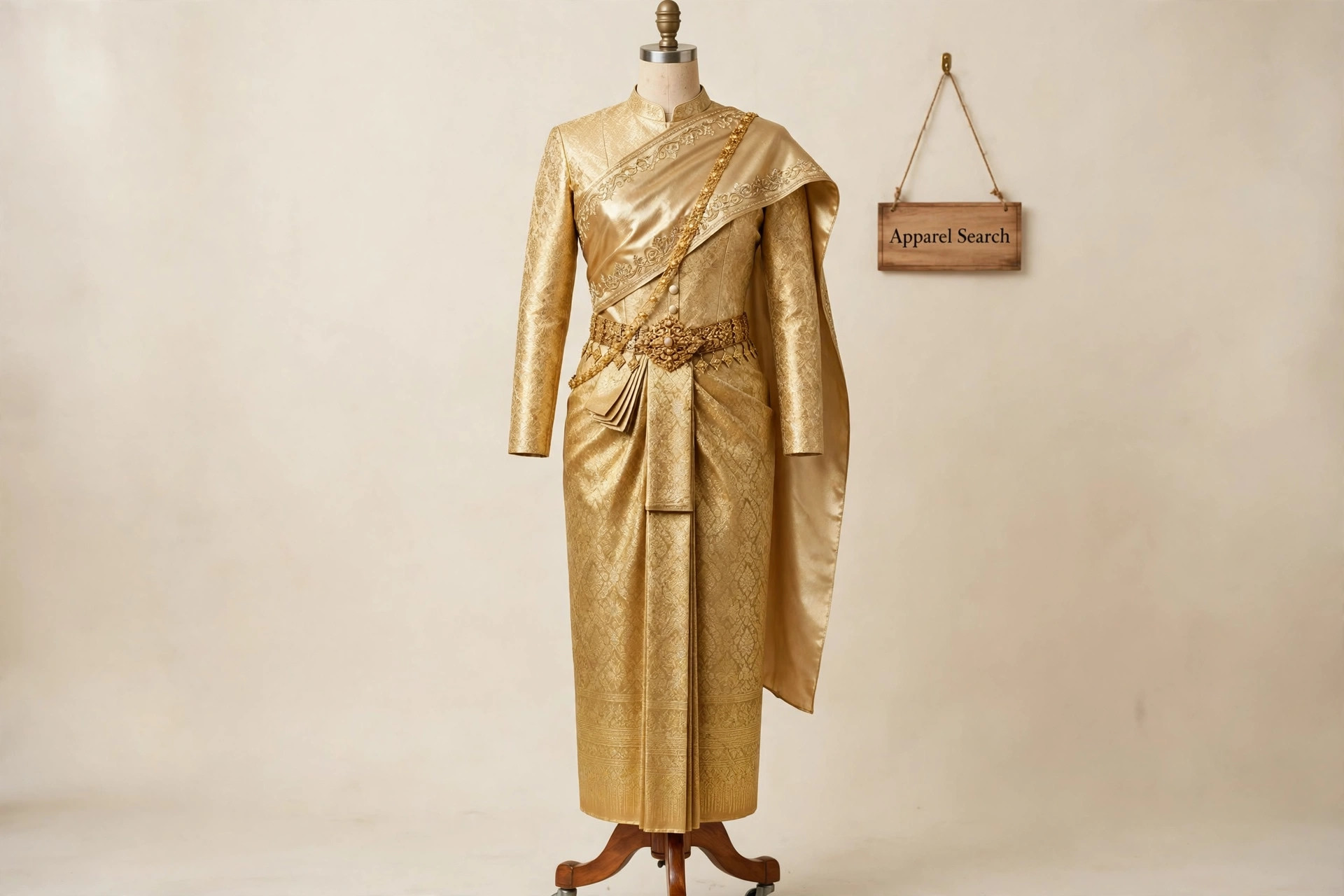
The eight styles of chut thai phraratchaniyom, in rising order of formality. Our hero photograph shows the Siwalai arrangement: long-sleeved blouse, pleated sabai and gold brocade sinh with an ornate belt.
| Style | What defines it | Worn for |
|---|---|---|
| Thai Ruean Ton | Collarless blouse, three-quarter sleeves, five buttons; striped ankle-length sinh | The least formal — casual gatherings, temple visits, relaxed occasions |
| Thai Chitralada | Short standing collar, long sleeves, plain or brocade silk sinh | Daytime ceremonies and official functions; black versions for funerals and mourning |
| Thai Amarin | Like Chitralada in richer silk brocade, worn without a belt, with fine jewellery | Formal evenings, receptions and royal ceremonies |
| Thai Boromphiman | Long-sleeved blouse with standing collar sewn to the sinh as one piece; front-pleated skirt and ornamental belt | Formal evening dress — gala dinners, official receptions; also worn by royal brides |
| Thai Dusit | Sleeveless blouse with a wide round neckline, embroidered with pearls, beads or sequins; gold brocade sinh | The Thai equivalent of a Western evening gown — the grandest formal evenings |
| Thai Chakkri | Pleated sabai over one shoulder over a tube top; gold or silver brocade sinh with front pleat and ornate belt | Evening ceremonies, royal occasions, engagements and weddings — the style most often pictured |
| Thai Siwalai | Like Chakkri, but the sabai is worn over a long-sleeved blouse with a short standing collar | The most formal royal ceremonies, day or evening |
| Thai Chakkraphat | Two layered sabai over the Chakkri arrangement, with full jewellery | The most ornate of all — formal banquets and occasions of the highest ceremony |
Two points help the system make sense. First, the ladder is built from the sabai: no sabai at the informal end, a pleated sabai over a bare shoulder in the middle, a sabai over a tailored blouse above that, and two sabai at the summit. Second, fabric rises with formality — plain silk gives way to brocade, and brocade to gold-thread brocade — so a knowledgeable eye can place an outfit before seeing a single jewel.
A Dress Designed to Carry a Country
The chut thai was created so that a Thai woman on an official occasion anywhere in the world would be dressed as unmistakably as a Japanese woman in kimono. Six decades on, it has done that work at state banquets, royal weddings and temple festivals alike — and it sent its makers back to Thailand’s village looms, where the silk for it is still woven by hand. Queen Sirikit’s SUPPORT Foundation, established in 1976, turned that demand into rural income, training weavers and bringing their cloth to market.
Cloth and Pattern
Thai Silk, Mudmee and Meaning
The chut thai is, above all, a showcase for Thai silk. Thailand’s traditional sericulture uses native silkworms whose cocoons give a naturally golden thread, and its village weaving is organised by region and technique. The most famous is mudmee (also written mat mi), the weft ikat of Isan in the northeast: bundles of weft thread are tied to resist the dye, dipped, retied and dipped again, so the pattern exists in the yarn before the loom is dressed. Woven, the motifs — nagas, hooks, stars, trees of life — land with the soft, feathered edges that are ikat’s signature. A fine mudmee sinh can represent weeks of tying, dyeing and weaving by one woman, and patterns are family knowledge, passed from mother to daughter.
Other techniques complete the wardrobe: jok, discontinuous supplementary weft picked in by fingertip, builds the dense patterned hem bands of northern sinh; khit runs a continuous supplementary weft across the cloth in diamonds and hooks; and the Phu Tai weavers of Kalasin produce prae wa, a shoulder cloth of packed supplementary-weft pattern on red silk, called the queen of Thai silks. Brocades woven with gold and silver thread supply the grand formal sinh. After the Second World War the American entrepreneur Jim Thompson famously built Thai silk into an international luxury trade; in parallel, royal patronage — above all the SUPPORT Foundation — kept the village end of the craft alive, and the two together made “Thai silk” a phrase the world knows.
Living Dress
When Chut Thai Is Worn Today
Chut thai is working dress, not costume. Weddings are its great showcase: brides commonly wear Chakkri or Siwalai in gold brocade for the morning ceremonies, and guests arrive in silk sinh of every colour. Temple festivals, merit-making and religious holidays call for Ruean Ton and Chitralada; official and royal ceremonies set the formal styles in motion; Loy Krathong and Songkran bring traditional dress onto the street; and schools, universities and government offices hold Thai-dress days that put a generation into sinh and sabai. Thai hospitality has adopted the simpler styles as elegant uniforms, and rental shops near major temples dress visitors for the day.
The garment also anchors a serious textile economy — silk villages, weaving cooperatives, Bangkok couturiers and the export garment trade profiled on our Thailand clothing industry page. For the chut thai as dress to wear in modern life, see our women’s chut thai guide.
Wearing
Wearing Basics
The tailored chut thai is easier to wear than its ancestors: the sinh is usually sewn as a wrap skirt with fastenings, folded so its front pleat or fold sits centred, and the waist is finished with the belt, which should sit level and firm. The sabai is pleated along its length, draped from the right hip across the chest to the left shoulder — leaving that shoulder covered and the right arm free in the Chakkri arrangement — and secured discreetly at the shoulder and waist so the diagonal line stays clean. Sleeved styles are worn with the sabai over the blouse, never under it. Hair is traditionally dressed up or neatly back, jewellery is matched to the style’s rank — a Dusit blouse already carries its own sewn-on sparkle and needs little more — and footwear is an elegant closed shoe or sandal with a heel. When in doubt, rent from or be dressed by a specialist shop: Thai dressers adjust the sabai’s pleats and the sinh’s fold in minutes, and the difference shows in every photograph.
Keeping
Care and Storage
Thai silk asks for the same respect as any fine silk, with one addition: mudmee and brocade are woven structures, and rough handling breaks their threads before it fades their colour. Dry-clean formal outfits, especially gold brocade and beaded Dusit blouses; simpler silk sinh can be hand-washed cool with mild detergent, never wrung, and dried in shade. Iron on low heat from the reverse, or steam, keeping the iron off metallic thread. Store outfits folded with acid-free tissue, the sabai rolled rather than sharply creased, away from light and from the humidity that invites mildew in the rainy season; air pieces on dry days. Antique sinh and inherited mudmee should be handled by a textile conservator for cleaning — the dyes of older pieces are often less fast than modern ones, and a family cloth is not replaceable.
Acquiring
Buying and Collecting
A chut thai can be bought at every level: ready-made outfits in department stores and market shops, made-to-measure silk from Bangkok dressmakers, and village-woven cloth bought by the piece and tailored into a sinh. When buying silk, learn the hand of the real thing — Thai silk has a slight slub and rustle, holds a knot of creases, and its mudmee patterns show on both faces of the cloth, since the pattern is in the yarn, not printed on the surface. A printed imitation shows the pattern crisply on one side and faintly on the other. Collectors prize older mudmee from named Isan districts, northern sinh with deep teen jok borders, prae wa shoulder cloths and antique court brocades; judge pieces by the fineness and evenness of the weaving, the complexity of the tying, and honest condition. Buying through weaving cooperatives and foundation shops puts the price in the weavers’ hands — which is, in the end, the purpose the Queen built into the system.
Common Questions
Common Questions
What is a chut thai?
Chut thai means “Thai outfit” and is the general name for Thailand’s traditional dress. In its best-known sense it refers to the eight formal styles for women — chut thai phraratchaniyom, the “royally endorsed Thai dresses” — formalised in the 1960s under Queen Sirikit. Each style combines a blouse or sabai shoulder cloth with a long wrapped skirt, the sinh, usually in Thai silk.
What are the eight chut thai styles?
From least to most formal they run: Ruean Ton, Chitralada, Amarin, Boromphiman, Dusit, Chakkri, Siwalai and Chakkraphat. Each is named after a royal villa or throne hall. They differ in collar, sleeves, whether a sabai is worn, and fabric — the simpler styles use plain silk, the grandest use gold brocade, layered sabai and full jewellery.
What is a sabai?
The sabai (also called pha biang) is a long shoulder cloth draped diagonally across the chest and over one shoulder, its end falling behind the back. It is one of the oldest elements of Thai dress. In the formal styles it appears pleated over a tube top in Chakkri, layered double in Chakkraphat, and over a long-sleeved blouse in Siwalai.
What is mudmee silk?
Mudmee (mat mi) is the weft-ikat silk of Isan, Thailand’s northeast: the crosswise threads are tied in bundles and dyed before weaving, so the pattern is built into the yarn and emerges with soft, feathered edges. Queen Sirikit championed village mudmee weaving, and her SUPPORT Foundation, founded in 1976, still promotes it as a source of rural income.
When is chut thai worn today?
Chut thai is worn at weddings, temple festivals and merit-making, official and royal ceremonies, cultural performances and national celebrations, and as elegant uniform dress in Thai hospitality. Many Thais keep one formal outfit for life’s ceremonies, and visitors can rent chut thai at temples and historic sites for photographs.
Keep Exploring
More to Explore
In This Series
Traditional Dress by Country
The series hub — every country guide, from the kimono of Japan to the kilt of Scotland, as each is published.
Visit the hub ↑Thailand Clothing Industry
Thailand’s apparel and textile industry directory — from Bangkok garment factories to the village silk looms of Isan.
Explore ↑Go Deeper on the Chut Thai
Search Apparel Search