Traditional Dress by Country · Indonesia
Indonesia — Kebaya and Batik
Indonesia’s national dress is a partnership between a blouse and a cloth. The kebaya — fitted, front-opening, often of lace fine enough to read through — is worn over a long wrapped skirt of batik, the wax-resist cloth whose patterns carry centuries of Javanese symbolism. Either half alone is famous; together they are one of the world’s great outfits. This guide explains the kebaya’s styles, from Kartini’s to the Peranakan encim, and batik itself: how it is drawn in hot wax, what parang and kawung mean, and why Indonesia wears batik to the office on Fridays.
The Garment
What the Kebaya Is
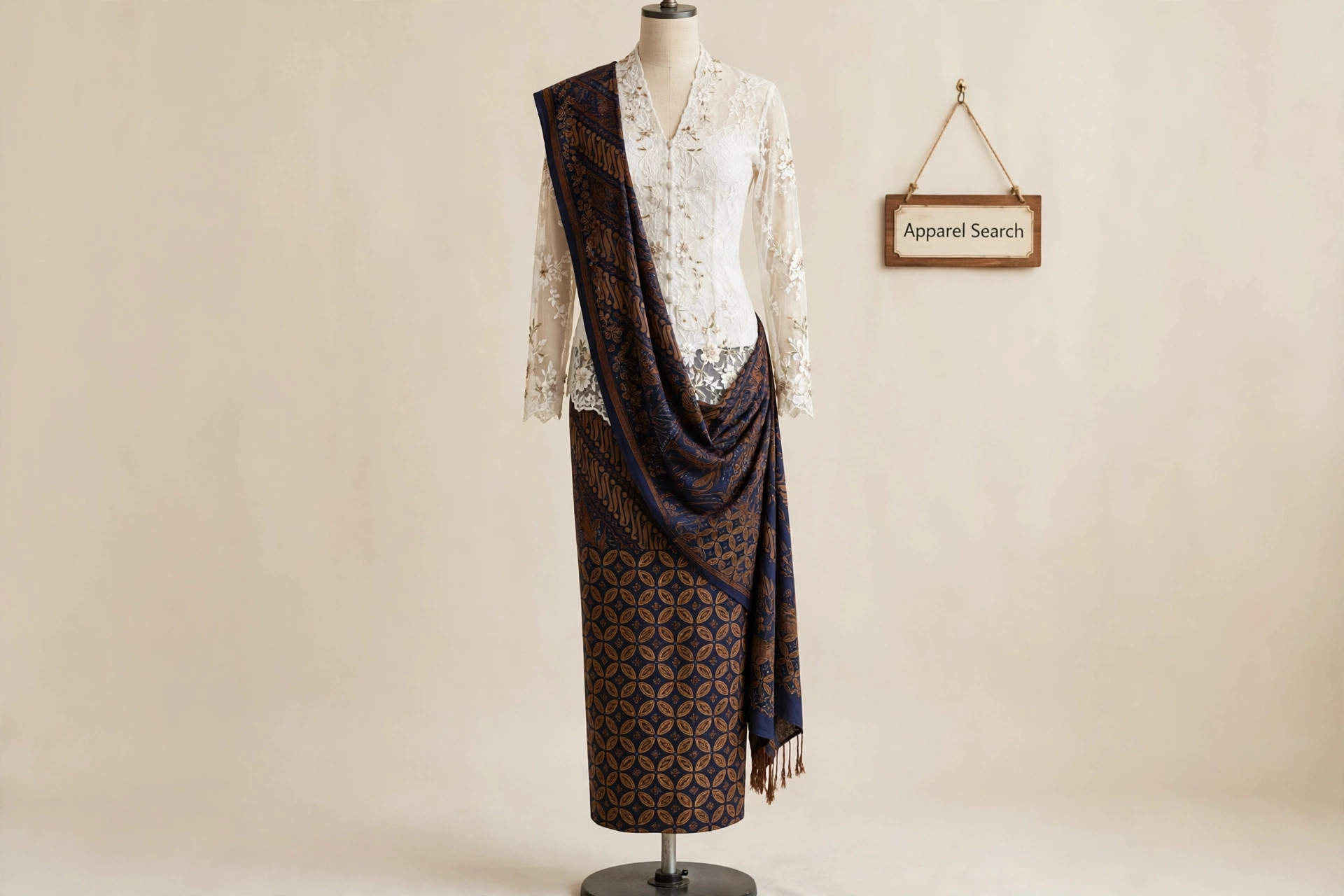
The kebaya is a blouse with a silhouette: fitted through the waist, opening at the front, its edges often finished with lace or embroidery, and its fabric — lace, brocade, embroidered voile — frequently sheer enough that the camisole beneath becomes part of the design. It is worn with a wrapped lower garment: the kain panjang, a “long cloth” of about two and a half metres, pleated and tucked at the waist, or a sewn sarong. A sash, the selendang, may cross the shoulder or, in Bali, bind the waist. The outfit’s ancestry is layered — the front-opening blouse is often linked to garments that arrived with Portuguese and earlier Arab and Chinese trade, naturalised over centuries in the courts and ports of Java until it became thoroughly Indonesian.
By the nineteenth century the kebaya was the dress of Javanese court women and of the Peranakan Chinese communities of the north coast, each group cutting and trimming it to its own taste. Its most famous wearer gave one style its name: Raden Ajeng Kartini (1879–1904), the Javanese advocate of women’s education whose letters made her a national heroine, is pictured in the kebaya and batik of the Central Javanese aristocracy — and “kebaya Kartini” still means that poised, modest classic. In the twentieth century the kebaya became a symbol of Indonesian womanhood itself, worn at the proclamation-era ceremonies and by generations of officials, teachers and brides.
The garment’s reach is regional, and in December 2024 the kebaya was inscribed on UNESCO’s Representative List of the Intangible Cultural Heritage of Humanity — on a joint nomination by five countries: Indonesia, Malaysia, Singapore, Brunei Darussalam and Thailand. Few garments can claim to be at once a village tradition, a national emblem and a shared Southeast Asian heritage. The kebaya is all three.
Anatomy
The Parts of the Outfit
The kebaya outfit is a small system of pieces, each doing quiet work:
- The kebaya itself
- A fitted blouse opening at the front, fastened with buttons, pins or a row of brooches. Classic fabrics are lace, brocade and fine embroidered cotton; the front edges, collar and cuffs carry the decoration — lace appliqué, cutwork embroidery (kerancang) or, on encim kebaya, vivid stitched flowers. The cut follows the body but never strains: the kebaya’s elegance is tailored, not tight.
- Kemben / camisole — the inner layer
- A bandeau or camisole worn beneath sheer kebaya, historically the kemben chest wrap. In Javanese court dress a wrapped stagen — a long waist sash wound firmly around the midriff — also shapes the torso under the kain and keeps the wrapped skirt secure.
- Kain panjang — the long cloth
- An unsewn length of batik, wrapped around the hips and folded into a panel of pleats (wiron) at the front. The pleats are the mark of a well-dressed Javanese outfit: even, narrow and falling straight. A sewn sarong — the same cloth stitched into a tube — is the practical alternative, dominant in Peranakan dress.
- Selendang — the sash
- A long shoulder sash of batik or songket, draped over one shoulder in Javanese and Peranakan dress, historically used also to carry a baby or goods. In Bali the sash is worn at the waist over the kebaya, tied to one side, and is essential to temple dress.
- Kerongsang and brooches
- Peranakan kebaya are fastened with kerongsang — a chain or row of linked brooches, often gold and set with stones — where a Javanese kebaya may use a single brooch at the breast. Heirloom kerongsang are jewellery in their own right.
- Sanggul and footwear
- The hair is traditionally dressed in a bun (sanggul), sometimes over a form, with jasmine or a hair ornament. Peranakan dress finishes with beaded slippers (kasut manek), embroidered with glass beads in floral designs; Javanese dress with neat heeled sandals or court slippers.
Styles
Kebaya Styles: Kartini, Encim, Kutubaru and Bali
Kebaya Kartini — the Central Javanese classic: a longer, modest cut in white or gentle colours, lace kept restrained, worn with the sober indigo-and-brown batiks of the courts. It is the kebaya of formal photographs, Kartini Day ceremonies each 21 April, and women in public life. Kebaya kutubaru adds a rectangular panel — the bef — joining the two front edges across the chest, a Central Javanese style that gives a modest, structured front and a favourite ground for lace. Kebaya encim is the Peranakan style of Jakarta and the north-coast cities: lighter, brighter, its edges alive with embroidered flowers, butterflies and lace, worn with vivid batik sarongs from Pekalongan and Cirebon. Balinese kebaya is cut close, often in lace, worn with a wrapped kamen skirt and the waist sash that temple etiquette requires; in white it is the dress of prayer. And the modern kebaya — sequinned, tailored, sometimes fused with a gown skirt — is the standard dress of Indonesian weddings and graduations, endlessly redesigned while keeping the front-opening, lace-edged silhouette that makes it a kebaya.
Cloth and Pattern
Batik: Wax, Fire and Meaning
Batik is a technique before it is a pattern — our definition of batik gives the short version. The full process: cloth is prepared, the design is drawn in hot liquid wax (malam) with the canting, a pen with a tiny copper spout, or stamped with a cap, a copper block that prints the motif in wax. The cloth is dyed; where wax covers, the dye cannot reach. The wax is boiled out, and the whole cycle repeats for every colour. Hand-drawn batik tulis — the finest grade — shows the pattern equally on both faces and carries the tiny crackle (retak) of wax lines through the dye. Stamped batik cap is faster and more regular; printed imitations, with the pattern on one face only, are not batik at all, however pretty the motif.
The great division is between the court batiks of Central Java — Yogyakarta and Surakarta, in indigo, cream and soga brown, geometric and restrained — and the coastal batiks of the north shore, where Pekalongan and Cirebon absorbed Chinese and European influences into bright florals and, from Cirebon, the cloud bands of mega mendung. Motifs are a language, and some were once law: certain patterns were larangan, forbidden to commoners in the courts.
| Motif | Meaning |
|---|---|
| Parang | Diagonal knife-like forms: power, authority and an unbroken spirit — once restricted to royalty |
| Kawung | Intersecting ellipses, among the oldest motifs: purity, longevity and just, balanced rule |
| Mega mendung | Stylised cloud bands from Cirebon: patience and calm, like clouds before rain |
| Truntum | Small star-flowers on a dark ground, associated with the Surakarta court: steadfast, guiding love — a wedding cloth for parents |
| Sido mukti | A wedding pattern whose name wishes the couple a life of happiness and prosperity |
UNESCO’s inscription of Indonesian batik on 2 October 2009 — now National Batik Day — recognised not a product but the whole chain of knowledge: the wax, the canting, the natural dyes, the motif meanings and the wearers who keep them in use.
Living Dress
When Kebaya and Batik Are Worn Today
Few traditional garments work as hard as these. The kebaya is the default formal dress of Indonesian women: weddings dress brides in modern kebaya gowns and mothers in classic lace; graduations have adopted the kebaya so completely that it is effectively the national graduation dress; Kartini Day each April fills schools and offices with kebaya in honour of Kartini herself; and state ceremonies, Independence Day events and official receptions all call for it. In Bali, kebaya in white lace is weekly temple dress, as ordinary and as necessary as clothing gets.
Batik, meanwhile, went to the office. Since 2009 the custom of Batik Friday has spread through government and private workplaces: men in batik shirts — accepted everywhere as formal wear in place of jacket and tie — and women in batik blouses and dresses. Airlines dress crews in kebaya and batik; presidents address the nation in batik shirts. The traditional and the everyday are the same wardrobe, which is exactly the outcome Indonesia’s batik makers hoped UNESCO recognition would bring. Our Indonesia clothing industry page profiles the wider sector, and our women’s kebaya guide covers the blouse as modern fashion.
Wearing
Wearing Basics
The kain is the skill. A kain panjang is wrapped firmly at the natural waist — the stagen beneath does the holding in formal Javanese dress — and the front is folded into its pleats, which must hang centred and straight; the cloth’s lower edge should clear the ankle evenly all round. The kebaya goes on over its camisole and is fastened so the front edges meet without gaping; brooches sit at the breast in a vertical line. The selendang is draped over the left shoulder in Javanese style, its ends falling front and back, or tied at the Balinese waist. Hair in a smooth sanggul, jewellery restrained, and the whole checked in a long mirror: the outfit’s formality lives in its neatness. Beginners are forgiven everything except a twisted pleat panel — take the kain off and wrap it again rather than adjusting it into crookedness.
Keeping
Care and Storage
Fine batik and lace kebaya are washed by hand, in cool water, traditionally with the lerak soapberry or a mild detergent made for batik; ordinary detergents and bleach strip natural dyes, and the deep indigos and soga browns of court batik are the first to suffer. Never wring; press water out, dry in shade on a line or flat, and iron cool from the reverse. Lace kebaya are best washed gently by hand or dry-cleaned if beaded or sequinned, and stored folded with tissue so lace edges do not catch. Keep batik away from prolonged sunlight, which fades it unevenly, and from damp storage, which mildews cotton in the tropics. A good batik improves with careful washing — the cloth softens while the wax-crackle pattern settles — and heirloom pieces should be aired, refolded on different lines each year, and kept from perfume and mothballs directly against the cloth.
Acquiring
Buying and Collecting
Indonesia is a wonderful place to buy both garments, and the first skill is telling grades apart. For batik, turn the cloth over: true batik tulis and cap show the pattern clearly on both faces; a print shows it on one. Smell for wax, look for the fine crackle, and ask the motif’s name and origin — sellers in Yogyakarta, Surakarta, Pekalongan and Cirebon expect the questions. Hand-drawn tulis costs what weeks of work costs; cap is the honest middle grade; both outclass prints in cloth and colour. For kebaya, judge the lace and the finishing: edges fully worked, fastenings secure, the cut shaped rather than merely small. Made-to-measure kebaya from a good tailor, fitted over your own camisole and kain, is the traditional purchase and still remarkably accessible. Collectors seek old court batiks with larangan motifs, fine Peranakan sarongs signed by their workshops, and heirloom kerongsang — and value honest condition and provenance over brightness, since an old cloth that has been worn and loved is the real thing.
Common Questions
Common Questions
What is a kebaya?
A kebaya is a fitted, front-opening blouse, traditionally of lace, brocade or fine cotton voile, worn over an inner camisole and paired with a long wrapped skirt — usually a batik kain panjang or sarong — often with a selendang sash. It is the traditional dress of Javanese, Sundanese and Balinese women and is worn across Indonesia and maritime Southeast Asia for ceremonies, weddings and formal occasions.
What is batik?
Batik is cloth patterned by wax-resist dyeing: hot wax is drawn onto fabric with a spouted pen called a canting, or stamped with a copper block called a cap, the cloth is dyed, the wax is removed, and the process repeats for each colour. UNESCO inscribed Indonesian batik on its Representative List of the Intangible Cultural Heritage of Humanity on 2 October 2009, a date now celebrated as National Batik Day.
What is the difference between kebaya Kartini and kebaya encim?
Kebaya Kartini is the classic Central Javanese style associated with the national heroine Raden Ajeng Kartini: modest, longer in cut, in white or soft colours, with restrained lace. Kebaya encim is the Peranakan Chinese style of the coastal cities: brighter in colour, with vivid floral embroidery and lace edging, worn with colourful batik sarongs and beaded slippers.
What do parang and kawung mean in batik?
Parang is a pattern of bold diagonal, knife-like forms; it speaks of power and unbroken spirit and was once restricted to royalty in the courts of Yogyakarta and Surakarta. Kawung — intersecting circles or ellipses, among the oldest known batik motifs — suggests the aren palm flower or fruit and carries meanings of purity, longevity and just rule.
Why do Indonesians wear batik on Fridays?
After UNESCO recognised Indonesian batik in 2009, the government encouraged wearing batik every Friday in government offices and private companies, and many workplaces and schools adopted the custom. Batik Friday keeps the cloth in daily life — as shirts for men and blouses and dresses for women — and supports the batik industry.
Keep Exploring
More to Explore
In This Series
Traditional Dress by Country
The series hub — every country guide, from the kimono of Japan to the kilt of Scotland, as each is published.
Visit the hub ↑Indonesia Clothing Industry
Indonesia’s apparel and textile industry directory — the modern industry of one of the world’s great textile nations.
Explore ↑Go Deeper on the Kebaya and Batik
Search Apparel Search