Traditional Dress by Country · Vietnam
Vietnam — The Ao Dai
Few garments are as instantly recognisable as the ao dai: a long, close-fitting tunic split from the waist into two floating panels, worn over loose silk trousers. It is at once modest and graceful, covering the body from neck to ankle while moving like water when the wearer walks. This guide traces the ao dai from the courts of the Nguyen lords to the tailors of 1950s Saigon, explains its parts and fabrics, and shows where it lives today — in schoolyards, at Tet celebrations and at weddings.
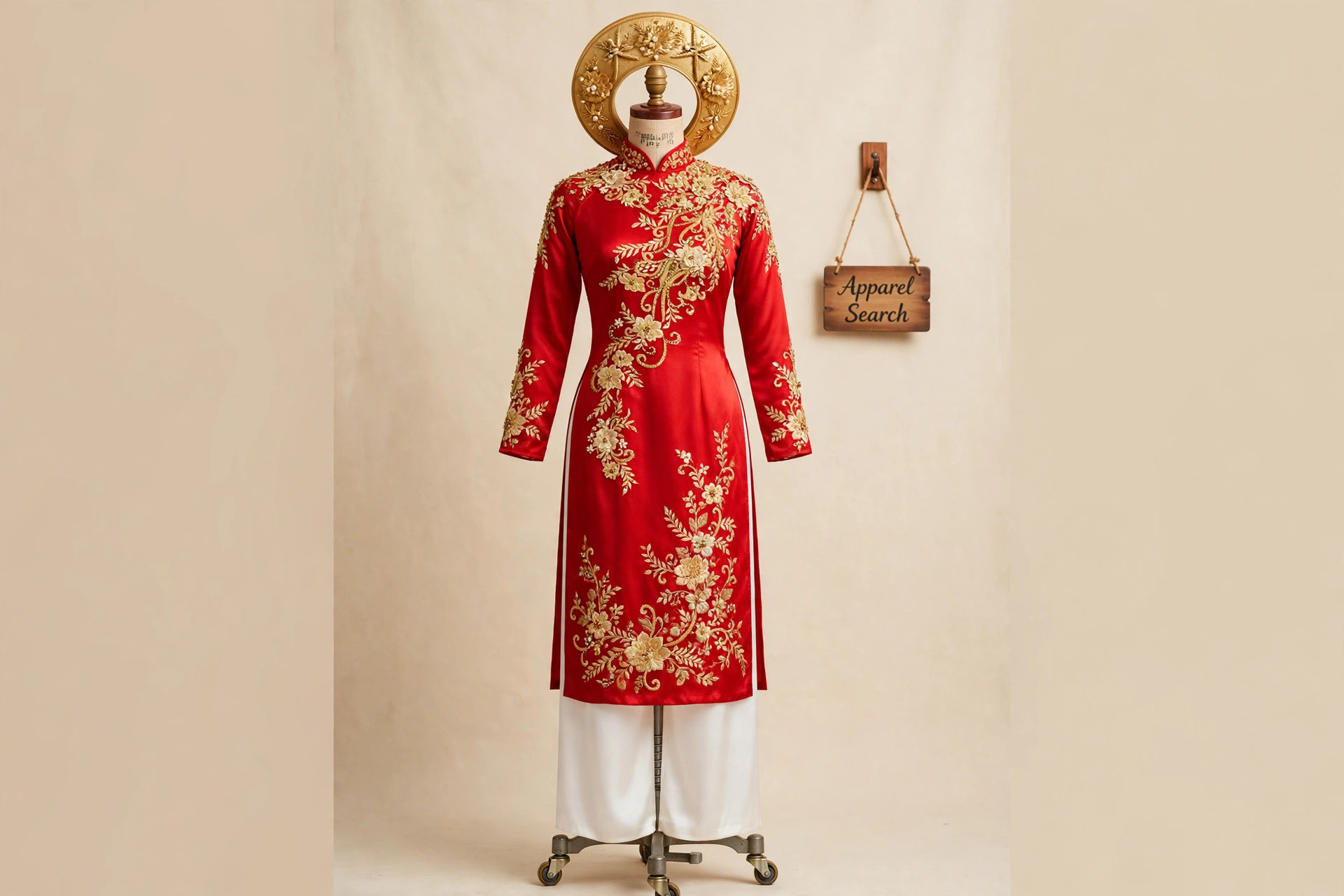
The Garment
What an Ao Dai Is
The name áo dài means “long shirt,” and the garment is exactly that, refined over centuries: a tunic that reaches the ankles, close through the shoulders, chest and waist, then opening at the waist into two long panels, front and back, that fall over a pair of loose trousers. Unlike a dress, nothing about it is one piece — tunic and trousers are made and worn as a pair, and the trousers are not an underlayer but half the design. The effect is a study in contrast: tailored stillness above the waist, movement below it, as the panels lift, separate and settle with every step.
The ao dai’s roots lie in the divided Vietnam of the 1700s. In 1744 the Nguyen lord Nguyễn Phúc Khoát, ruling the south from Huế, decreed that his courtiers wear trousers beneath a long front-buttoning gown — a deliberate break with the cross-collared robes and skirts of the rival Trịnh court in the north. Through the following century that court dress evolved into the five-panelled áo ngũ thân worn by aristocrats, while northern working women wore the four-panelled áo tứ thân over a skirt. When the Nguyen dynasty unified the country, court rules pressed the trousered southern style on the whole nation, and the ao dai’s ancestor became Vietnamese dress.
The modern silhouette is a twentieth-century creation. In the 1930s the Hanoi artist Nguyễn Cát Tường — known as Le Mur — reshaped the loose five-panel gown along Paris lines, fitting it to the body with darts and longer, flowing panels. Then, in the 1950s, Saigon tailors completed the transformation: the celebrated shops of Trần Kim and Dũng introduced the raglan sleeve, which let the tunic sit smoothly over the shoulder, and cut the body close. The result — the ao dai the world knows — is a Vietnamese garment made with French-influenced tailoring, and proudly claimed as a national symbol precisely because it absorbed outside ideas and made them its own.
Anatomy
The Parts of the Outfit
An ao dai outfit has few pieces, but each is cut with precision, and the whole stands or falls on the fit of the tunic. From the top down:
- The collar
- Traditionally a short standing collar in the Mandarin style, fastening at the throat. In the 1950s Trần Lệ Xuân — Madame Nhu — scandalised conservatives with a collarless, open boat neckline, and modern ao dai offer every variation between the two: standing, round, boat and jewel necklines.
- The bodice and sleeves
- The upper tunic is tailored close, usually with raglan sleeves that run in a diagonal seam from neck to underarm — the 1950s Saigon innovation that gives the modern garment its smooth shoulder line. Sleeves are long and close-fitting; closures are discreet snaps, small buttons or a concealed zip.
- The panels (thân)
- From the waist, the tunic divides into two panels, front and back, falling to the ankle or below. The split begins at the waist — higher splits read as more modern, lower splits as more traditional. The panels are the garment’s signature: they are what moves.
- The trousers (quần)
- Loose, full-length trousers in silk or satin, traditionally white beneath a coloured tunic, though matching and contrasting trousers are both worn today. They are cut generously and gathered or fitted at the waist so the tunic’s panels fall cleanly over them.
- Khăn đóng — the headdress
- A stiff, circular turban-like headdress, worn with formal ao dai at weddings and ceremonies — by brides and grooms, and by older men in the brocade áo gấm. Gold khăn đóng with red ao dai is the classic wedding pairing shown in our photograph.
- Nón lá — the conical hat
- The palm-leaf conical hat is the ao dai’s everyday companion, especially associated with Huế, where schoolgirls in white ao dai and nón lá remain an emblem of the city. Poem hats (nón bài thơ) from Huế carry verses that appear when the hat is held to the light.
Styles
Types and Occasions
There is no rigid formality ladder for the ao dai as there is for the kimono, but fabric, colour and tailoring speak clearly. Everyday ao dai in printed cotton or easy-care synthetics serve as uniforms — for teachers, office staff, airline and hotel teams, and officials — chosen for a neat, unmistakably Vietnamese professionalism. The white school ao dai is a type of its own: plain, unpatterned and worn with white trousers, it is less a uniform than a rite of passage, and many women keep theirs long after graduation.
Festive ao dai turn to silk, brocade and embroidery. For Tet, the Lunar New Year, bright colours and floral or symbolic patterns wish the wearer luck; reds, yellows and fresh spring greens dominate. Wedding ao dai are the most elaborate of all: the bride in red or gold silk, often richly embroidered and worn with a khăn đóng, the groom in a brocade áo gấm, and the two families colour-coordinated around them. Older women and mothers of the couple favour deep jewel tones and velvet in the cooler months.
Men’s ao dai deserve emphasis, because the garment is not only women’s dress. The male version is cut looser and straighter, in stiffer fabrics — brocade above all — and worn for Tet visits, weddings, ancestor ceremonies and official portraits. A man in áo gấm and khăn đóng is dressed at the highest level of Vietnamese formality, the counterpart of the bride’s red silk.
Designers in Vietnam and the diaspora also produce cách tân — “renovated” ao dai: shorter panels, cropped or flared trousers, prints, and dresses that quote the silhouette. They are fashion rather than tradition, and the debate they provoke each Tet — charming modernisation or dilution of a classic — is itself a sign of how much the garment still matters.
Cloth and Colour
Fabric, Pattern and Meaning
Silk is the classic ao dai fabric — light, fluid and cool in a tropical climate — and Vietnam has its own silk traditions, including the weaving villages around Hanoi and the lotus-silk experiments of recent years, in which fibre drawn from lotus stems is woven into rare, costly cloth. Brocade (gấm) serves formal and men’s garments; chiffon and georgette give modern panels their float; velvet appears in the north in winter; and printed synthetics carry the everyday uniform market.
Pattern on an ao dai is usually kept to the panels, where it can move: trailing floral sprays, bamboo, lotus and plum blossom, and for Tet and weddings the characters and emblems of good fortune. Colour carries the clearest meaning of all:
| Colour | Meaning and use |
|---|---|
| White | Purity and youth — the school uniform, and young women’s festive dress |
| Red | Luck, happiness and celebration — Tet, weddings, the bride’s first choice |
| Gold and yellow | Prosperity and royalty — weddings and Tet, often paired with red |
| Pastels | Everyday grace — office, teaching and visiting wear |
| Deep jewel tones | Age and dignity — mature women, mothers at weddings, formal portraits |
Fit is part of the fabric story: an ao dai is traditionally made to measure, and a good tailor judges the cloth against the wearer — how the panels will hang, where a pattern will fall when split at the waist, whether the trousers should match or contrast. Ready-made sizing exists, but the made-to-measure garment remains the standard against which others are judged.
Living Dress
When the Ao Dai Is Worn Today
The ao dai never disappeared, but it came close to retreating into ceremony after 1975, when it was criticised in the north as impractical and bourgeois. Its revival gathered pace from the late 1980s, and today it is everywhere in Vietnamese life. Tet brings whole families into new ao dai for visits and photographs. Weddings dress not only the couple but parents, attendants and guests. Schools keep the white ao dai in daily use; workplaces — airlines, banks, hotels, government offices — adopt it as a uniform that is also a statement of identity. Festivals, beauty pageants, ao dai fashion shows and the growing custom of renting ao dai for photo shoots in Hoi An’s old town or Hanoi’s autumn streets keep the garment in front of cameras year-round.
The ao dai also travels: in the Vietnamese diaspora it is the dress of Tet celebrations, weddings and cultural festivals from California to Paris, and a way of carrying home visibly. Behind the garment stands a large modern industry of textile mills, export factories and tailor shops — our Vietnam clothing industry page profiles the sector as a whole. And for the ao dai as clothing to buy and wear now, our women’s ao dai guide covers current styles.
Wearing
Wearing Basics
An ao dai is simple to put on — trousers first, then the tunic, fastened from the collar down — but a few points separate a correct outfit from a careless one. The tunic should skim the body without straining at the fastenings; pulling or gaping means the fit, not the wearer, is wrong. The panels should hang to the same length front and back and fall cleanly over the trousers, not catch on them. Trousers should reach the shoe without pooling. Undergarments are chosen smooth and unobtrusive, since light silk shows lines. Footwear is traditionally a pair of high heels or neat sandals for women — the extra height keeps the panels clear of the ground — and dress shoes for men. Sit by smoothing the back panel to one side rather than sitting on it, and on a motorbike or bicycle, gather the panels safely clear of the wheel: generations of schoolgirls have perfected the technique of draping them over the lap.
Keeping
Care and Storage
Silk ao dai repay gentle handling. Hand-wash in cool water with mild detergent, or dry-clean valuable embroidered and brocade pieces; never wring the panels, which can set creases into the silk. Dry in shade — tropical sun fades reds and golds quickly — and iron on a low setting while slightly damp, or steam, taking care around embroidery and metallic thread. Between wearings, hang the tunic on a padded hanger or fold it along its length with tissue at the folds, and store it away from damp, which mildews silk in a monsoon climate. White school ao dai are washed often and simply; their enemy is yellowing, so store them clean, dry and out of sunlight. Brocade áo gấm and khăn đóng should be kept dry and uncrushed, the headdress on a stand or in a box that holds its circular shape.
Acquiring
Buying and Collecting
Vietnam is one of the best places in the world to have clothes made, and the ao dai is the garment its tailors know best. In Hanoi, Huế, Hoi An and Ho Chi Minh City, tailor shops will measure, cut and finish an ao dai from your chosen silk in days; Hoi An’s tailors are famous for speed, but allow time for at least one fitting, since the garment’s whole effect is fit. Choose fabric in person where you can — hold silk to the light, check that embroidery is neat on the reverse, and confirm whether a “silk” is silk or a blend. Ready-made ao dai from reputable shops suit visitors well and are easily adjusted. Collectors look for older hand-embroidered panels, fine brocades and regional silks, and judge a vintage piece by the evenness of its stitching, the condition of the collar and fastenings, and whether the trousers survive with the tunic — a complete, matched outfit is worth more than either piece alone.
Common Questions
Common Questions
What is an ao dai?
An ao dai is Vietnam’s traditional dress: a long tunic, fitted at the bodice and split from the waist into front and back panels, worn over loose full-length trousers. The name simply means “long shirt.” It is worn by women for school, work, festivals and weddings, and by men — usually in a stiffer brocade version — for Tet, weddings and ceremonies.
Why is the ao dai split at the sides?
The split is the garment’s defining practical feature. The two long panels fall over trousers rather than a skirt, so the wearer can walk, climb stairs and ride a bicycle or motorbike freely while the tunic keeps its long, formal line. The panels lift and float as the wearer moves, which is much of the ao dai’s famous grace.
Why do Vietnamese schoolgirls wear white ao dai?
The white ao dai is the uniform of many Vietnamese high schools and a national symbol of schoolgirl youth and purity. Girls wear the plain white tunic and trousers for class and ceremonies; the image of students in white ao dai cycling to school is one of the most familiar in Vietnamese life.
What do the colours of an ao dai mean?
Colour is chosen for the occasion and the wearer. White signals school and purity; bright red and gold are worn for Tet and weddings as emblems of luck, happiness and prosperity; soft pastels suit everyday and office wear; and deep, rich tones are often chosen by older women. Brides traditionally wear red or gold, sometimes with a khăn đóng headdress.
Can visitors to Vietnam wear an ao dai?
Yes. Ao dai are widely sold ready-made and made to measure in Vietnam, and wearing one respectfully at festivals, in old towns such as Hoi An, or for photographs is welcomed. Choose a reputable tailor or shop, have the fit checked — the tunic should skim, not strain — and wear the trousers and panels with the care the garment deserves.
Keep Exploring
More to Explore
In This Series
Traditional Dress by Country
The series hub — every country guide, from the kimono of Japan to the kilt of Scotland, as each is published.
Visit the hub ↑Vietnam Clothing Industry
Vietnam’s apparel and textile industry directory — one of the world’s great garment-making nations, and the modern industry behind the traditional craft.
Explore ↑Go Deeper on the Ao Dai
Search Apparel Search