Traditional Dress by Country · Russia
Russia — The Sarafan
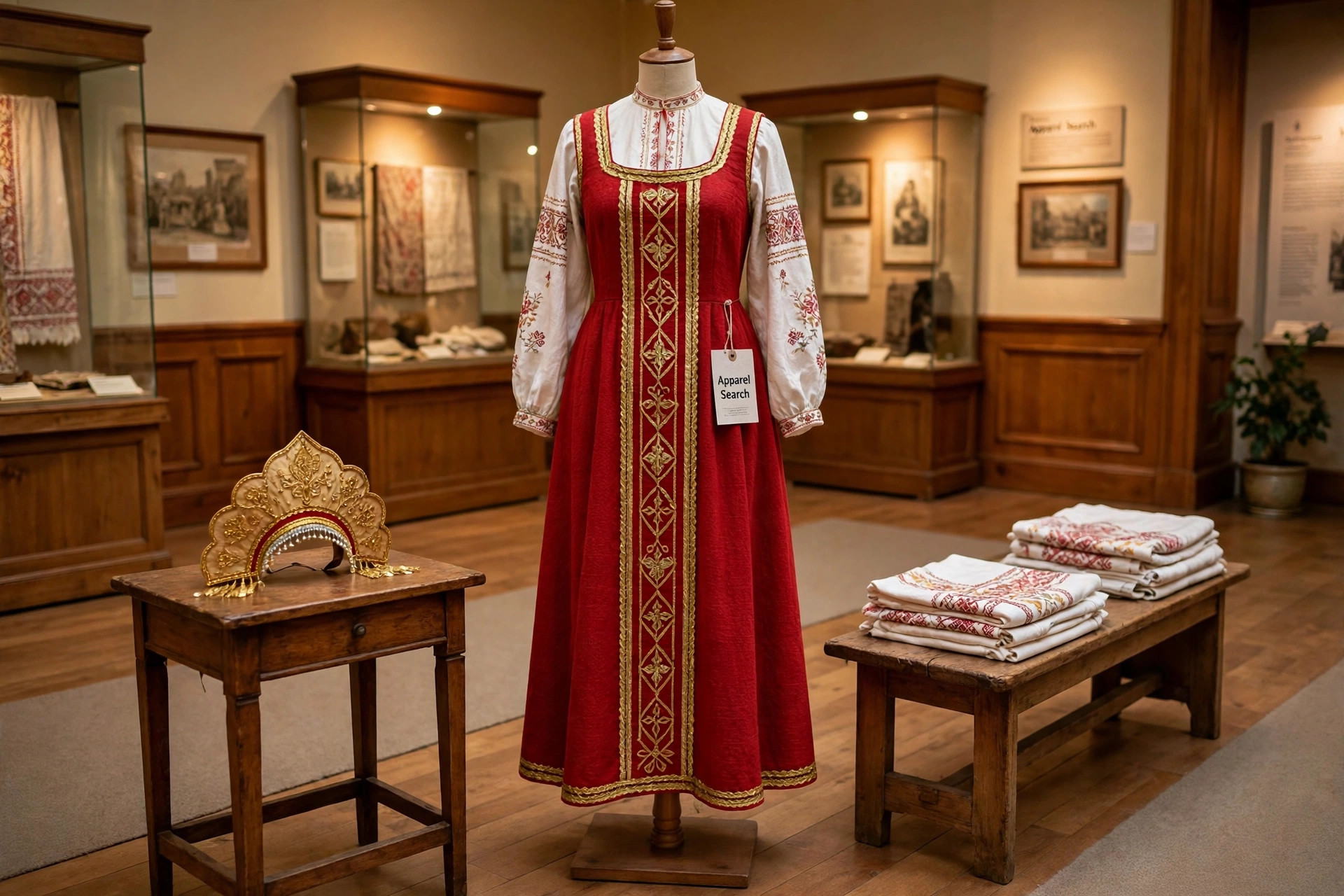
The sarafan is the tall, serene silhouette of Russian folk dress: a long, sleeveless pinafore dress that hangs from the shoulders over an embroidered linen blouse, and above it the kokoshnik — a stiff, pearl-covered crest that was among the most precious objects a woman owned. For centuries this was the dress of northern and central Russia, cut from straight panels of homespun cloth with nothing wasted, its decoration gathered at the collar, cuffs and hem. This guide explains the outfit piece by piece, the sarafan’s changing cuts, the great north–south divide in Russian dress, and where the sarafan lives today.
The Garment
What a Sarafan Is
The sarafan is a long, sleeveless dress worn over a shirt — a pinafore, in essence, but one with a thousand years of development behind it. Its name comes from the Persian sarāpā, “from head to feet,” and the word appears in Russian chronicles as early as 1376 — though the garment it first named was men’s dress, a long kaftan-like robe. Only in the sixteenth and seventeenth centuries did the sarafan become exclusively a woman’s garment, and from around the turn of the eighteenth century it was the most characteristic dress of peasant women across northern and central Russia. Its lines are straight and flowing: panels of cloth hung from straps or a short bodice, widening toward the ground, so that a woman in a festive sarafan seems to glide rather than walk — an effect Russian dress historians describe as the period’s ideal of beauty, a grand, unhurried, monumental silhouette.
The sarafan’s history turns on the reforms of Peter the Great. Around 1700, Peter compelled the nobility and townspeople into European dress; the old Russian garments survived where his writ mattered least — in the villages. From then on the sarafan was peasant and merchant dress, and it is the peasant version, preserved in dowries, chests and eventually museum collections, that defines it. In the countryside it remained everyday wear into the 1920s, and older women wore it into the 1940s. Cloth explains its construction. Homespun linen was precious — spinning and weaving it was women’s work measured in months — so garments were assembled from straight loom-width panels with almost no cutting and no waste, their shape coming from gores and gathers rather than from a tailor’s curves. What a family could spare went into the festive set: sarafans of brocade, silk, velvet or fine bought wool, worn with headdresses covered in river pearls.
Anatomy
The Parts of the Outfit
The sarafan complex is a layered system. From the skin out:
- Rubakha — the blouse beneath
- The foundation of all Russian dress: a long shirt of linen (later cotton), assembled from straight panels folded over the shoulder, with inset shoulder pieces (poliki) and underarm gussets that let the sleeve move without a shaped armhole. Under a sarafan, its full sleeves, stand collar and hem are what show — and they carry the embroidery, worked traditionally in red thread at collar, cuffs and hem, the garment’s openings, where folk belief placed protective patterns.
- The sarafan itself
- The long sleeveless dress, hanging from the shoulders on straps or a fitted upper section, belted or unbelted over the rubakha. Everyday versions were homespun linen, hemp or printed cotton in blue, red or checks; festive versions were brocade, silk, velvet or fine wool, edged with braid, lace, metallic galloon and rows of decorative buttons down the front.
- Kokoshnik — the headdress
- The crown of the festive outfit, described in its own section below: a stiff shaped crest covered in damask, velvet or brocade, worked with gold embroidery, freshwater pearls and beads, often with a pearl net (podniz) falling over the forehead and pearl strings (ryasny) at the temples.
- Other headdresses
- Not every occasion called for a kokoshnik. Girls wore open bands and wreaths that showed the hair and the single braid. Married women’s everyday covering was a soft cap (povoinik) or a kerchief; the south had its own forms — the horned kika and the soroka, named for the magpie, with its raised front and hanging tails.
- Dushegreya — the “soul-warmer”
- A short, fitted jacket worn over the sarafan in cool weather and for festivity — sleeveless or long-sleeved, often in velvet or brocade with fur trim, its name a small poem in itself. Shawls, especially the famous printed Pavlovo Posad shawls, were layered over everything in winter.
- Belt, apron and footwear
- A woven belt (poyas) with tasselled ends tied the layers together; an apron protected the front in working dress and added another embroidered panel in festive sets. On the feet: leather shoes, bast (woven bark) shoes for work, and felt valenki boots against the winter.
Formality
The Cuts of the Sarafan, and the North–South Divide
The sarafan changed its cut over the centuries, and old and new forms lived side by side in different provinces. Ethnographers distinguish three main lines of development:
| Sarafan type | Construction | Character |
|---|---|---|
| Closed (blind) sarafan | The most archaic: a tunic-like garment pulled over the head, with wide armholes, known by local names such as shushun and dubas | The oldest layer of the tradition, surviving longest in remote districts |
| Kosoklinny — the gore sarafan | Built from front and back panels widened by triangular side gores, opening down the front with a buttoned fastening — real or decorative | The classic festive silhouette of the eighteenth and early nineteenth centuries: a full cone of rich cloth |
| Krugly — the straight, or round, sarafan | Several straight panels gathered into a band or straps at the top, with no shaped gores | The most common form by the mid-nineteenth century; simpler to make from bought printed cottons |
And beyond the sarafan’s own territory lay the other Russia. The rough dividing line runs at about the latitude of Moscow. North and centre: the sarafan complex — Vologda, Arkhangelsk, Novgorod, Pskov and their neighbours. South — Tula, Voronezh, Tambov, the black-earth provinces — the older ponyova complex, in which a woman wore her rubakha with the ponyova, a wrap skirt of checked woollen cloth, three loom-widths sewn together and gathered on a cord at the waist, usually dark blue or black crossed by a white grid. The difference is structural, not just regional: a sarafan hangs from the shoulders and takes its shape from its panels; a ponyova hangs from the waist and takes its shape from being wrapped. A girl received her first ponyova at coming of age, as northern girls received their sarafans — dress marking the stages of a life in both worlds.
Cloth and Pattern
Embroidery, Pearls and the Kokoshnik
Decoration on Russian dress is never scattered; it concentrates where the garment opens — collar, cuffs, hem, the front fastening — and tradition explains why: those edges were the vulnerable places, and the stitching guarded them. The classic work is red on white linen: cross-stitch and counted-thread embroidery in geometric and stylised plant, bird and figure motifs, the red itself bound up with beauty — in Russian, the old word krasny means both “red” and “beautiful,” and it survives in the name of Moscow’s Red Square. Festive rubakhas added woven pattern bands and lace; sarafans answered with braid, galloon, silk ribbon and buttons that were jewellery in themselves.
The kokoshnik carried the richest work of all. Its name is usually linked to kokosh, a hen — the tall crest recalling a hen’s comb — and its forms map Russia: cylindrical hats in Novgorod, two-pointed and triangular kika forms in Vladimir and Kostroma, small pearl-covered caps in Kargopol, scarlet crests in Moscow. The craft was specialist work, done by professional craftswomen and monastery workshops: gold embroidery (zolotnoe shitye) couched in patterns of flowers and vines, freshwater pearls from the northern rivers sewn in dense designs, mother-of-pearl, glass beads and foil. The pearl podniz net veiled the forehead; pearl strings swung at the temples. The headdress also spoke plainly about its wearer: the kokoshnik proper belonged to a married woman and covered her hair entirely — to be caught bareheaded was a disgrace, a memory kept in the Russian word for embarrassing oneself — while a girl’s open band displayed the braid that was her pride. A fine kokoshnik was a dowry treasure, commissioned, paid for over time, and handed from mother to daughter.
Living Dress
When the Sarafan Is Worn Today
The sarafan’s everyday life ended with the world that made it: collectivisation, war and the Soviet century moved Russian women into factory and city dress, and by the mid-twentieth century the sarafan survived in chests, museums and memory. But it never disappeared. Folk ensembles — the song and dance troupes found in every Russian city and cultural centre — perform in sarafan and kokoshnik, and their stage versions, simplified and brightened, are the form in which most people now know the costume. Museums hold the masterpieces: the Russian Museum, the State Historical Museum and regional collections preserve festive sets whose pearl work rewards close looking, and collectors such as Natalia de Shabelsky, who assembled her great collection around 1900 precisely because she saw the tradition vanishing, carried Russian costume into the Metropolitan Museum of Art and other Western collections.
Today the sarafan returns at folk festivals and Maslenitsa celebrations, at weddings where a bride chooses folk dress for part of the day, in church and village feast-day revivals, and in the hands of historical reenactors and embroiderers who reconstruct historic sets stitch by stitch. The kokoshnik has travelled furthest of all: taken up as a fashion headdress and a symbol of Russian style worldwide — a journey that began when the Imperial court itself revived folk dress in the nineteenth century and the photographs of the 1903 Winter Palace costume ball fixed the sarafan-and-kokoshnik image for the world. Russia’s modern apparel and textile industry — heir to the great mill towns that once printed the cottons for a million sarafans — is profiled on our Russia clothing industry page.
Wearing
Wearing Basics
The sarafan outfit is assembled in layers, and its dignity is in the order. The rubakha goes on first, its embroidered collar set straight and its sleeves smoothed; the sarafan over it, straps even, the front fastening — where the kosoklinny cut has one — centred and closed; the belt tied at the waist over or under the sarafan according to local custom; then the dushegreya or shawl if the day calls for it. Hair decides the headdress: a girl’s single braid with an open band, a married woman’s hair parted, braided in two and put up entirely beneath the povoinik and kokoshnik, the podniz net drawn down over the forehead. Nothing is hurried and nothing is tight: the silhouette should stand away from the body in its long straight lines, and the wearer moves in it slowly — the glide that contemporaries described is a product of the dress itself.
Keeping
Care and Storage
Historic sarafan sets survive because their owners treated them as treasure: the festive outfit lived in the dowry chest, wrapped in clean linen, worn on the great days and put away cleaned. The rules that preserved them still apply. Linen rubakhas wash gently and iron well — that was their design — but embroidery should be washed inside a protective bag and never wrung hard. Brocade, velvet and gold-work sarafans are not washed at all: they are aired, brushed, spot-treated by a textile conservator, and stored flat or rolled with acid-free tissue, away from light, which fades red dyes first. Kokoshniks are the most fragile pieces: pearls and gold thread on a stiffened ground, they must be stored supported in their own shape, never stacked, and handled by the base. Felt valenki and leather want dry rooms and moth vigilance; cedar and regular inspection are the traditional answers. Anyone lucky enough to own an old set owns a document as much as a garment — photograph it, record where it came from, and mend by stabilising rather than remaking.
Acquiring
Buying and Collecting
Three kinds of sarafan can be bought today, and it is worth knowing which you are looking at. Stage costumes — the bright, simplified sarafans and kokoshniks made for folk ensembles — are inexpensive, robust and honest about what they are: performance dress. Modern folk-style dress from Russian makers ranges from printed-cotton summer sarafans in the krugly cut to serious reconstructions with hand embroidery, priced by the handwork in them. Antique pieces — nineteenth-century festive sarafans, rubakhas and above all kokoshniks — are collected as folk art; value sits in condition, region, and the quality of pearl and gold work, and provenance matters, since the great museum collections were formed from exactly such pieces. Judge any sarafan by its cloth and its edges: the embroidery at collar and cuff, the braid at the hem, the finish inside the seams. And wear it with its layers complete — a sarafan without its rubakha is a dress missing its foundation, and the Russians who designed the outfit over centuries knew the difference at a glance.
Common Questions
Common Questions
What is a sarafan?
A sarafan is the long, sleeveless, trapezoidal dress at the heart of Russian folk costume for women. It hangs from straps or a high bodice over a long linen blouse, the rubakha, and flares toward the hem — in its classic northern form into a full cone of cloth. Everyday sarafans were homespun linen or printed cotton; festive ones were brocade, silk or fine wool, trimmed with braid, buttons and embroidery, and crowned by the kokoshnik headdress.
What is worn under a sarafan?
The rubakha: a long shirt of linen, worn by women and men alike as the foundation of Russian dress. Under a sarafan only its sleeves, collar and hem show, and those visible edges carry the outfit's embroidery — traditionally in red thread at the collar, cuffs and hem, the openings of the garment, where folk belief held that protection was needed most. A woven belt and, in cold weather, a short jacket completed the layers.
What is a kokoshnik?
The kokoshnik is the great festive headdress worn with the sarafan: a stiff, shaped crest — arched, pointed, cylindrical or horned, depending on the region — covered in rich fabric and decorated with gold embroidery, freshwater pearls, beads and a pearl net, the podniz, over the forehead. It was traditionally a married woman's headdress, covering her hair completely; girls wore open bands that left their braid visible. Fine kokoshniks were treasures, made by specialist craftswomen and handed down.
How did northern and southern Russian dress differ?
Ethnographers divide Russian folk dress into two great complexes, meeting roughly at the latitude of Moscow. In the north and centre, the sarafan complex: blouse, shoulder-hung sarafan and kokoshnik. In the south, the older ponyova complex: blouse, a checked woollen wrap skirt (the ponyova) gathered at the waist, an apron, and headdresses such as the horned kika and the magpie-tailed soroka. The difference is structural — the sarafan hangs from the shoulders, the ponyova from the waist.
Is the sarafan still worn today?
Not as everyday dress — it survived as daily peasant wear into the early twentieth century, and elderly women wore it into the 1940s. Today it lives on stage and at festivals: folk song and dance ensembles perform in sarafan and kokoshnik, museums preserve and display historic sets, weddings and folk holidays revive it, and the kokoshnik in particular has been taken up by fashion far beyond Russia. Modern versions for performance are simplified, but the silhouette is unmistakable.
Keep Exploring
More to Explore
In This Series
Search Apparel Search