Traditional Dress by Country · Spain
Spain — The Flamenco Dress
Every other folk costume in Europe is a fixed pattern, preserved. Spain's flamenco dress is the famous exception: a traditional dress that behaves like fashion, redesigned every year. The traje de flamenca — fitted to the knee, then breaking into tiers of ruffles — is the dress of Seville's Feria de Abril and of the flamenco stage, and its story runs from the work-gowns of market women to an annual catwalk. This guide traces the whole arc: the ruffles, the polka dots, the trained bata de cola, and the difference between dancing flamenco and dressing for the fair.
The Garment
What a Traje de Flamenca Is
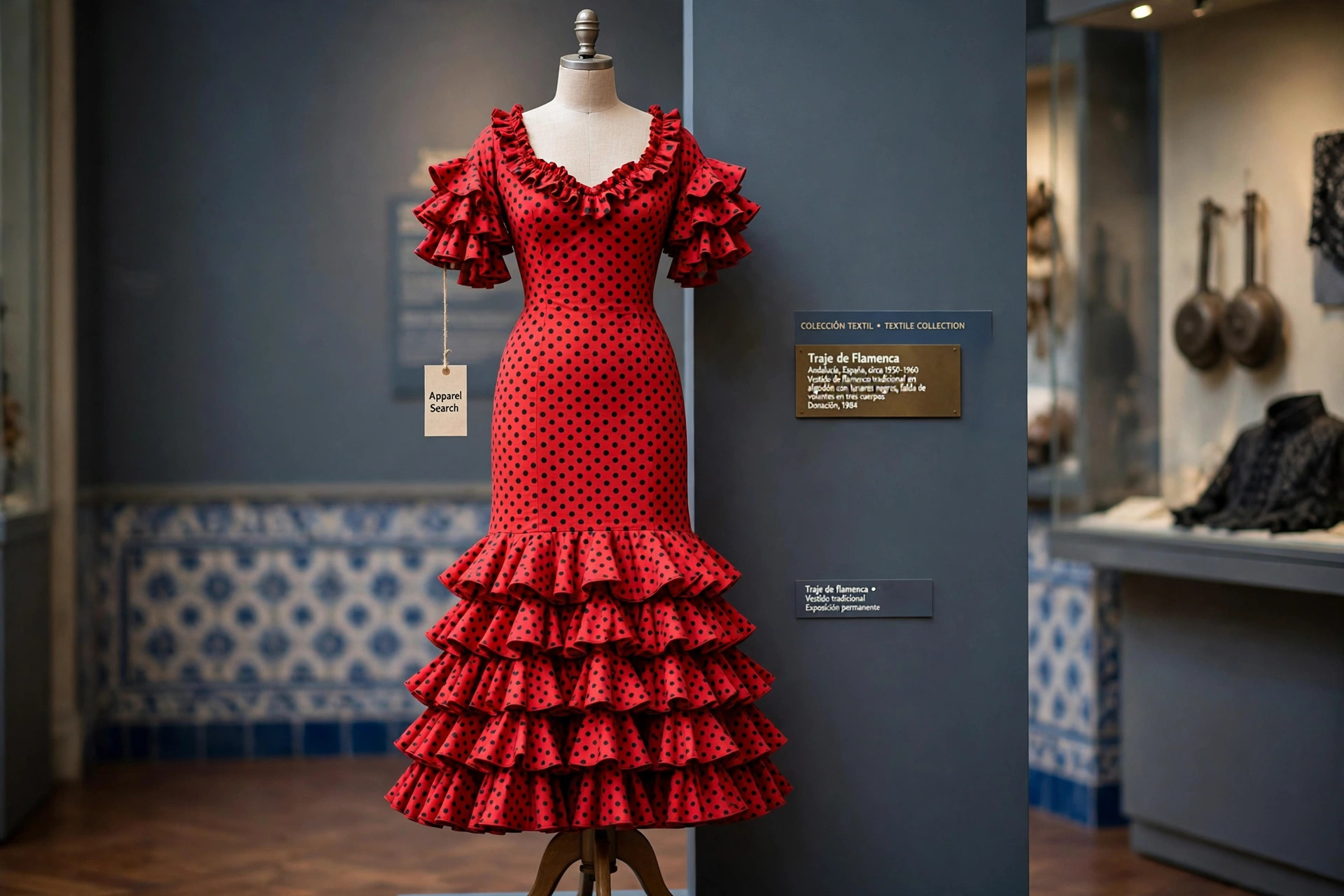
The traje de flamenca is a dress with a silhouette anyone can draw from memory: close-fitted through the bodice, waist and hips, then releasing below the knee into tier upon tier of ruffles — volantes — that move with every step. Its classic fabric carries lunares, polka dots, though florals, stripes and plains all have their seasons. It is finished with ruffled sleeves, a flower in the hair, large earrings and often a fringed mantoncillo shawl across the shoulders. It is the dress of the Andalusian spring fairs, and in a longer, trained form, of the flamenco stage.
Its origins are humbler than its glamour suggests. In the nineteenth century, the women who came to Andalusia's livestock fairs — market women, vendors and Roma (gitana) women, whose name the dress still carries in its other title, traje de gitana — wore modest ruffle-trimmed work-gowns, the single ruffle at the hem a practical device as much as an ornament. The fair that changed everything was Seville's: proposed in 1846 and first held in April 1847 as a cattle fair, the Feria de Abril grew from trade into the city's great social week, and wealthier Sevillian women took up the market women's dress, enriching its fabrics and multiplying its ruffles. By the time of Seville's Ibero-American Exposition of 1929, the traje de flamenca had been recognised as the official dress of the fair — a working woman's gown enthroned as regional dress.
Flamenco itself, the music and dance of Andalusia — inscribed by UNESCO on its Representative List of the Intangible Cultural Heritage of Humanity in 2010, with the Gitano community's role in its development expressly acknowledged — gave the dress its worldwide stage. But as the sections below explain, the feria dress and the dancer's dress are cousins, not twins.
Anatomy
The Parts of the Outfit
- Cuerpo — the fitted body
- The bodice and skirt are cut as one close fit to the hips or mid-thigh. The fit is the dress's discipline: a traje de flamenca is made or altered to the wearer, traditionally by a modista, a dressmaker, and it should move like a second skin until the ruffles take over.
- Volantes — the ruffles
- Tiered flounces from the knee (or higher, in some years' fashion) to the hem, and repeated in smaller form on the sleeves. Their number, size and placement are exactly where each year's fashion shows: one season favours a single deep flounce, the next stacks five.
- Lunares — the polka dots
- The signature pattern. Dots large or small, in contrast or tone-on-tone, on red, black, white, green and every fashion colour in turn. Florals run a close second; plain dresses rely on cut and ruffle alone.
- Bata de cola — the train
- For performance, the skirt extends into a long, heavy, ruffled train. The bata de cola is a professional instrument: its weight and sweep are choreographed, and learning to dance it is a specialism in itself.
- Mantoncillo and mantón
- The mantoncillo is the small fringed, often embroidered shawl worn crossed over the bodice at the feria. Its grand relative, the mantón de Manila — an embroidered silk shawl that reached Spain through the Manila galleon trade — is a dancer's prop and an heirloom textile in its own right.
- Peineta, flower and earrings
- The hair is dressed up with a flower, and for formal occasions the tall comb (peineta) under a lace mantilla; large earrings complete the feria look. Footwear is a heeled shoe made for dancing sevillanas on fairground ground — elegant, but built to be used.
- Traje corto — the men's counterpart
- Men at the feria wear the traje corto: a short fitted jacket, tight trousers, boots and a wide-brimmed Cordoban hat — the dress of the horseman, matching the flamenca's formality without sharing its silhouette.
The Exception
The Dress That Changes Every Year
Here is the fact that sets the traje de flamenca apart from every other garment in this series: it evolves with yearly fashion. Traditional dress elsewhere is a pattern to be preserved; the flamenca is a pattern to be renewed. Each winter and spring, designers in Seville and across Andalusia present new flamenco collections — shown at dedicated flamenco fashion events such as Seville's SIMOF salon, founded in the 1990s — and each year the details move: sleeves lengthen or vanish, necklines plunge or square, ruffles climb the leg or settle low, lengths rise and fall, and fabrics run from classic dotted cotton to lace, satin and prints that would startle a traditionalist, until next year makes them normal.
Women respond as fashion customers, not costume-keepers: a dress may serve several ferias with alterations — a new sleeve, an added ruffle, a re-cut neckline is the dressmaker's annual bread and butter — or be replaced outright in the new season's colour. This is why photographs of the Feria de Abril date themselves as precisely as fashion photographs: the crowd is in folk dress, and the folk dress is this year's. No other regional costume in Spain — arguably in Europe — behaves this way, and it is the direct inheritance of the dress's origin: it was never a uniform, only ever the best dress of women who followed fashion with the means they had.
Two Dresses
Dancing Flamenco vs Dressing for the Feria
The same name covers two related but distinct wardrobes, and telling them apart is the mark of understanding the dress. The feria dress is social dress: the standard traje de flamenca, fitted and ruffled, made to walk the fairground, ride in a carriage, eat, drink and dance sevillanas — the joyful, social folk dance of the fair, related to flamenco but a form of its own — for hours among crowds. It is pretty before it is practical, but it must be both.
The dancer's dress is working equipment. In class, flamenco dancers wear practice skirts and hard-soled, low-heeled flamenco shoes, not ruffles and trains. On stage — in the tablaos and theatres — the costume is cut for technique: skirts that answer the legs' movements, and for particular palos (flamenco's rhythmic forms) the bata de cola, whose train the dancer sweeps, kicks and turns with a precision that takes years to learn, or the mantón worked as an extension of the arms. A feria dress at a feria and a bata de cola on stage are the same tradition at two different jobs — celebration and art — and confusing them is like confusing a wedding dress with a ballet costume because both are white and full-skirted.
Cloth and Colour
Fabric, Pattern and Meaning
Colour in the flamenca is expressive rather than coded. Red is the classic — the colour of the dress in the world's imagination — and black runs it close, dramatic against a fairground at dusk; white dresses appear for daytime and for the romerías, and each season brings its own fashion colours, from acid green to powder pink, taken up or dropped as the year decides. The lunares remain the constant: dots survive every fashion cycle, shrinking to pinheads or swelling to coins, because they are the pattern the dress grew up in. Fabric follows the same double logic — dotted cotton and modern easy-care cloths for the working feria dress, lace, satin, crepe and embroidered tulle where the year's fashion and the wearer's budget allow — and the ruffles themselves are an engineering problem in miniature, each volante cut as a spiral or circle so it flares without bulk at the seam. A good dressmaker talks about ruffles the way a tailor talks about lapels: they are where the dress is made or lost.
Living Dress
When the Flamenco Dress Is Worn Today
The dress's calendar is the Andalusian spring. It opens with Seville's Feria de Abril — a week of casetas (striped canvas tents), horses, music and sevillanas, falling two weeks after Easter — and continues through the ferias of Córdoba, Jerez, Málaga and every Andalusian town, and the romerías, the pilgrimages such as El Rocío, where the dress takes a plainer, walkable form for the road. At these events the traje de flamenca is not costume but correct dress: most women wear it, grandmothers and little girls alike, the girls' versions exact miniatures of their mothers'.
Year-round, the dress works on stage wherever flamenco is performed — in Andalusia's tablaos, in theatres worldwide, and at the great flamenco festivals — while its ruffles keep walking into mainstream fashion whenever designers look south. Behind both lives stands an industry of flamenco dressmakers, specialist shops and the annual design season, part of the wider sector profiled on our Spain clothing industry page.
Spain Beyond Andalusia
A closing word of proportion: the flamenca is Andalusia's dress, not Spain's whole wardrobe. Spain's other regions keep their own trajes regionales — the silk fallera dress of Valencia's Fallas, the dress of Aragon, the Galician and Catalan costumes, the Basque beret and sash, the mantilla worn for Semana Santa and formal occasions across the country — each a complete tradition of its own. They are mentioned here only in passing, as this guide's subject demands, but no account of Spanish dress is honest without noting that the famous ruffles are one region's glory among many.
Wearing
Wearing Basics
Fit is everything: the dress should be close through the body without restricting the stride — you must be able to walk, climb into a carriage and dance — and the ruffles should begin where this year's pattern puts them and move freely from there. Buy or hire from a flamenco dressmaker where possible; the alterations culture is part of the tradition, and a modista will adjust last year's dress into this year's shape. Dress the hair up, add the flower and earrings, choose heeled shoes you can actually dance in, and wear the dress as its owners do — as festive best, not fancy dress.
Keeping
Care and Storage
Ruffles are the care problem and the storage problem in one. Wash or clean the dress according to its fabric — many feria dresses are cotton or modern easy-care cloth and wash gently; embroidered mantoncillos and silk mantones are dry-clean or specialist items — and dry it hanging so the volantes fall back into shape, steaming rather than pressing the ruffles where they need help. Store the dress hanging with room around it, or folded with the ruffles loosely supported; a crushed volante can be steamed back, but a season in a tight box will try its patience. Heels and dance shoes should be checked before the feria, not during it — flamenco shoes take real punishment, and cobblers in Andalusia do a brisk pre-feria trade.
Acquiring
Buying and Collecting
A new traje de flamenca ranges from ready-made dresses in Seville's flamenco shops — bought off the rail each spring in the season's prints — to fully bespoke work from a named designer, priced like the occasionwear it is. The secondhand and alteration market is part of the culture: last year's dress, re-ruffled, is no disgrace but the norm. When buying, judge the fit first, the ruffle work second (even, full, and securely attached — volantes live hard lives) and the fashion year honestly: a strongly dated sleeve is a feature if you love it and a cost if you will pay to change it. Vintage mantones de Manila, by contrast, are collected as textiles: judge them by the fineness of the silk embroidery and the length of the hand-knotted fringe, and keep them folded in tissue, away from light. Whether for the fair or the collection, buy the dress as Andalusians do — for this spring, and with pleasure.
Common Questions
Common Questions
What is a traje de flamenca?
The traje de flamenca is the ruffled dress of Andalusia in southern Spain: a dress fitted closely through the body to the hips or knees, then flaring into tiered ruffles called volantes, often in polka-dot fabric (lunares). It is worn above all at the spring ferias — Seville's Feria de Abril first among them — and in adapted forms by flamenco dancers. It is also called the traje de gitana.
Why does the flamenco dress change every year?
Uniquely among traditional costumes, the traje de flamenca follows fashion: each year designers and dressmakers renew its fabrics, sleeve shapes, necklines, lengths and ruffle arrangements, and women buy or remake dresses in the new season's style for the feria. The dress was never frozen as a historic uniform — it grew out of contemporary nineteenth-century dress and has behaved like living fashion ever since.
What is a bata de cola?
The bata de cola is the flamenco performance dress with a long, weighted, ruffled train trailing behind the dancer. Moving it — sweeping it, kicking it up, turning without treading on it — is a distinct advanced technique, so the bata de cola belongs to trained dancers and particular flamenco forms, not to the feria, where the shorter, walkable traje de flamenca rules.
What is the Feria de Abril?
The Feria de Abril is Seville's April Fair, a week-long festival of dancing, music, horses and socialising in rows of striped tents (casetas), held each spring. Founded as a livestock fair in 1847, it is the great showcase of the traje de flamenca: most women attend in flamenco dress, and the fair is where each year's new styles are seen first.
Is the flamenco dress the national dress of all Spain?
No — it is specifically the dress of Andalusia. Spain keeps a distinct regional dress (traje regional) for each of its regions: the fallera dress of Valencia, the dress of Aragon, Galicia, Catalonia, the Basque Country and others are all different garments. The flamenco dress is simply the most famous of them, known worldwide through flamenco itself.
Keep Exploring
More to Explore
In This Series
Search Apparel Search