Traditional Dress by Country · Ukraine
Ukraine — The Vyshyvanka
Some garments carry a whole country in their stitches. The vyshyvanka — Ukraine's embroidered shirt — is one of them: a plain linen sorochka transformed by hundreds of hours of needlework into a record of region, family and belief. This guide explains how to read one: the white-on-white restraint of Poltava, the dense black sleeves of Borshchiv, the bright geometry of the Hutsul mountains, the stitches and symbols behind them, and why, on the third Thursday of every May, Ukrainians everywhere put one on.
The Garment
What a Vyshyvanka Is
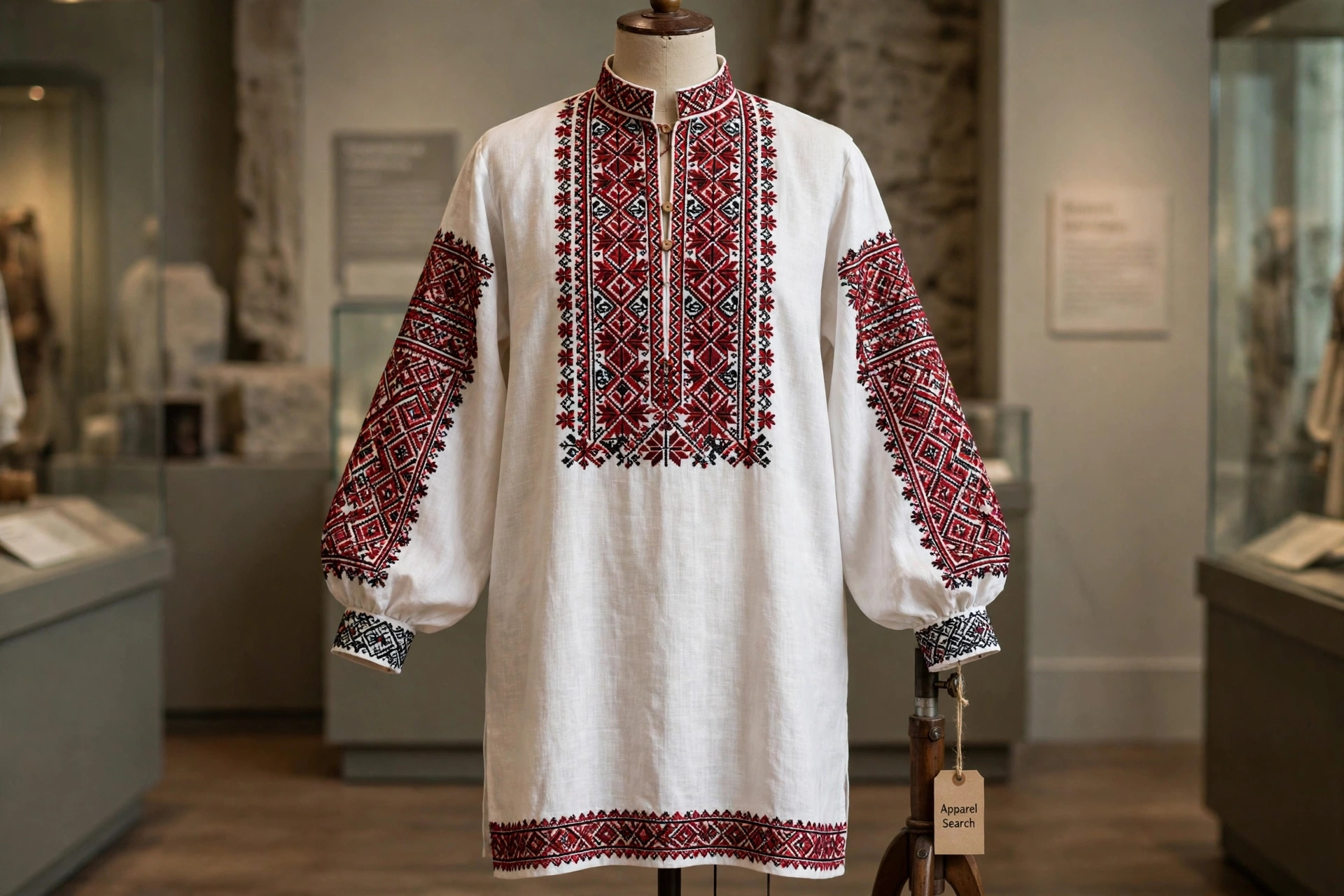
The vyshyvanka is, at its base, a shirt — in Ukrainian, a sorochka. Cut loose and straight from homespun linen or hemp cloth, it was for centuries the foundation garment of Ukrainian dress for men and women alike, worn next to the skin, under waistcoats and over skirts or trousers. What lifts it out of the ordinary is the embroidery: bands and panels of stitched ornament worked by hand at the collar, down the chest, across the shoulders and sleeves, and at the cuffs and hem. The word vyshyvanka itself simply comes from vyshyvaty, to embroider — the shirt is defined by its stitching.
Embroidery of this kind is old in the lands of Ukraine. Needlework decorated ritual cloth and dress long before the modern shirt took shape, and by the nineteenth century the embroidered sorochka had become the centrepiece of festive dress in village after village — the garment a family made best, kept longest and passed down. A bride's trousseau included embroidered shirts and rushnyky, the ornamental towels that share the same stitch vocabulary; a fine shirt represented weeks of evening work by the women of a household, and its quality was read by neighbours as plainly as handwriting.
The twentieth century tested the tradition hard. Under Soviet rule, Ukrainian folk dress was at times promoted as staged folklore and at other times suppressed as nationalist expression, and many regional techniques thinned out as factory clothing replaced homespun. Yet shirts survived in chests and family keeping, and since Ukrainian independence in 1991 the vyshyvanka has returned — first as festive and ceremonial dress, then, powerfully in the years since 2014 and again since 2022, as an everyday emblem of identity worn by soldiers, officials, schoolchildren and the worldwide Ukrainian diaspora. Few national garments are still being made, by hand, in their historic regional styles; this one is.
Anatomy
The Parts of the Outfit
The shirt itself is the heart of the outfit, but traditional Ukrainian dress builds around it in layers that differ for men and women and from region to region:
- The sorochka — the shirt
- The embroidered shirt itself. Men's shirts are typically hip- or thigh-length, worn belted or loose over trousers, with embroidery concentrated on the collar, chest placket and cuffs. Women's shirts are longer, with the richest work on the sleeves — in some regions the whole sleeve is a field of stitching — and are worn with a woven skirt or wrap skirt.
- Collar, chest and cuffs
- The classic placements. A standing or turned collar carries a narrow band of pattern; the chest opening is flanked by embroidered strips; cuffs close the full sleeves with a stitched border. These framed the face and hands and received the finest work.
- Korsetka and kersetka — the waistcoat
- A fitted sleeveless vest, often in dark wool or velvet and sometimes itself embroidered or trimmed, worn over the shirt by women in central Ukraine. Men wore a similar waistcoat, the kamy zelka in some districts, over the shirt.
- Plakhta and zapaska — woven skirts
- For women, the festive skirt was often a plakhta: panels of checked or patterned woven wool wrapped and belted at the waist, worn with a woven apron (zapaska or fartukh) at the front — the apron, too, frequently embroidered at its hem.
- Krayka — the woven belt
- A long woven sash, wound round the waist several times and tied, finishing both men's and women's outfits and holding the loose shirt in shape.
- Vinok and headwear
- Unmarried girls wore the vinok, a wreath of fresh or artificial flowers with long ribbons down the back; married women covered their hair with a scarf or the structured ochipok cap. Men wore felt or sheepskin hats, and in the Carpathians the embroidered shirt was paired with a wide leather belt, the cheres.
Regions
Regional Styles: One Country, Many Shirts
There is no single Ukrainian embroidery. There are dozens of local schools, and a knowledgeable eye can often name a shirt's home district from its sleeve alone. The differences run through colour, motif and technique together:
| Region | Character |
|---|---|
| Poltava | Famous for white-on-white embroidery — white thread on white linen, the pattern read through texture and shadow rather than colour, often combined with drawn-thread work (merezhka) and delicate cutwork. Restrained, technically demanding, and the style most associated with fine festive shirts in central-eastern Ukraine. |
| Borshchiv (Podillia) | The opposite pole: sleeves dense with black wool embroidery, worked so thickly that the ground cloth nearly disappears, sometimes lifted with dark red. Traditional explanations for the black — mourning after invasion, protection, the black earth of Podillia — are best presented as the legends they are; the effect itself, sombre and magnificent, needs no explanation. |
| Hutsul region (Carpathians) | Bold geometric bands in red, orange, yellow and green with black outlining, worked in wool as well as cotton thread, covering the sleeve in stacked horizontal registers. Hutsul embroidery belongs to a wider mountain craft culture of weaving, woodwork and metalwork in the same strong colours. |
| Kyiv and Cherkasy | Plant motifs — stylised grapes, viburnum and flowers — in red and black, often with a touch of yellow or blue, in a more naturalistic style than the geometric north and west. |
| Polissia | The northern woodland belt: simple, boldly scaled red geometric ornament, a few motifs repeated with great confidence on coarse homespun. |
| Bukovyna | Fine, dense geometric patterning, often with metallic thread and beadwork on festive pieces, reflecting the region's crossroads history. |
Construction varies with region too. The oldest shirts were assembled from straight panels of homespun with the embroidery worked before the garment was sewn up, and gathered or pleated into collar and cuffs; later shirts adopted a shoulder yoke and, in the twentieth century, a more tailored cut — which is why an antique sorochka and a modern handmade one, carrying the same Poltava white work, can still feel like cousins rather than copies. Collectors read these construction details alongside the stitching itself.
These are the best-known schools, not the whole map — Volyn, Podillia beyond Borshchiv, Sloboda Ukraine and the steppe south each keep their own habits of stitch and colour, and museum collections in Kyiv and Lviv preserve thousands of district-level variations.
Technique and Meaning
Stitch, Symbol and the Protective Shirt
Ukrainian embroiderers command a large stitch vocabulary — sources on the tradition commonly count more than two hundred techniques and variants. The ones a beginner meets first are cross-stitch, the counted-thread work behind most red-and-black geometric shirts; satin stitch and its counted forms, used for Poltava's white work and for floral motifs; drawn-thread work (merezhka), where threads are withdrawn from the ground cloth and the remaining threads bundled into open lace-like bands; and the low, surface-covering stitches of Podillia that lay long floats across the cloth so the pattern reads almost as weaving. Historically the thread was wool, linen or cotton dyed at home; silk and metallic thread marked festive wealth.
The motifs fall into three families: geometric — diamonds and rhombuses, eight-pointed stars, crosses, zigzags and meanders; plant — the tree of life, oak leaves, grapes, poppies and above all the kalyna, the red viburnum berry that has become a national emblem; and animal — stylised birds, including the swallow and the nightingale, and rams' horns in mountain work. Popular readings attach meanings to them: the rhombus with a dot as a sown field and fertility, the star as a solar sign of order and protection, oak for strength, poppy for remembrance, kalyna for beauty, lineage and homeland. Colour carries meaning alongside motif — red for love and vitality, black for the earth (and in places for sorrow), white for purity, blue for sky and water.
An honest guide should add what museums themselves stress: these readings were local and varied from village to village, many confident “codes” repeated online are modern inventions, and the oldest geometric motifs had already lost any single fixed meaning generations ago. What is well documented is the belief in the shirt as a protective garment — a talisman. Embroidery was placed most densely at the openings of the shirt, where folk belief held the body most exposed; shirts were stitched with intention by mothers and brides for the people they loved, and a gifted shirt carried that care with it. Read the symbolism in that spirit — as devotion made visible — rather than as a cipher to be decoded letter by letter.
Living Dress
When the Vyshyvanka Is Worn Today
The vyshyvanka never retreated into the museum. It is worn at weddings and christenings, at Easter and Christmas, on the first day of school and at graduation, by folk ensembles and by officials at state occasions. Brides still marry in embroidered shirts — some in a grandmother's, kept for decades for exactly that day — and a newborn's first embroidered shirt remains a treasured gift.
Above all there is Vyshyvanka Day, held on the third Thursday of May. It began in 2006 as a student initiative at Chernivtsi National University — the idea, credited to student Lesya Voronyuk, was simply that everyone come to class in an embroidered shirt on the same day — and it grew into an international celebration, organised as a worldwide event from 2015 and since marked in more than a hundred countries. On that day offices, universities, parliaments and whole city streets fill with embroidery, from heirloom shirts to new work by contemporary Ukrainian makers.
In the years since Russia's full-scale invasion of 2022, the shirt's role as an emblem of identity has only deepened: it is worn at solidarity events across the diaspora, embroidered in blue-and-yellow and in military olive, and made by volunteer and professional workshops alike. Behind the garment stands a living craft economy of embroiderers, weavers and small ateliers — part of the wider sector profiled on our Ukraine clothing industry page.
Wearing
Wearing Basics
A vyshyvanka is easy to wear well. The traditional men's shirt is worn over trousers, either loose or held with a woven belt, its embroidered chest and collar left fully visible — nothing should cover the chest panel. The women's shirt pairs traditionally with a woven skirt, but today it is just as commonly worn with a plain modern skirt or trousers; the embroidered sleeves are the feature, so keep them uncovered and let the cuffs show. Fit should be relaxed — this is a straight-cut folk shirt, not a tailored one — and the linen softens with every wash and wear. On Vyshyvanka Day the only real rule is participation: heirloom, handmade or fairly bought new, the shirt is the point.
Keeping
Care and Storage
Hand embroidery rewards gentle handling. Wash a vyshyvanka by hand or on a delicate machine cycle in cool water with mild detergent, inside out and preferably in a mesh bag, and never wring the embroidered panels. Older shirts and natural-dyed threads deserve hand-washing only, since early red dyes can bleed. Dry flat or on a line in shade, and iron on the reverse, over a cloth, so the stitches keep their relief — ironing from the back into a padded surface is the embroiderer's own method for making cross-stitch stand up crisply. Store folded in breathable cotton, away from light; heirloom pieces are best kept flat with acid-free tissue, checked yearly, and refolded on different lines so old linen does not crack along a permanent crease.
Acquiring
Buying and Collecting
Buyers face three broad choices. Antique and vintage shirts, mostly nineteenth- and early twentieth-century village work, are collected seriously: value lies in the fineness and density of the stitching, the rarity of the regional style, natural dyes and honest condition — expect wear, and be wary of “antique” shirts in suspiciously perfect, bright synthetic colour. New handmade shirts from Ukrainian embroiderers and ateliers continue the regional styles stitch for stitch; they cost what hundreds of hours of handwork should cost, and buying them supports the craft directly. Machine-embroidered shirts are the accessible everyday option — good ones reproduce historic patterns faithfully and are what most people wear on Vyshyvanka Day. Whichever you choose, learn to read the sleeve before you buy: the region a shirt comes from, or faithfully honours, is written there.
Common Questions
Common Questions
What is a vyshyvanka?
A vyshyvanka is Ukraine's traditional embroidered shirt — a linen or cotton shirt (a sorochka) decorated with hand embroidery at the collar, chest, shoulders, sleeves and cuffs. The name comes from the Ukrainian verb vyshyvaty, “to embroider.” Worn by men and women for centuries, it is both everyday heritage dress and, today, a widely worn symbol of Ukrainian identity.
What do the colours on a vyshyvanka mean?
Colour readings vary by region and family, but the most widely shared are these: red for love, vitality and life; black for the earth — and, in some districts, for mourning and remembrance; white for purity and light; blue for sky and water; and green and yellow for spring, youth and the harvest. Treat any single fixed “code” with care — meanings were local, not national.
What is Vyshyvanka Day?
Vyshyvanka Day is an informal international celebration held on the third Thursday of May, when Ukrainians and supporters wear an embroidered shirt to work, school and public events. It began in 2006 as a student initiative at Chernivtsi National University and has grown into a worldwide occasion marked in more than a hundred countries.
Why is embroidery placed at the collar, cuffs and hem?
Tradition placed the densest embroidery at the shirt's openings — collar, cuffs, chest slit and hem. Alongside decoration, folk belief held that stitched ornament at these vulnerable edges protected the wearer. Whether read as protection, identity or pure craft, the placement is practical too: these are the parts of the shirt that frame the face and hands and are seen first.
Can visitors wear a vyshyvanka?
Yes — wearing a vyshyvanka respectfully is welcomed in Ukraine, and embroidered shirts are sold openly to visitors in markets and craft shops across the country. Choose a well-made shirt, learn a little about the style of the region you are in, and wear it as you would any valued garment — at festivals, celebrations and on Vyshyvanka Day itself.
Keep Exploring
More to Explore
In This Series
Search Apparel Search