Traditional Dress by Country · Scotland
Scotland — Highland Dress
Highland dress is Scotland’s national costume: a tailored kilt of pleated tartan, worn with a short jacket, a sporran at the front, long hose and laced brogues. It began as the practical dress of the Highlands, was banned for a generation, revived as a symbol of the whole country, and is tailored today to standards a Savile Row cutter would recognise. This guide explains the garment itself — the eight yards of cloth, the sett of the tartan, pleating to the sett or the stripe — the full outfit piece by piece, and when and how Highland dress is worn now.
The Garment
What Highland Dress Is
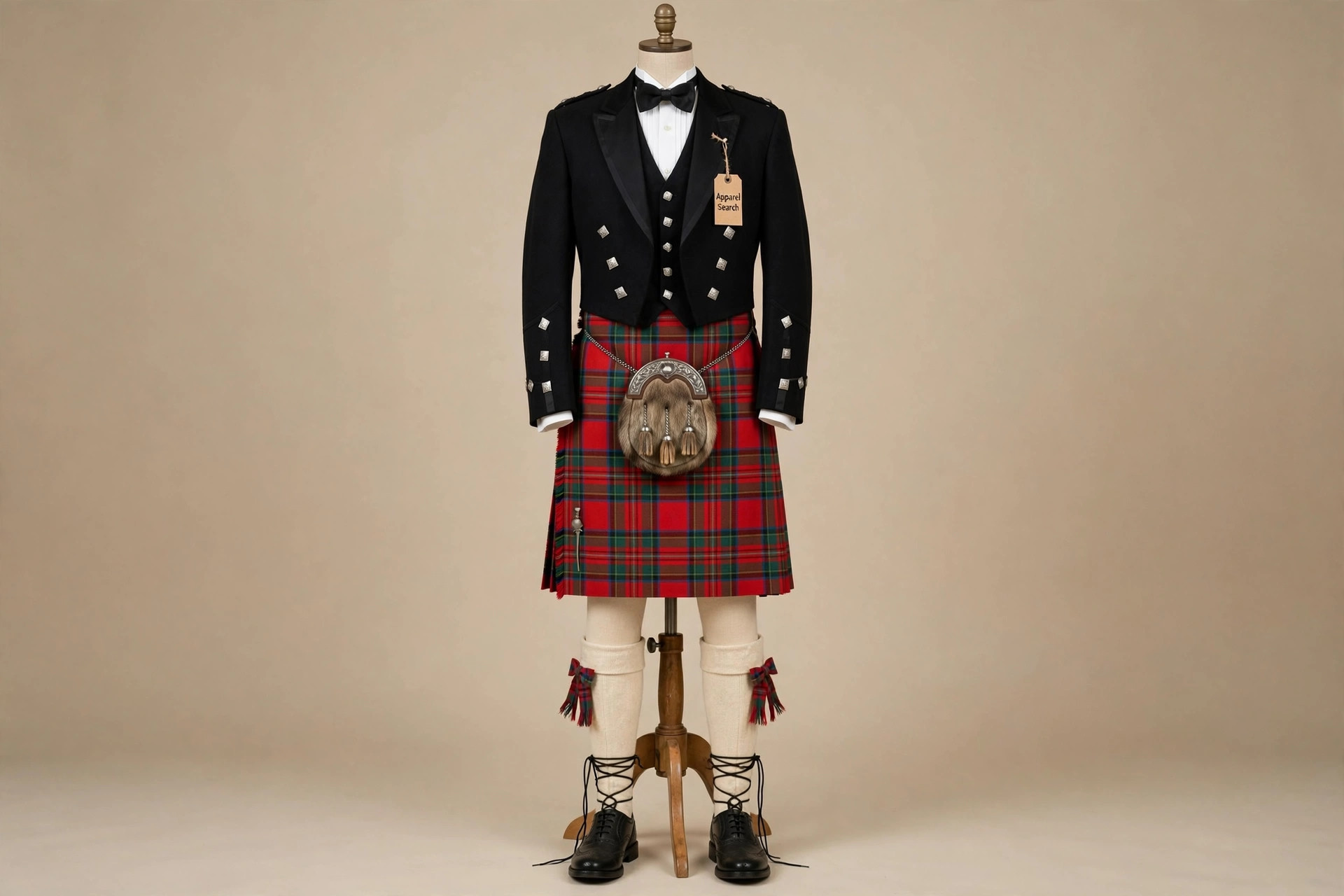
Highland dress is the traditional dress of the Scottish Highlands and Islands, and its centrepiece is the kilt: a knee-length, tailored wrap garment, flat at the front and deeply pleated at the back, made almost always in tartan — the checked woollen cloth whose coloured stripes cross in warp and weft. Around the kilt sits a complete outfit with a part for everything: a jacket cut short so it never covers the pleats, a pouch — the sporran — because the kilt has no pockets, knee-length hose, and tongueless shoes made for wet ground. Worn whole, it is one of Europe’s most recognisable national costumes, and one of the few still made by hand to individual measure as a matter of course.
The ancestor of the kilt is the féileadh mòr, the great kilt or belted plaid: a single length of tartan cloth, several yards of it, laid on the ground over a belt, pleated by hand each morning, and belted round the waist with the spare cloth thrown over the shoulder as a cloak — and unrolled at night as a blanket. It appears in Highland use from the late sixteenth century. The modern kilt is its lower half made permanent: the féileadh beag, the small kilt, with the pleats stitched in by a tailor instead of gathered daily. A story often repeated credits an English industrialist, Thomas Rawlinson, with commissioning the shortened garment in the 1720s for his Highland workers; historians treat that account cautiously, but the tailored kilt certainly belongs to the eighteenth century.
Then came the rupture. After the Jacobite rising of 1745 and the defeat at Culloden, the Dress Act of 1746 — part of the Act of Proscription — banned Highland dress for ordinary men and boys in the Highlands, tartan and plaid included. Highland regiments of the British Army were exempt, and it was the regiments that carried the kilt through the ban years. The Act was repealed in 1782, and in 1822 Sir Walter Scott stage-managed the visit of George IV to Edinburgh as a pageant of tartan, with the king himself appearing in a kilt. From that moment the dress of one region became the dress of Scotland itself — Lowlanders adopted it, Queen Victoria’s enthusiasm for Balmoral entrenched it, and the Victorian era fixed the formal outfit much as it is worn today. For the short dictionary version, see Apparel Search’s definition of kilt.
Anatomy
The Parts of the Outfit
A full Highland outfit runs to a dozen pieces, and each has its place. From the waist out:
- The kilt
- The tailored garment itself: about eight yards of tartan, pleated at the back and sides, with two flat overlapping aprons at the front fastened by straps and buckles. It is worn high, at the natural waist, and the hem should fall to the middle of the kneecap. A kilt pin at the lower corner of the outer apron adds weight against the wind.
- The jacket — Prince Charlie or Argyll
- The jacket sets the formality. The Prince Charlie coatee is the evening jacket: black barathea, satin lapels, silver buttons, short tails, worn with a waistcoat and bow tie. The Argyll is the all-purpose jacket, in tweed for the day or black barathea, worn with a shirt and tie. Older doublet styles — Montrose, Sheriffmuir, Regulation — survive for the most formal evening wear.
- Sporran
- The pouch hung at the front on a chain or leather strap, doing the work of the pockets a kilt does not have. Plain leather day sporrans are for everyday and daytime wear; dress sporrans, with a polished metal cantle and a fur front, belong to evening dress; long horsehair sporrans are mostly a military and pipe-band sight.
- Kilt hose and flashes
- Long woollen socks turned down below the knee, held by garter flashes — elastic bands whose coloured tabs show beneath the turn-down, traditionally matching or toning with the tartan.
- Ghillie brogues
- The traditional shoe: a tongueless brogue whose long laces wrap and tie above the ankle, so the shoe is not pulled off in mud and the foot dries quickly — a design made for Highland ground. Ordinary brogues are perfectly acceptable, especially for day wear.
- Sgian-dubh
- The small knife — Gaelic for “black knife,” pronounced roughly skee-an doo — tucked into the top of the right hose with only the hilt showing. Today it is a ceremonial piece, and blunt or replica versions are common where knife laws apply.
- Shirt, tie and the extras
- A white dress shirt and black bow tie for evening; an ordinary shirt and tie by day. A wide kilt belt is worn with day jackets (never with a waistcoat), and a fly plaid — a length of tartan over the shoulder, pinned with a brooch — appears at the most formal occasions, often on a groom.
The same kilt serves every level of dress; it is the jacket, sporran and shoes that move the outfit up or down:
| Level | Jacket | Sporran & shoes | Typical occasions |
|---|---|---|---|
| Formal evening | Prince Charlie, waistcoat, bow tie | Dress sporran, ghillie brogues, sgian-dubh | Weddings, black-tie dinners, balls |
| Formal day | Argyll or tweed jacket, shirt and tie | Day sporran, brogues, kilt belt | Day ceremonies, funerals, christenings |
| Smart casual | Tweed jacket or none; jumper or ghillie shirt | Simple leather sporran, boots or brogues | Highland games, ceilidhs, rugby matches |
| Casual | T-shirt, polo or sweater | Plain sporran, boots or trainers | Festivals, the Kiltwalk, everyday wear |
Cloth and Pattern
Tartan and the Sett
Tartan is not a print and not just “plaid.” It is a woven structure, traditionally a wool twill, in which the same sequence of coloured stripes runs in both directions of the cloth. That sequence — the sett — is the tartan’s identity, recorded as a threadcount: so many threads of blue, then so many of red, and so on through one full repeat. Where a stripe crosses a stripe of the same colour, the colour stays solid; where two different colours cross, they blend into a half-tone, which is what gives tartan its depth. A kiltmaker pleats the cloth in one of two ways: to the sett, so the full pattern appears to run unbroken across the back, or to the stripe, so one chosen stripe centres every pleat and the back becomes a row of bold vertical bands — the military look, standard in regiments and pipe bands.
Whose tartan? The familiar system of one sett per clan is younger than most people assume. Checked cloth is ancient in Scotland, and early tartans belonged to districts and their weavers more than to surnames. The clan system largely crystallised in the nineteenth century: from 1815 the Highland Society of London asked clan chiefs to certify a tartan for their name — some had to choose one for the first time — and Scott’s 1822 pageant, followed by bestselling pattern books, fixed the idea in the public mind. Thousands of setts now exist: clan and family tartans, district tartans tied to places, regimental and corporate tartans, commemorative and fashion designs. Since 2009 they have an official home in the Scottish Register of Tartans, kept by National Records of Scotland, where new designs can be recorded by threadcount. Colourways vary too — the same sett woven in “modern” bright dyes, softer “ancient” tones, or muted “weathered” shades — and none is more correct than another. If your name has no tartan, a district sett for a place your family came from, or a universal tartan open to everyone, is the conventional and entirely respectable route.
Living Dress
When Highland Dress Is Worn Today
Highland dress is not a museum costume in Scotland; it is the country’s formal wear. Weddings are its great showcase — groom, best man and guests in Prince Charlie jackets, often in a hired tartan chosen for the day, with the fly plaid reserved for the groom. Highland games through the summer — caber tossing, piping, Highland dancing — bring out day dress and regimental tartan in quantity, and the competitors in the heavy events compete in kilts. Ceilidhs, balls, graduation ceremonies, Burns Night suppers each January, funerals and christenings all call for it at their different levels, and Scotland’s rugby and football supporters have made the casual kilt — boots, jumper, plain sporran — a travelling national uniform.
The military thread still runs through it: Highland regiments carried the kilt through the years of the ban and wore it in service into the modern era, and pipe bands worldwide — military, police, fire service and civilian — parade in pleats pleated to the stripe. Women’s Highland dress builds on the same tartan in different forms: ankle-length tartan skirts with a blouse and vest, a tartan sash or earasaid pinned with a brooch, and the white dresses with tartan sashes of Highland dancers. Behind the weddings stands a working industry of kiltmakers, mills and hire shops; Scotland’s wider clothing and textile sector is profiled on our United Kingdom clothing industry page, and our men’s kilts guide covers kilts as clothing to buy and wear, from traditional wool to modern utility styles.
Fitting
Wearing Basics
A kilt outfit is put on in a fixed order, and most mistakes are visible at a glance. Hose first, turned down below the knee with the flashes at the outer side; then the brogues, their laces twisted, crossed and tied above the ankle. The kilt itself fastens high on the natural waist — well above the hip bones — with the straps snug but not strained, the aprons flat and centred, and the hem falling to the middle of the knee: a kilt worn low and long looks wrong instantly. The sporran hangs on its chain about a hand’s width below the waistband, centred on the aprons. The sgian-dubh goes in the right hose (the left for left-handers), hilt showing. Jacket, waistcoat and tie finish the outfit — and the belt is left off when a waistcoat is worn, since the two compete for the same space. Sit as you would in a short skirt: sweep the pleats flat beneath you with a hand as you go down, and the kilt will look after itself.
Keeping
Care and Storage
A good kilt is a lifetime garment, and its enemies are moths, damp and crushed pleats. Wool tartan should be brushed after wear, aired, and spot-cleaned promptly; full cleaning belongs to a dry cleaner who knows kilts, and it should be rare — the pleats are basted before cleaning so they return in place. Store the kilt rolled around a padded tube or hung from a proper kilt hanger that grips the whole waistband, never folded in a drawer where the pleats take a wrong set, and keep it in a breathable cover with cedar or other moth protection. Jackets and waistcoats are ordinary good tailoring: brush, air, and dry-clean sparingly. Leather sporrans want an occasional feed of leather balm, fur-front dress sporrans a cool dry cupboard, and ghillie brogues shoe trees and rest days like any leather shoe. Pressing a kilt at home is possible — pleat by pleat, under a cloth, following the original folds — but most owners leave it to the kiltmaker, who will also re-stitch loosened pleats and replace straps.
Acquiring
Buying and Hiring
There are three honest routes into a kilt. Hiring is the Scottish norm for weddings: a hire shop will fit you with kilt, jacket, sporran, hose and brogues in a popular tartan for the day, which is why so many wedding photographs show a whole party in matching setts. Buying off the peg covers everything from lightweight casual kilts in wool blends to machine-made traditional styles. Buying made-to-measure is the heirloom route: a kiltmaker measures you, weaves or orders your sett, and hand-stitches some eight yards of cloth into pleats tapered through the hip so the pattern still reads across the seat. Judge any kilt by its cloth weight, the depth and evenness of its pleats, and whether the sett matches across the aprons. Choose your tartan by connection first — family, district, regiment, or a universal design — and in the colourway you like best; there is no tartan police, but a kilt chosen with a reason is worn with more confidence. A well-made wool kilt, kept properly, is routinely passed down a generation.
Common Questions
Common Questions
How much cloth is in a traditional kilt?
A traditional tailored kilt uses about eight yards of tartan cloth — roughly seven metres of single-width fabric. Nearly all of it disappears into the deep pleats at the back and sides, while the front stays as two flat, overlapping aprons. The weight of all that wool is part of the garment: a well-made kilt swings and settles as the wearer walks, and it is warm in Highland weather.
What is a tartan sett?
The sett is the repeating unit of a tartan: the exact sequence of coloured stripes, recorded as a threadcount, that runs in both the warp and the weft of the cloth. Where a stripe crosses itself the colour stays solid; where two colours cross they blend. Every named tartan — clan, district, regimental or universal — is defined by its sett, and since 2009 new designs can be recorded in the Scottish Register of Tartans.
Can anyone wear a clan tartan?
There is no law of tartan, and nobody polices it — but convention matters to many Scots. If you have a family or clan connection, wearing that tartan is the natural choice. If you do not, district tartans tied to a place and universal tartans that anyone may wear exist precisely for you, and choosing one is a mark of respect rather than a second-best. Renting an outfit for a wedding, you will usually be offered a choice of popular setts.
What is worn under a kilt?
That is the oldest joke in Scotland, and the honest answer is: whatever the wearer prefers. Underwear is entirely normal with a hired kilt — hire shops insist on it — and with one's own kilt it is a personal choice. The traditional “true Scotsman” answer survives mainly as banter; comfort and hygiene decide in practice.
What is the difference between a Prince Charlie and an Argyll jacket?
Formality. The Prince Charlie is the evening jacket: black barathea with satin lapels, silver buttons and short tails, worn with a waistcoat and bow tie for weddings and black-tie events. The Argyll is the versatile day jacket, in tweed or black barathea, worn with a normal shirt and tie for daytime ceremonies, funerals and Highland games. Both are cut short at the waist so the kilt's pleats and the sporran show.
Keep Exploring
More to Explore
In This Series
Traditional Dress by Country
The series hub — every country guide, from the hanbok of Korea to the sarafan of Russia, as each is published.
Visit the hub ↑United Kingdom Clothing Industry
The UK’s apparel and textile industry directory — Scotland’s mills and makers within the wider British trade.
Explore ↑Go Deeper on the Kilt
Search Apparel Search