Traditional Dress by Country · Greece
Greece — The Fustanella
No garment announces Greece like the fustanella: a white skirt of hundreds of pleats, worn with an embroidered waistcoat and red shoes tipped with black pompons. It is the uniform of the Evzones who guard the Tomb of the Unknown Soldier in Athens, and before that it was the dress of mountain fighters and shepherds across mainland Greece. This guide unpicks the whole outfit — pleats, fermeli, tsarouchia and all — and sets it among the wider, wonderfully varied folk dress of Greece's islands and regions.
The Garment
What a Fustanella Is
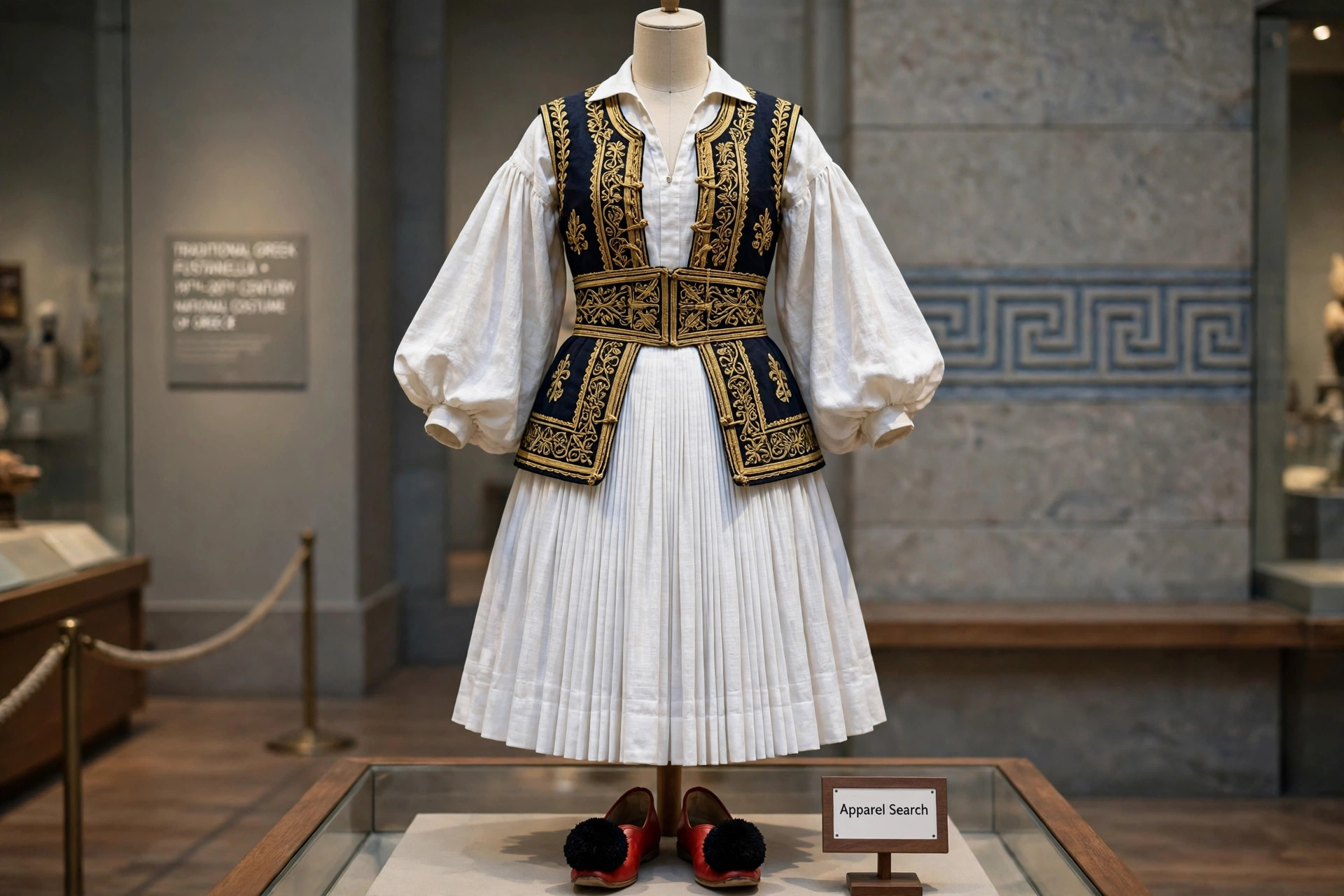
The fustanella is a man's skirt: a length of white cotton or linen cloth, gathered and pleated at the waist into hundreds of fine folds that flare to about the knee. Worn with a wide-sleeved white shirt, an ornate embroidered waistcoat and pomponned shoes, it makes up the most recognisable traditional costume in Greece — the dress of the Evzone guards in Athens, and the image that stands for Greek folk dress around the world.
Its roots are Balkan and shared. Pleated skirt garments were worn across the southern Balkans and the wider Ottoman world — by Albanian, Greek, Aromanian and other communities — varying by geography, occupation and wealth more than by any fixed ethnic line. In the Greek lands the fustanella became especially associated with the klephts, the mountain brigand-fighters who resisted Ottoman rule, and the armatoles who policed the passes; when those men became the heroes of the Greek War of Independence in 1821, their dress became a national emblem with them. In the young Greek kingdom the costume was formalised — worn at court under King Otto and standardised for the Evzone battalions established in the nineteenth century — and the regional working garment became, deliberately, a uniform of the nation.
That double life is the fustanella's story ever since: a practical mountain garment, pleated so a fighter or shepherd could stride, climb and ride, recast as the most ceremonial dress in the country. The version visitors see in Athens is its most developed form, handmade and maintained to a standard few working garments ever meet — but village and folk-dance versions across mainland Greece keep the older, simpler line alive.
Anatomy
The Parts of the Outfit
The full costume is an ensemble of named pieces, each with its own craft. From the head down, in its Evzone form:
- Farion — the cap
- A scarlet felt cap (a small fez) with a long black silk tassel, bearing the national emblem at the front. In folk versions a simple cap or headscarf served instead.
- Ypoditis (poukamiso) — the shirt
- A white shirt with very wide, full sleeves that flare dramatically as the arms move — on parade they are part of the spectacle, said to symbolise the purity of the national purpose.
- Fermeli — the waistcoat
- The costume's masterpiece: a sleeveless (or short-sleeved) waistcoat, traditionally called the yeleki in its wider Balkan form, hand-embroidered in white, silk or gilt cord over dark wool. The fermeli is the most intricate and slowest-made piece of the uniform — months of work in the Guard's workshops — and its lower sleeve stripes quietly mark rank: one for a corporal, two for a sergeant. The related long embroidered coat of the everyday Evzone uniform is the doulamas.
- The fustanella itself
- The pleated white skirt, made — in the ceremonial version — from around 30 metres of cloth, pleated, washed and pressed so the folds stand crisp. Blue-and-white fringes, the krossia, in the colours of the Greek flag, hang at the waist.
- Periskelides and garters
- Thick white woollen stockings — the Evzones wear two on each leg — held by black silk garters (kaltsodetes) tied below the knee with tassels.
- Tsarouchia — the shoes
- Red leather shoes with sharply upturned toes, each crowned with a black pompon (founta), hand-cut to shape. The Guard's tsarouchia are studded beneath with dozens of nails and weigh well over a kilogram each; the nails' click on stone is part of the changing of the guard's sound.
- Belt and cartridge case
- A leather belt — in fighting dress historically a wide sash and cartridge belt (selahi) holding pistols, knife and ammunition — completes the waist where shirt, waistcoat and skirt meet.
The Pleats
Four Hundred Pleats: Tradition's Claim
Ask about the fustanella and you will be told about its pleats: the ceremonial skirt is said to have 400 pleats, one for each year of Ottoman rule — the Tourkokratia — that Greece endured before independence. It is a powerful piece of symbolism, and it should be repeated exactly as that: tradition's claim, not a measured specification. Skirts are made by hand, pleat counts vary, and the number's meaning matters more than its arithmetic — the liberated soldier quite literally wearing the years of occupation, transformed into the dress of a free state.
What is certain is the labour. Tens of metres of white cloth are pleated by hand, and the Guard's fustanellas are washed, starched and pressed with a care closer to liturgy than laundry: the pleats must fall in an unbroken white fan, and any Athenian will tell you the standard is exacting. In folk use the pleats had a plainer virtue — a pleated skirt gives a full stride on mountain paths and falls back into place, which is why pleated dress served fighters and shepherds long before it served ceremony.
The Evzones of Athens
Every hour, at the Tomb of the Unknown Soldier in front of the Hellenic Parliament, the Presidential Guard changes in one of Europe's great small ceremonies: two Evzones in full dress move in slow, deliberate, high-stepping unison, rifles shouldered, tsarouchia striking sparks and echoes from the stone. On Sundays at 11 a.m. the full guard changes with a military band. The soldiers are volunteers from the Hellenic Army, selected for height and bearing, and their uniforms are made and maintained by the Guard's own tailors — the fermeli embroidered by hand, the fustanella pleated and pressed in-house, the tsarouchia nailed and polished. It is traditional dress kept alive not in a case but on duty, in all weathers, every day of the year.
Beyond the Fustanella
Mainland and Island Folk Dress
Greece has never had one costume. The fustanella is the dress of the mainland mountains and the national guard; the rest of the country's folk dress is a rich patchwork that this guide can only sketch. Crete dresses its men differently: the vraka — baggy black breeches tucked into high boots — with a black waistcoat, a woven sash and the black fringed headscarf (sariki) still seen at Cretan weddings and dances, where the island's embroidered dress and heavy silver jewellery dress the women. The Aegean islands developed their own ensembles: white breeches and embroidered waistcoats for men, and for women layered dresses with richly embroidered bodices, aprons and headscarves, each island — Skyros, Rhodes, the Cyclades — keeping its own embroidery hand. Women's mainland dress is a world of its own: the chemise and sleeveless sigouni coat of Roumeli, the heavily embroidered costumes of Attica and Boeotia, coin- and embroidery-covered bodices in Macedonia and Thrace, where Bulgarian, Pontic and other traditions meet.
Jewellery and metalwork complete the regional picture. Mainland and island brides wore silver and gold with their festive dress — buckles and belts in the north, coin necklaces and heavy earrings in the islands, the Cretan man's silver-mounted knife at his sash — and a costume displayed without its jewellery is only half dressed. Folk museums therefore keep dress and jewellery together, region by region, and dance ensembles do the same: the silver is not decoration added to the costume, it is part of the costume, saved for, inherited and worn with the same pride as the embroidery itself.
To call the fustanella “Greek dress” is true only as shorthand — it is the national emblem of a country whose real wardrobe is gloriously plural.
Living Dress
When the Fustanella Is Worn Today
Today the fustanella lives in ceremony. The Presidential Guard wears it daily in Athens — the full white dress on Sundays, national holidays and the reception of foreign dignitaries, the blue or khaki doulamas tunic on ordinary weekdays. Folk-dance ensembles across Greece and the diaspora perform in fustanella and regional dress, schoolchildren wear it for the national parades of 25 March (Independence Day) and 28 October (Ohi Day), and it appears at festivals, weddings by choice, and official folk representation abroad.
Behind the ceremony stands real craft: the Guard's workshops, folk-costume makers, embroiderers and shoemakers who still cut tsarouchia by hand — one thread of the wider industry profiled on our Greece clothing industry page. Museums such as the Museum of Greek Folk Art in Athens preserve the regional originals from which the ceremonial version descends, and it is there — pleat by pleat, stitch by stitch — that the costume's working past is best studied.
Wearing
Wearing Basics
The costume is worn as a set, and its order matters: stockings and garters first, then the wide-sleeved shirt, the fustanella settled and pleats arranged evenly all round, the fermeli over the shirt and fastened, and the tsarouchia last. The skirt should hang level at about the knee, its pleats falling in a continuous fan — a twisted waistband ruins the effect at once. The full Evzone dress is heavy, formal and unmistakably military in its associations; outside Greece it belongs to folk-dance and official contexts, and within Greece it is worn with the respect due to what has become, in effect, a national uniform.
Keeping
Care and Storage
White pleats are the maintenance. A fustanella is washed, then pleated and pressed fold by fold — in the Guard, by specialists whose whole craft is keeping the white fan crisp — and stored hanging or carefully folded so the pleats are not crushed flat. The fermeli, dense with cord embroidery over wool, is brushed and aired rather than washed, and kept from moths as all wool must be. Tsarouchia are polished leatherwork: keep them stuffed to hold the upturned toe, condition the leather, and shape the pompon by hand. Folk ensembles store complete costumes together, labelled by region — a discipline museums share, since a fermeli separated from its skirt loses half its meaning.
Acquiring
Buying and Collecting
Antique Greek costume is collected through folk-art dealers and auctions, and the fermeli is its prize: a finely cord-embroidered nineteenth-century waistcoat, its pattern dense and even, is a serious textile by any standard. Judge pieces by the embroidery's fineness, the honesty of their condition and any provenance to a region — a costume with a known island or village origin is worth more, in every sense, than a prettier anonymous one. New costumes are made by folk-dance outfitters in Greece for ensembles and guards; tourist-shop versions in Athens compress the whole costume into a souvenir, charming as a keepsake but no substitute for the handmade thing. As with all national dress, buy the craft, not the caricature.
Common Questions
Common Questions
What is a fustanella?
The fustanella is a white, knee-length, heavily pleated skirt-like garment traditionally worn by men in mainland Greece and across parts of the Balkans. In Greece it forms the centrepiece of the costume completed by a wide-sleeved white shirt, an embroidered waistcoat called the fermeli, white stockings and red tsarouchia shoes with pompons — the dress best known today from the Evzones of the Presidential Guard.
Why does the fustanella have 400 pleats?
Tradition says the ceremonial fustanella of the Evzones carries 400 pleats, one for each of the roughly 400 years of Ottoman rule over Greece. The figure is best understood as tradition's claim rather than a tailor's specification — pleat counts vary — but the symbolism is the point: every fold is said to hold a year of occupation, worn by a free Greek soldier.
What are tsarouchia?
Tsarouchia are the red leather shoes of the fustanella costume, with upturned toes each crowned by a large black pompon (a founta). The Evzones' version is famously heavy, its sole studded with nails that click and spark on parade ground stone; in folk use the tsarouchi was a sturdy mountain shoe, and its pompon is said to have protected the toes and kept off snow and mud.
Who are the Evzones?
The Evzones were historically elite light infantry and mountain units of the Greek Army, named for their distinctive dress. Today the name belongs above all to the Presidential Guard in Athens, whose soldiers — still called Evzones — mount the ceremonial guard at the Tomb of the Unknown Soldier and the Presidential Mansion in full fustanella dress, changing the guard every hour in a slow, high-stepping ceremony.
Is the fustanella still worn outside ceremonies?
As everyday dress, no — the fustanella belongs now to ceremony, folk dance and national occasions. It is worn by the Presidential Guard daily in Athens, by folk-dance ensembles and at festivals and national celebrations across Greece, and it remains the recognised national costume for formal folk representation, while regional dress such as the Cretan vraka survives alongside it.
Keep Exploring
More to Explore
In This Series
Search Apparel Search