Traditional Dress by Country · Germany & Austria
Germany & Austria — Dirndl and Lederhosen
In Bavaria and Austria, traditional dress never quite went away. The dirndl — bodice, blouse, full skirt and apron — and leather lederhosen with embroidered braces are worn to church festivals, weddings, markets and beer gardens as well as to the Oktoberfest the world knows them from. Together they are called Tracht: not costume, but a living regional wardrobe with its own rules, its own craftspeople, and even a silent language — the side on which a dirndl’s apron bow is tied. This guide explains both garments piece by piece, what the bow means, how Tracht varies from valley to valley, and how to wear, care for and buy it well.
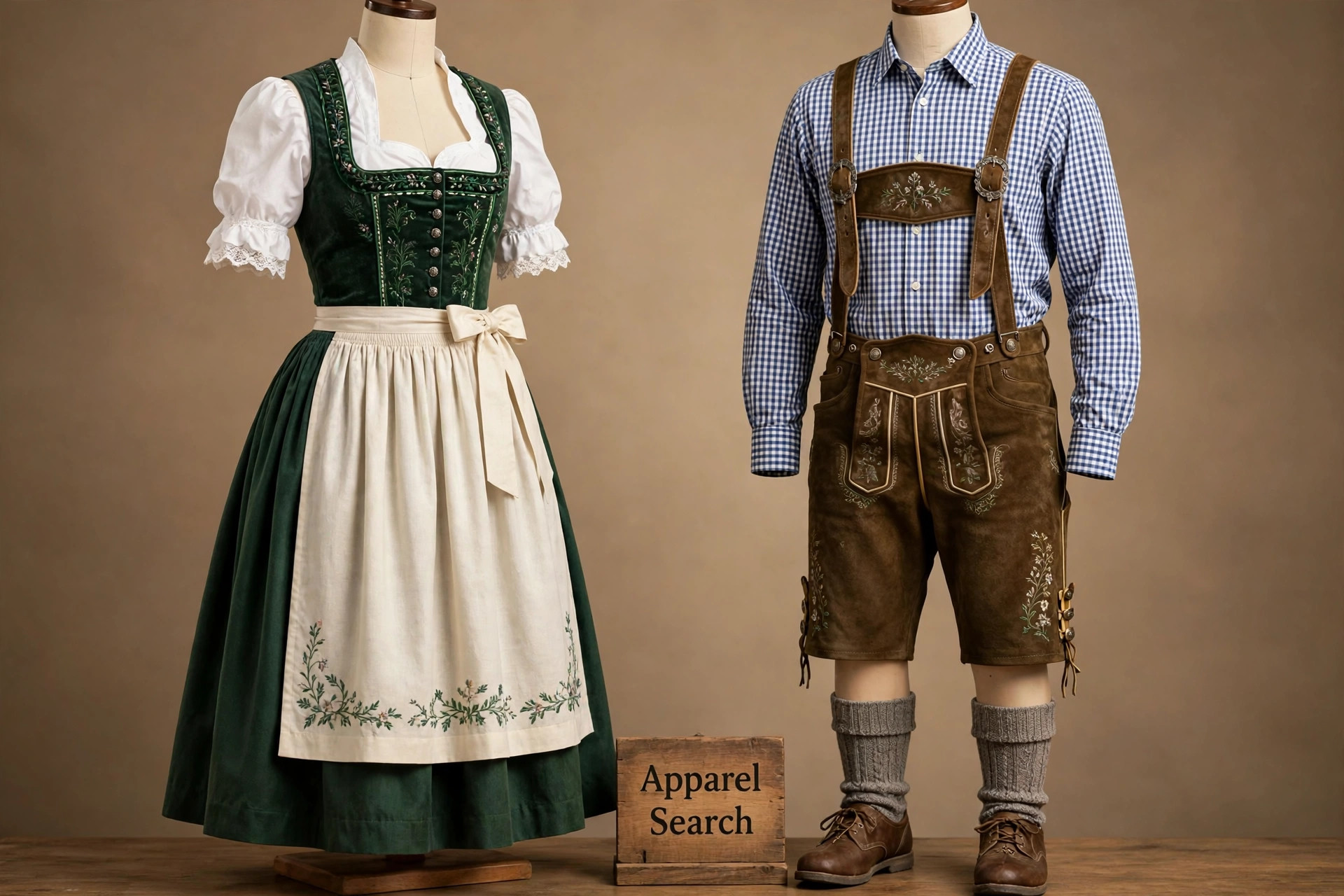
The Garments
What Tracht Is
Tracht — from tragen, to wear — is the German word for traditional regional dress, and in the Alpine south of Germany and across Austria it names a wardrobe that is still genuinely worn. Its two best-known garments began as work clothes. The dirndl takes its name from Dirn, a young woman or maidservant in the Bavarian-Austrian dialect: it was the practical dress of farm and domestic workers in the eighteenth and nineteenth centuries — a fitted bodice and full skirt that could be washed, mended and worn hard, with an apron protecting the skirt front. Lederhosen, literally “leather breeches,” were the working trousers of Alpine farmers, hunters, foresters and labourers: leather because it outlasted cloth in rough country, short or knee-length because legs needed to move on steep ground.
In the late nineteenth century both garments were taken up with enthusiasm by townspeople and the aristocracy holidaying in the Alps, and Tracht became a badge of regional identity as much as a working dress. Heritage associations — Trachtenvereine — were founded to preserve the local forms, and they still flourish: their members wear the documented dress of their own town or valley, keep the dances and festivals that go with it, and can be strict about details an outsider would never notice. That is the first thing to understand about Tracht: it is local. There is no single German dirndl and no single Austrian one. The Miesbacher Tracht of Upper Bavaria, with its fitted dark bodice and silver fittings, became a reference point in the twentieth century, but Salzburg, Styria, Tyrol, the Allgäu and a hundred smaller districts each keep their own colours, cuts and accessories — and a knowledgeable wearer can place an outfit to its valley.
The second thing is the distinction locals draw between Tracht itself and Trachtenmode — fashion in the Tracht style. A true dirndl is built like a garment, from cotton, linen, wool, silk or velvet, with a structured bodice; a festival-fashion version may be a single zipped dress in printed polyester. Both appear at Oktoberfest, but they are not the same thing, and the sections below describe the real construction.
Anatomy
The Parts of the Outfits
A dirndl is four pieces working together, and lederhosen are worn as a set of their own. The full inventory:
- The dirndl dress — Mieder and skirt
- The dress itself: a close-fitted, often boned or firmly lined bodice (the Mieder) fastened with hooks, buttons or lacing, joined to a full, gathered skirt. Length is a matter of era and taste — traditional Tracht sits below the knee or at mid-calf; shorter festival styles are a modern fashion choice. Our women’s dirndl guide covers dirndl styles as clothing to buy and wear today.
- Bluse — the blouse
- A short blouse worn under the bodice, usually white, its puffed or elbow-length sleeves and its neckline — round, square or heart-shaped — framing the bodice above. Blouses are interchangeable, and changing the blouse changes the whole outfit’s mood.
- Schürze — the apron, and its bow
- The apron is never optional on a traditional dirndl: a panel of cotton, linen, silk or lace tied over the skirt front, finished with a bow. Where the bow sits is the famous code, set out in the table below.
- Lederhosen — the leather breeches
- Short (above the knee) or knee-length (Kniebundhosen) breeches in deerskin, goatskin or cowhide, with a drop-front flap (the Latz) fastened by horn buttons, raised hand embroidery in Alpine motifs — edelweiss, oak leaves, deer — side lacing or a laced back gusset to adjust the fit, and traditionally a small knife pocket on the right leg. A specialist maker is a Säckler; a good pair is an heirloom. See our men’s lederhosen guide for styles and buying advice.
- Hosen-Träger — the braces
- Leather suspenders buttoned to the breeches, in H-form with an embroidered cross-piece (the Steg) across the chest, or V-form. The cross-piece is a small canvas for embroidery and often carries the district’s motifs.
- Shirt, Janker, socks and Haferl shoes
- A plain white or checked shirt; over it, for cooler weather and smarter wear, the Janker — a straight-cut wool jacket, traditionally in grey, green or brown with a contrasting collar stand. On the legs, knee socks or the two-part Loferl (a calf warmer worn with a short foot sock), and on the feet sturdy Haferl shoes — heavy leather shoes whose shape is said to follow a goat’s hoof. A decorative chain, the Charivari, may be worn across the Latz, and a hat with a brush of chamois hair (Gamsbart) completes festive dress.
The apron bow deserves its own table. Positions are judged from the wearer’s left and right — the point beginners most often get backwards:
| Bow position | Traditional meaning |
|---|---|
| Left | Single — unmarried and unattached |
| Right | Taken — married, engaged or in a committed relationship |
| Centre front | Traditionally a maiden or virgin; today most often worn by children, or chosen as a neutral position |
| Back | Traditionally a widow; also the practical tie for waitresses and serving staff at work |
A note of honesty about the code: it is a widely observed modern convention rather than an ancient law, its centre and back meanings vary a little by district — in parts of Upper Austria and Styria, for instance, aprons are commonly tied at the back as a matter of course — and nobody is bound by it. But at a folk festival it is still read, and tying your bow deliberately is part of wearing a dirndl properly.
Formality and Region
Types, Occasions and Regional Styles
Tracht grades itself the way suits do. At the everyday end are cotton dirndls in small prints and sturdy lederhosen worn for village festivals, markets and the beer garden. Festtagstracht — festival dress — is the formal grade: silk or velvet bodices, fine lace blouses, silk aprons, silver jewellery and coin chains for women; the best deerskin lederhosen, an embroidered Steg, a Janker and a hat for men. Between the two sits the smart dirndl or lederhosen outfit worn to weddings, christenings, first communions and family celebrations, where in much of Bavaria and Austria Tracht is not an alternative to formal dress — it is formal dress, and a guest in a well-made dirndl is dressed exactly as correctly as a guest in a cocktail dress.
Regional variation is the soul of the system. Bodice colours, skirt lengths, apron fabrics, hat shapes and jewellery all change from district to district, and Trachtenvereine document their local form down to the buttons. Austrian Tracht has its own strongholds — the Salzburg and Styrian styles are famous, and the dirndl of the Wachau, in blue-print cotton with a white apron, is a working dress still worn daily by some. Germany’s Tracht map extends well beyond Bavaria — the Black Forest’s Bollenhut, with its great red pom-poms, is the best-known northern example — but it is the Alpine dirndl and lederhosen that the world has adopted, and this guide follows them.
The Festival Calendar
Worn All Year, Not Just at Oktoberfest
Oktoberfest in Munich is the largest stage, but the Tracht calendar runs all year: parish festivals and Corpus Christi processions, Maypole raisings on 1 May, cattle-driving celebrations when the herds come down from the Alpine pastures in autumn, Christmas markets, weddings in every season, and the Sunday beer garden. A Munich local’s dirndl or lederhosen is not a costume pulled out once a year — it is the good outfit, kept ready.
Living Dress
When Dirndl and Lederhosen Are Worn Today
The Oktoberfest is where most visitors meet Tracht: Munich’s festival fills its tents with dirndls and lederhosen worn by locals and guests alike, there is no dress code requiring them, and wearing a proper outfit is taken as joining in. The festival’s Traditional Costume and Marksmen’s Parade, held on the first Oktoberfest Sunday, is the great showpiece of documented regional Tracht. But the same garments serve the whole folk-festival (Volksfest) circuit across Bavaria and Austria — hundreds of local fairs, church consecration festivals (Kirchweih), wine and harvest festivals — and the quieter occasions listed above, where Tracht signals respect for the event rather than festivity alone.
Tracht also has a working present: waitresses in traditional beer halls wear the dirndl as a uniform (apron tied at the back, out of the way), hotel and shop staff in Alpine resorts wear it daily, and folk-dance and music groups perform in their district dress. For the industries behind the festivals and the garments, our Germany clothing industry page profiles the German apparel and textile sector, and our Austria clothing industry page does the same for Austria — two countries whose Tracht traditions are intertwined, but whose modern industries each deserve their own directory.
Fitting
Wearing Basics
A dirndl should fit like tailoring, not like a costume: the bodice snug enough to need a firm pull on its fastenings, the blouse sitting smoothly inside its neckline, the skirt falling from the natural waist, and the apron tied at the waist with its bow placed — deliberately — on the side your message intends. Under it, a dirndl bra or a well-fitting ordinary bra shapes the blouse’s neckline; petticoats are optional and mostly a fashion choice. Lederhosen are bought snug — new leather should feel almost too tight at the waist, because it gives with wear and moulds to the body; braces button on, the shirt is tucked in, socks are pulled to the knee or the Loferl set at the calf, and trainers are the one thing that spoils the set: Haferl shoes or any sturdy leather shoe complete it. Both outfits are worn with the confidence of ordinary clothes — because that is what, in their home country, they are.
Keeping
Care and Storage
The dirndl’s pieces are cared for separately: blouses and aprons wash like the fine cotton, linen or silk they are; the dress itself is aired after wear, spot-cleaned, and professionally cleaned only when needed, since bodice structure suffers in washing. Store it hanging, out of light, with the apron untied so its bow takes no set. Lederhosen ask for the opposite treatment — almost none. Leather breeches are traditionally never washed in water; they are brushed, aired, and allowed to develop their patina, which wearers prize as the record of years of festivals. Stubborn marks are a specialist leather cleaner’s job. Keep them dry, on a wide hanger, away from radiators that crack leather, and treat the braces’ embroidery as you would any needlework. A Janker, being good wool tailoring, wants brushing, airing and moth protection. Looked after this way, both garments routinely outlast their fashion equivalents by decades.
Acquiring
Buying and Collecting
Buy a dirndl by its construction: a real bodice with structure, natural fibres, a skirt with enough cloth to gather fully, and a separate blouse and apron you can change. Fit matters more than decoration — a plain, perfectly fitted dirndl in cotton outclasses a glittering loose one. Specialist Tracht shops in Munich, Salzburg and the Alpine towns will advise on regional styles and alter to fit; expect a good dirndl to cost like a good dress, and a silk festival dirndl considerably more. Lederhosen are bought on leather and stitching: deerskin softest and dearest, goatskin a fine middle course, cowhide the toughest; hand-raised embroidery, horn buttons, laced adjustment and a maker’s name are the marks of the real thing, and a Säckler-made pair is priced — and lasts — like the heirloom it is. Secondhand Tracht is a thriving, sensible market in both countries: leather already broken in and dirndls from closed wardrobes change hands constantly, and a vintage piece in your district’s style is a find, not a compromise.
Common Questions
Common Questions
What does the position of the dirndl apron bow mean?
By the well-known modern convention, the bow is a quiet signal about the wearer, judged from the wearer's own left and right. Tied on the left it means single; on the right, married, engaged or otherwise taken; at the centre front it traditionally meant a maiden, and today is often worn by children or simply as a neutral choice; tied at the back it traditionally marked a widow, and it is also how serving staff tie their aprons for work. It is a custom, not a law — but at a Bavarian or Austrian festival, people do still read it.
What are the parts of a dirndl?
Four pieces worn together: the dress itself, with its fitted bodice (the Mieder) and full gathered skirt; a short, usually white blouse (Bluse) worn underneath, its sleeves and neckline showing; and an apron (Schürze) tied over the skirt at the front. Change the blouse or the apron and the same dress reads differently, which is why dirndl owners often own several of each.
What are lederhosen made from, and how long do they last?
Real lederhosen are leather breeches — traditionally deerskin, the softest and most prized, with goatskin and cowhide as hard-wearing alternatives. They were Alpine workwear before they were festival dress, and they are built accordingly: a good pair, kept dry and worn in, moulds to its owner, develops a patina, and lasts for decades — long enough to be handed down. Embroidered braces, horn buttons and a drop-front flap mark the traditional construction.
What is the difference between Tracht and Trachtenmode?
Tracht is the real thing: traditional dress rooted in a particular region, made from natural materials and, in its strictest form, kept to local rules by heritage associations (Trachtenvereine) — a Miesbach outfit is not an Allgäu one. Trachtenmode is fashion inspired by Tracht: the dirndl-style dresses and lederhosen-look shorts sold for festivals. Both fill the Oktoberfest tents, but locals can tell them apart at a glance.
Do I have to wear a dirndl or lederhosen to Oktoberfest?
No — there is no dress code, and ordinary clothes are fine in every tent. But a large share of visitors, locals included, do wear Tracht, and wearing it respectfully is welcomed as joining in rather than dressing up. If you buy or hire an outfit, wear it properly: the full set of pieces, the apron tied with its bow placed deliberately, and real shoes rather than trainers.
Keep Exploring
More to Explore
In This Series
Traditional Dress by Country
The series hub — every country guide, from the hanbok of Korea to the sarafan of Russia, as each is published.
Visit the hub ↑Germany Clothing Industry
Germany’s apparel and textile industry directory — the modern industry of the country whose south keeps Tracht alive.
Explore ↑Austria Clothing Industry
Austria’s apparel and textile industry directory — Salzburg, Styria and the Alpine Tracht heartland.
Explore ↑Go Deeper on Dirndl and Lederhosen
Search Apparel Search