Traditional Dress by Country · Peru
The Andean Dress of Peru
In the Peruvian highlands, clothing is a language. The shape of a woman’s hat names her village, the woven bands of her shawl carry her community’s patterns, and her layered pollera skirts are built, layer over layer, against the mountain cold. Woven from alpaca and sheep wool on the backstrap loom and coloured with cochineal and plant dyes, Quechua Andean dress is at once working clothing, identity document and one of the world’s great textile arts. This guide explains its parts, its regions and its making, and how it is worn, cared for and collected today.
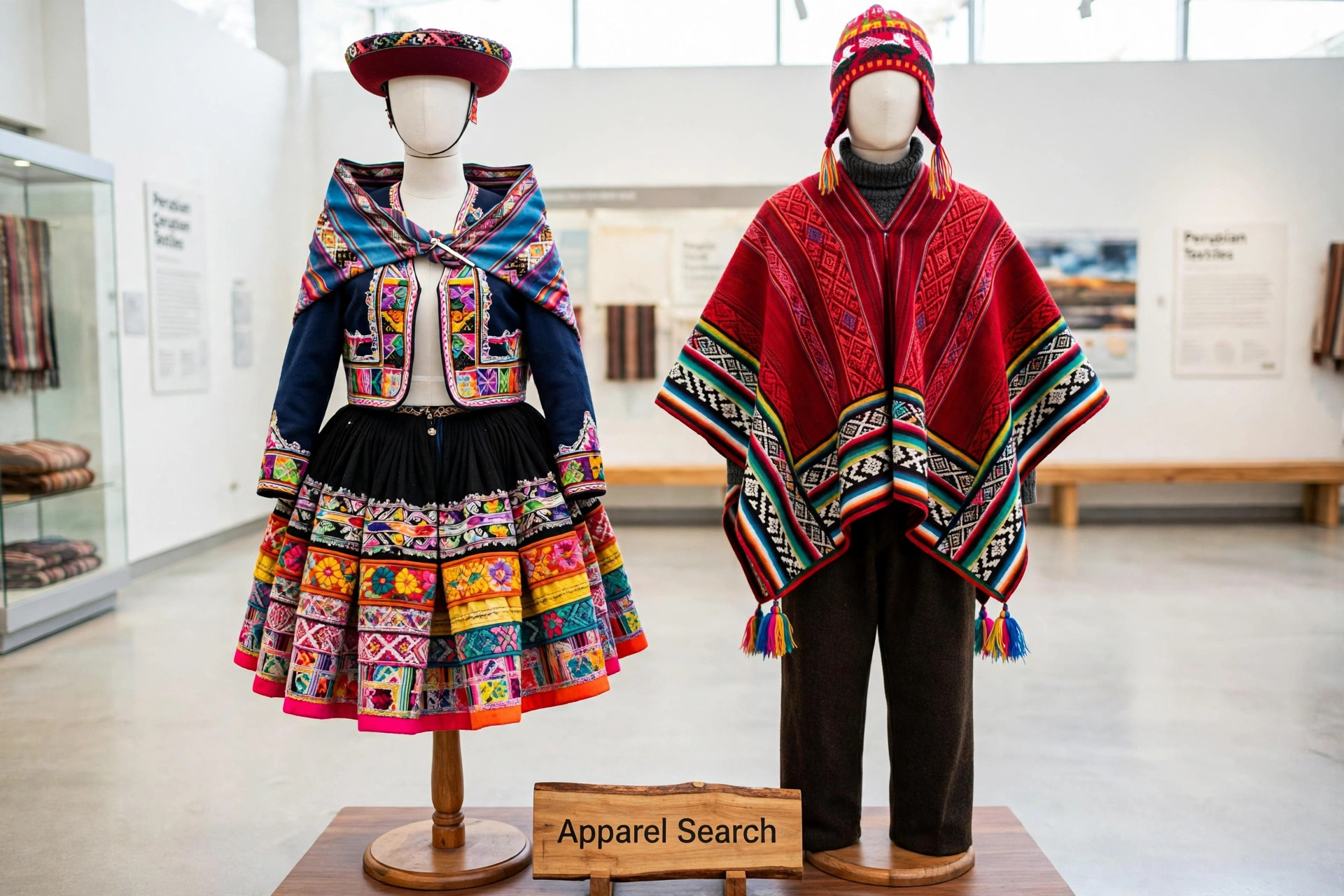
The Garment
Dress of the High Andes
High in the Peruvian Andes, dress is information. A woman crossing a market square in Cusco or Puno carries her home village in the shape of her hat, the pattern of her woven shawl and the colours of her layered skirts — legible at a glance to anyone from the highlands. This is the traditional dress of Peru’s Quechua communities (and, around Lake Titicaca, of Aymara communities too): a wardrobe of wool, built in layers against mountain cold and sun, and woven by hand with techniques older than the Inca state that once organised textile production across these same valleys.
The wardrobe is a meeting of two worlds. Its weaving — the backstrap loom, the warp-faced cloth, the camelid fibres — is Indigenous and ancient. Several of its garment shapes are Spanish: the full skirt called the pollera began as a colonial imposition, ordered for Indigenous women in the Spanish style, and was remade by Andean weavers in their own wool, their own dyes and their own patterns until it became a badge of Indigenous identity. The hat, the shawl, the knitted cap and the poncho each carry a share of the same double inheritance. Our short definition of poncho covers the simplest and most famous of these garments on its own.
Unlike the occasion dress in many chapters of this series, highland Andean dress is still daily dress in much of rural Peru — worn for farming, herding, markets and school runs as well as for the festivals where it reaches its fullest form. That is what gives it its density of meaning: these are working clothes that never stopped being art.
Anatomy
The Parts of the Outfit
A woman’s outfit is assembled in layers, each with a Quechua name and a job. A man’s is simpler — but his poncho and knitted cap carry the same community patterns as his wife’s weaving.
- Pollera — the layered skirt
- A full, gathered skirt of hand-woven wool cloth (bayeta), its hem finished with a woven or embroidered band called the puyto. Polleras are worn in layers — several at once for warmth and volume in daily life, and more, in the best embroidered cloth, for festivals. The layering is the silhouette: a bell of coloured wool built skirt over skirt.
- Jobona — the jacket
- A short wool jacket worn under the shawl, fitted and fastened with rows of coloured buttons, its cuffs and fronts often embroidered. It gives the outfit its structured upper half against the pollera’s volume.
- Lliclla — the woven shawl
- A rectangular hand-woven cloth worn over the back and shoulders like a small cape, fastened at the chest with a pin — traditionally a decorated metal tupu. The lliclla is the outfit’s canvas: its warp-patterned bands (pallay) carry the motifs of the weaver’s community. A larger carrying cloth, the aguayo (in Quechua, k’eperina), is folded over the back to carry a baby, produce or market goods, the load held by the cloth knotted or held at the chest.
- Chumpi — the belt
- A narrow woven belt, wound at the waist over the polleras. Its patterns match the lliclla’s, and its tight winding helps support the back under a carrying load.
- Montera — the hat
- The most local garment in Peru. The montera is a stiff, structured hat whose shape, colour and decoration identify the wearer’s community — flat discs, round crowns, upturned brims, each valley with its own form, as the table below shows. It is held by the sanq’apa, a woven chin strap heavy with white beads.
- Chullo — the knitted cap
- A knitted wool cap with earflaps, worn by men and children against the altiplano cold. Its patterns are as local as the montera’s shapes: on Taquile Island in Lake Titicaca, where the men are the knitters, the chullo’s colours and the way it is worn carry information about its wearer.
- Poncho — the man’s outer garment
- A large rectangle of woven wool with a slit for the head — the word comes from the Quechua punchu — woven in two panels and joined, its fields and striped pattern bands varying by community. The Cusco poncho is characteristically deep red with fine linear patterning. A poncho is blanket, coat and rain-shed in one.
- Ojotas — the sandals
- The highland sandal (Quechua usuta), traditionally of leather, today most often cut from recycled tyre rubber for the sole — light, hard-wearing footwear worn by men and women alike, in fields and markets, in all weathers.
One garment, three regions — the montera is the quickest lesson in how Andean dress maps geography:
| Region | Montera form | Notes |
|---|---|---|
| Cusco and the Sacred Valley | Flat and disc-like, broad and round, often in red felt with colourful fringe | Around Chinchero and Pisac the flat montera, tied with the beaded sanq’apa, names the wearer’s village |
| Puno and Lake Titicaca | Taller and bowl-shaped, with pom-poms; wavy-rimmed forms on the Capachica peninsula | Heavy polleras and the chullo-knitting tradition of Taquile belong to the same lakeside dress world |
| Colca Canyon (Arequipa) | Two forms side by side: a white straw hat with coloured ribbons, and a low hat dense with embroidery | The white hat marks Collagua women, the embroidered hat Cabana women — the two peoples of the canyon, distinguished by dress since their head-shaping customs were banned in colonial times |
Occasion
Daily Dress and Festival Dress
Andean dress has no separate “costume” — it has degrees. The daily outfit is the festival outfit’s foundation: the same polleras, jobona, lliclla and montera, in working cloth, worn fewer layers deep, the shawl as likely to be carrying potatoes or a child as sitting straight for display. Dressing up means adding: more polleras, the best embroidered skirt outermost, the finest lliclla, jewellery at the tupu, and the hat at its most decorated. Dancers’ outfits for the great festivals push the system further still — heavier embroidery, sequins, and skirts built to flare in the turn.
Colour and pattern do the identifying at every level. The woven bands of a lliclla or poncho are not generic decoration: a community’s pallay — its chosen warp patterns, its favoured colour order, its animal, plant and geometric motifs — are learned from mothers and grandmothers and repeated with variation, so that dress functions as a woven address. Two women in the same market may wear outfits identical in cut and entirely different in statement.
Cloth and Pattern
Fibre, Dye and the Backstrap Loom
The highlands dress in wool because the highlands are cold, and the wools are layered by history. The native camelids came first: alpaca, warm, soft and light, in a natural range from white through browns to black; llama, coarser, for heavy cloth and carrying; and vicuña, the wild camelid whose fleece is among the finest of any animal, reserved in Inca times for nobility and protected today. The Spanish brought sheep, whose wool now supplies much everyday cloth, including the bayeta of the polleras. Undyed natural fleece colours are woven as they come; the brilliant colours are dyed.
Traditional dyeing is a chemistry of the local landscape. Cochineal — a small insect harvested from cactus — gives the great Andean reds, and, shifted with minerals and mordants, pinks and purples. Indigo gives blue; plants such as ch’illca give greens; other plants, barks and minerals give yellows, oranges and browns. Weaving-centre demonstrations in the Sacred Valley still run the whole sequence in an afternoon: spin with a drop spindle, dye in steaming pots, weave.
The weaving itself is done largely on the backstrap loom: one end of the warp is tied to a post or tree, the other to a strap around the weaver’s waist, and her body supplies the tension. Andean cloth is warp-faced — the lengthwise threads are packed so densely that they hide the weft completely and carry the entire pattern — which is why the designs are built thread by thread as the warp is laid out, in the technique called pallay, “picking up” the pattern threads. A fine lliclla represents weeks of this work. Larger pieces such as ponchos are also woven on larger ground and vertical looms, in two panels joined at the centre.
Living Dress
When Andean Dress Is Worn Today
Travel anywhere in the Cusco, Puno or Ayacucho highlands and the dress in this guide is simply what people are wearing: at the great Sunday markets, on the paths between villages, at school gates and on buses. Its ceremonial peaks are the festival calendar — Inti Raymi in Cusco each June, the vast Virgen de la Candelaria celebrations in Puno each February, and hundreds of village fiestas with their dance troupes — where the fullest polleras, the most embroidered jackets and the most local hats come out together. Weaving cooperatives and textile centres, many of them women-led, sell cloth directly and teach the dye pots and the backstrap loom to visitors, keeping the skills paid as well as practised.
The poncho and the chullo have also travelled: both are now global cold-weather garments, knitted and woven far from the Andes. Our men’s ponchos guide covers the poncho as modern clothing to buy and wear. And the whole tradition sits inside a national industry that runs from village looms to Lima’s garment factories — our Peru clothing industry page profiles the country’s wider apparel and textile sector.
Wearing
Wearing Basics
The system is assembled from the skin out and the logic is thermal: polleras layered until the bell stands out and the legs are warm, the chumpi wound firm at the waist, the jobona buttoned, then the lliclla squared across the back and pinned at the chest with the tupu so its patterned bands sit level. The montera goes on straight and is tied under the chin with the sanq’apa; braids are worn in front of the shoulders or down the back according to local custom. A carrying cloth is a skill of its own — the load is set high on the back, the cloth brought over it and over the shoulders, and held or knotted at the chest, leaving the hands free. A man’s poncho is simply dropped over the head and settled square; the chullo’s flaps come down over the ears when the wind does. Visitors trying the dress at a weaving centre will be dressed by the weavers — the best way to feel how much engineering is inside what looks, in a photograph, like simple colour.
Keeping
Care and Storage
Hand-woven wool asks for the classic wool disciplines, with one Andean addition: respect the dyes. Good natural-dyed cloth is colourfast in ways its makers understood, but it is still washed cold, gently, and rarely — most pieces are aired and spot-cleaned rather than washed — and dried in shade, since high-altitude sun bleaches as fiercely as it warms. Never wring a lliclla: roll it in a towel, reshape it flat, and store it folded with the pallay bands unstressed. Alpaca and sheep wool are stored clean against moths, with cedar or lavender as the traditional deterrents. Knitted chullos are washed by hand and dried flat so the earflaps keep their shape. Embroidered festival pieces, with their sequins and metallic threads, are stored flat or rolled with tissue, like the china poblana skirts of Mexico — crushed embroidery does not recover.
Acquiring
Buying and Collecting
Peru is one of the best places in this series to buy the real thing, because the makers sell it themselves: in weaving-centre shops in Chinchero and the Sacred Valley, in Cusco’s artisan markets, and from cooperatives around Puno and Taquile. The judgements to learn are fibre and weave. True alpaca is soft, light and warm with a slight lustre; the “alpaca” of the cheapest tourist stalls is often acrylic, which is shiny, squeaky in the hand and cold by comparison — sellers at cooperatives will happily show you the difference, and a hand-woven backstrap cloth, dense and slightly irregular, is unmistakable next to a machine-woven imitation once both are in your hands. Ask which community wove a piece and what its patterns are called; the answer is part of what you are buying, and fairly priced handwork costs what weeks of labour should cost. A fine lliclla, a Cusco poncho or a Taquile chullo bought from its makers is a working textile, a community’s signature, and the surest support the tradition can receive.
Common Questions
Common Questions
What is traditional Andean dress in Peru?
Traditional Andean dress is the layered wool clothing of Peru's Quechua highlands (and of Aymara communities around Lake Titicaca). For women it means layered pollera skirts, an embroidered jobona jacket, a hand-woven lliclla shawl pinned at the chest and a region-specific montera hat. For men it means a woven poncho and a knitted chullo cap. It is still daily dress in much of rural Peru.
What is a pollera?
A pollera is the full, gathered skirt worn by Andean women, made of hand-woven wool cloth called bayeta and finished at the hem with a woven or embroidered band, the puyto. Polleras are worn in layers — several at once for warmth and volume, and more for festivals. The skirt began as a Spanish colonial garment and was remade by Andean weavers in their own wool, dyes and patterns.
What is a lliclla, and what is an aguayo?
A lliclla is a rectangular hand-woven shawl worn over a woman's back and shoulders and fastened at the chest with a pin called a tupu. Its warp-patterned bands, the pallay, carry the motifs of the weaver's community. An aguayo — k'eperina in Quechua — is a larger cloth of the same kind, used to carry a baby, produce or goods on the back.
How does a montera hat show where a woman comes from?
The montera is a stiff, structured hat whose shape is specific to each region and often to each village. Around Cusco it is flat and disc-like, in Puno taller and bowl-shaped with pom-poms, and in the Colca Canyon the white straw hat of Collagua women contrasts with the densely embroidered hat of Cabana women. Highlanders read a stranger's home from her hat at a glance.
What is a chullo?
A chullo is a knitted wool cap with earflaps, worn by Andean men and children against the high-altitude cold. It is knitted from alpaca or sheep wool, and its patterns are local to each community. On Taquile Island in Lake Titicaca, where men are the knitters, the chullo's colours and the way it is worn carry information about the wearer.
Keep Exploring
More to Explore
In This Series
Traditional Dress by Country
The series hub — every country guide, from the kimono of Japan to the galabeya of Egypt, as each is published.
Visit the hub ↑Peru Clothing Industry
Peru’s apparel and textile industry directory — from village looms to Lima’s garment sector.
Explore ↑Go Deeper on the Poncho
Search Apparel Search