Traditional Dress by Country · Mexico
The Charro Suit and China Poblana of Mexico
No pairing in traditional dress is more famous than Mexico’s: the charro in his silver-buttoned suit and great sombrero, and the china poblana in her sequined skirt and embroidered blouse, turning together in the Jarabe Tapatío. Behind the emblem stand two real crafts — the tailor’s, silversmith’s and hat-maker’s arts of the charro suit, graded from working dress to full ceremonial etiqueta, and the embroiderer’s art of Puebla — and a living equestrian tradition, charrería, recognised by UNESCO. This guide explains both outfits, their parts, their grades and their legend.
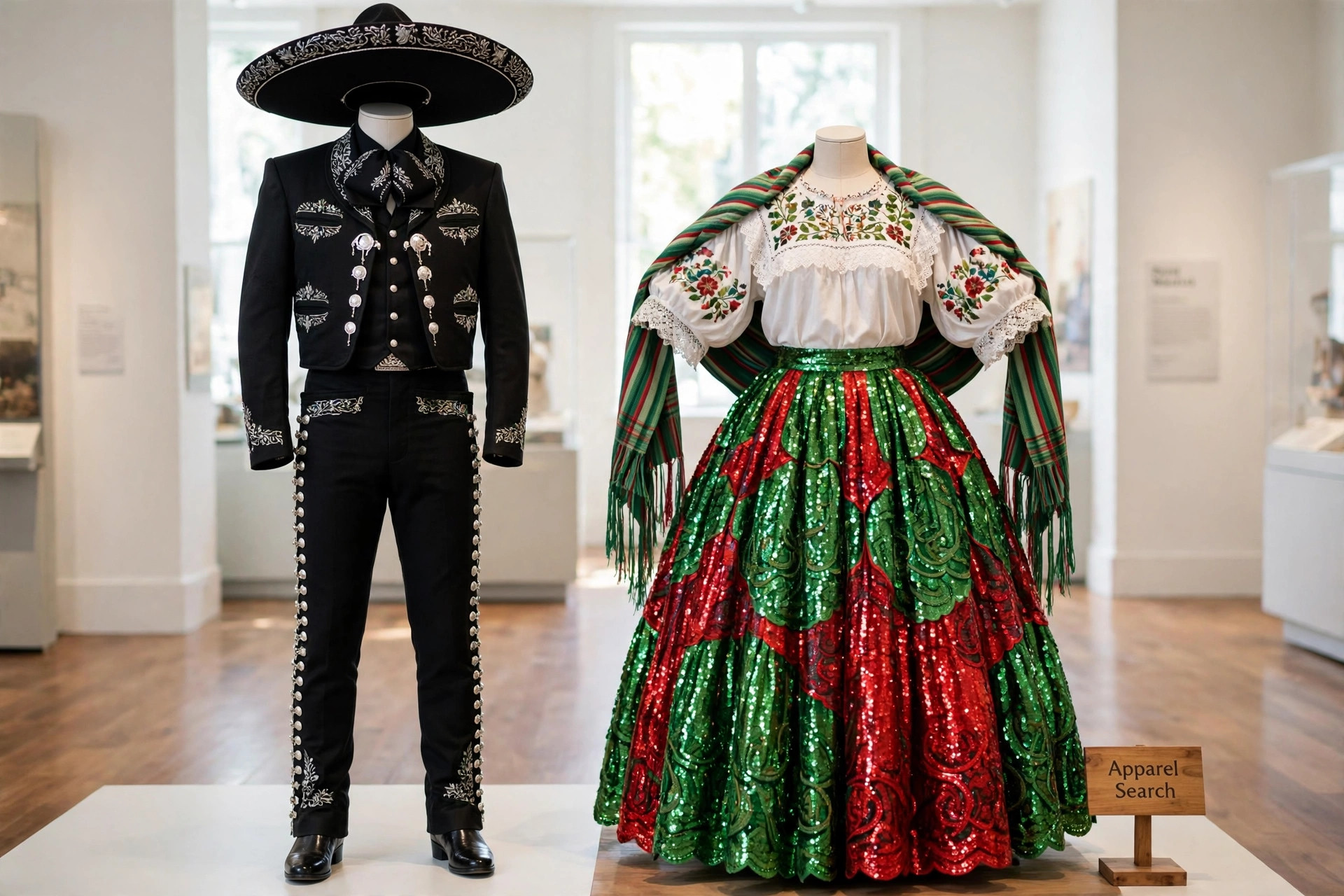
The Garments
Two Outfits, One Pairing
Mexico’s best-known traditional dress is a pair. The traje de charro — the charro suit — is the formal dress of the Mexican horseman: a short, fitted jacket and tight trousers covered in silver buttons and embroidery, crowned by a wide-brimmed sombrero. The china poblana is its female counterpart in the national imagination: a white blouse embroidered in silk and beads, a full skirt glittering with sequins, and a woven rebozo over the shoulders. Dancing together in the Jarabe Tapatío, the “Mexican hat dance,” the charro and the china poblana became the paired emblem of Mexico itself — a pairing fixed in the national imagination in the decades after the Revolution, when both outfits were taken up as symbols of a shared identity.
The charro suit grew out of work. The charros were the horsemen of the great cattle haciendas of central and western Mexico — Jalisco above all — whose roping, riding and livestock skills became, in time, the organised sport and ceremony of charrería. Their working dress was practical: close-fitting so that no loose cloth could catch on a horn or a rope, sturdy, and shaded by the broad sombrero. As charrería formalised in the early twentieth century, the suit formalised with it, until its embroidery, silverwork and tailoring made it a work of craft in its own right. Mariachi musicians adopted the same suit, which is why the charro outfit is now seen on stages as often as in the arena.
The china poblana has a different history — part documented, part legend, and told as legend below. What is certain is the garment itself, associated with the city of Puebla: by the nineteenth century the “china” was a recognised figure of Mexican popular dress, and her outfit — embroidered blouse, sequined skirt, rebozo, braided hair with ribbons — was codified as festive national dress in the twentieth. Both outfits are occasion dress today, worn with pride for charreadas, dances, parades and national holidays rather than as daily clothing.
Anatomy
The Parts of the Outfits
- Chaquetilla — the charro jacket
- A short, close-fitting jacket that ends at the waist, worn open or closed with ornamental brooches. Its fronts, cuffs and back carry embroidery or appliquéd suede designs (greca scrollwork), and on gala suits the work is done in silver or gold thread.
- Pantalón and botonadura
- The trousers are cut tight to the leg, and down the outside seam of each leg runs the suit’s signature: the botonadura, a row of buttons — silver on formal suits, bone, horn or suede-covered on plainer ones — linked in sets and often hung with small chains. It began as a practical fastening and became pure heraldry.
- Chaleco, camisa and moño
- A waistcoat (chaleco) and shirt are worn under the jacket, with the moño, a wide, soft bow tie of silk, at the neck. The most formal suits add a sash-like girdle (faja) at the waist, matched to the tie.
- Sombrero
- The wide-brimmed charro sombrero, in felt or palm according to grade, its brim and crown embroidered on formal suits with metallic thread (galoneado work). In the Jarabe Tapatío the hat is set on the floor and danced around — and finally onto — by the china poblana.
- Botines and chaparreras
- Short heeled boots (botines) with spurs for riding; leather chaps (chaparreras) go over the trousers for work and for some events in the arena.
- The china poblana blouse
- A white blouse, its yoke, front and sleeves embroidered with flowers in silk thread and beads (chaquira), often finished with lace. The embroidery is the blouse’s glory and is traditionally done by hand.
- The castor skirt
- The full, wide skirt — called the castor — is covered with sequins (lentejuelas) and beads worked into pictures and patterns: flowers, the Virgin, and above all patriotic emblems, including the Mexican eagle, in the green, white and red of the flag. White petticoats with zigzag lace show beneath the hem as the skirt turns in the dance.
- Rebozo
- The long woven shawl worn across the shoulders or over the head, its ends finished with knotted fringe. The rebozo is far older than the outfit it completes: a garment of every class in Mexico, used as wrap, head covering and carrying cloth. The blue-and-white ikat (jaspe) rebozos of Santa María del Río, in San Luis Potosí, are the classic partner to the china poblana.
The charro suit is formally graded by the national charro federation, from working dress to full ceremonial:
| Grade | Character | Worn for |
|---|---|---|
| Faena | The working suit — plain, sturdy fabrics, little or no metal ornament | Ranch work and charreada competition |
| Media gala | Some silver or leather trim, a vest, more finished tailoring | Competition and performance; many mariachi suits sit here and at gala |
| Gala | Full formal suit with silver botonadura and embroidered sombrero | Public appearances, parades, championships |
| Gran gala | The finest materials — silk, silver and gold work, girdle at the waist | Major state and ceremonial occasions |
| Etiqueta | The most formal of all, in black with gold and silver; not used in competition | Weddings, funerals and state affairs — the charro’s equivalent of evening dress |
The Legend
The China Poblana and Catarina de San Juan
Every china poblana carries a story, and the story must be told as what it is: a legend. Puebla tradition links the dress to Catarina de San Juan, a woman born in Asia — accounts place her origins in India — who was enslaved as a child and carried across the Pacific on the Manila galleon route to New Spain in the seventeenth century. In Puebla she became known for her piety and charity, and after her death in 1688 she was revered almost as a saint. Because Asians in colonial Mexico were loosely called chinos, she was remembered as “la China.”
The legend holds that her dress — a fusion of the clothing she brought with her and Mexican dress — became the china poblana. Historians question the connection: the china as a popular figure, and the sequined outfit itself, belong to the nineteenth century, long after Catarina’s death, and Spanish popular dress offers closer models for parts of it. The honest summary is that a beloved Puebla saint acquired, over time, a beloved Puebla dress. The pairing tells its own truth — about a port-city country built from Indigenous, Spanish and Asian threads arriving on the galleons — even where the biography cannot be proved.
Charrería: A Living Sport
Charrería is Mexico’s national sport: a suite of equestrian events, performed in a walled arena called a lienzo charro, that grew directly from the livestock work of the haciendas — roping, riding, and handling cattle and horses with skills first developed for the ranch. A full charreada runs through a set order of events (suertes), judged on skill and form, and its tenth event belongs to women: the escaramuza, in which teams of eight riders perform intricate, fast formations sidesaddle, wearing full-skirted Adelita-style dresses named for the women of the Revolution. In 2016 UNESCO inscribed “Charrería, equestrian tradition in Mexico” on its Representative List of the Intangible Cultural Heritage of Humanity — recognising the dress, the saddlery and the craft of the artisans who make them as part of the tradition itself.
Cloth and Craft
Fabric, Silver and Sequin Work
A charro suit is a tailor’s and a silversmith’s garment at once. The cloth of a fine suit is wool suiting or cashmere, cut close and stiffened to hold its sculpted shape; plainer suits use gabardine, twill or suede. The decoration runs on two tracks. The first is thread and leather: embroidery in silk or metallic thread, and cachiruleado, designs appliquéd in suede, scrolling across the jacket and down the trousers. The second is metal: the botonadura itself, cast and finished by silversmiths, together with the jacket brooches, belt buckles and hat ornaments. A suit, its sombrero and its matching saddle form a single commission, and charro tailors (sastres charros) and the artisans who embroider sombreros are named crafts in their own right.
The china poblana’s craft is the needle. Her skirt can carry thousands of sequins and beads, each sewn by hand, building the design up from a drawn pattern until the whole castor glitters as one surface; her blouse embroidery is worked in silk and chaquira beads. The rebozo is the weaver’s contribution — the finest jaspe rebozos are ikat-dyed before weaving, so their blurred white patterns on indigo or black are in the threads themselves, and their long fringes are knotted by specialists into openwork. None of the three crafts is quick, which is why good examples of both outfits are heirlooms rather than purchases.
Living Dress
When the Outfits Are Worn Today
The charro suit is worn wherever charrería is practised — at charreadas across Mexico and in Mexican communities abroad — and wherever mariachi plays, from plazas and restaurants to concert halls: the black gala suit with silver botonadura is the mariachi uniform the world recognises. Charros ride in parades and civic ceremonies, and the etiqueta suit still serves at weddings and formal occasions. The china poblana appears at folkloric dance performances, school and civic celebrations, and above all at the Fiestas Patrias of September, when the Jarabe Tapatío is danced in town squares across the country and the charro and china whirl around the sombrero once more.
Both outfits are also working symbols: they appear on everything from festival posters to the dress of dance companies touring abroad, carrying a whole culture’s idea of itself. Behind the symbols stands a real economy of tailors, embroiderers, silversmiths, hat-makers and weavers. Our Mexico clothing industry page profiles the country’s wider apparel and textile sector, from its garment factories to its famous weaving and embroidery regions.
Wearing
Wearing Basics
A charro suit succeeds or fails on fit: it is tailored to stand away from nothing and flap nowhere, the jacket short enough to show the botonadura’s full run, the trousers close to the leg and breaking just over the botín. The sombrero is worn level, the moño tied wide and flat, and for competition the federation’s rules govern every element down to the buttons on the cuff — charros dress to a code, and judges notice. The china poblana is assembled for movement: petticoats give the castor its bell, the rebozo is crossed over the shoulders or carried over one arm, and the hair is braided with ribbons — an outfit designed to be danced in, and heavy with sequins, so a dancer’s version is built lighter than a display piece. Visitors will meet simplified versions of both outfits at festivals and in markets; they are festive dress, and are worn as such, with the respect due to garments that carry a national meaning.
Keeping
Care and Storage
Silver is the charro suit’s glory and its chore: botonadura, brooches and hat ornaments tarnish, and are polished gently with a soft cloth — never dipped or scrubbed, since the buttons are often hollow and the chains fine. The suit itself is dry-cleaned by a cleaner who understands structured tailoring, and stored on a shaped hanger, the sombrero kept in its box or on a stand so the brim holds its line. Suede appliqué should never be wetted. The china poblana asks for the opposite patience: a sequined castor is never machine-washed — sequins crack, beads loosen and colours run — but aired, spot-cleaned, and stored flat or rolled with tissue between the folds so the sequin work is not crushed. Blouses are washed gently by hand and their embroidery ironed from the reverse. Rebozos are stored rolled, their fringes combed straight, away from light that would fade the ikat.
Acquiring
Buying and Collecting
A true charro suit is commissioned, not bought off a rail: the tailor measures, the silversmith casts the botonadura, the hat-maker shapes and embroiders the sombrero, and a gala or gran gala suit is priced accordingly — as bespoke formal wear anywhere. Mariachi and dance groups commission suits in matched sets. When judging one, look at the botonadura first (cast silver has weight and crisp detail; plated substitutes are light and soft-edged), then at the embroidery’s density and the jacket’s structure. For the china poblana, hand-sewn sequin work — slightly irregular, dense, and finished on the reverse — is the mark of the real Puebla craft, against the glued and machine-made skirts sold for festivals; both have their place, but they are not the same garment or the same price. Vintage suits and skirts surface in Mexican markets and specialist dealers; check silver for tarnish damage, sequins for losses along the fold lines, and always ask which town’s workshop made the piece — in charro and china poblana dress, the maker is part of the value.
Common Questions
Common Questions
What is a charro suit?
The charro suit (traje de charro) is the formal dress of the Mexican horseman: a short, fitted jacket and tight trousers decorated with embroidery and a row of buttons called the botonadura down the outside leg seam, worn with a wide bow tie, short boots and a wide-brimmed sombrero. Mariachi musicians wear the same suit. It is graded from the plain working faena to the full ceremonial etiqueta.
What is the botonadura?
The botonadura is the row of ornamental buttons that runs down the outside seam of each charro trouser leg — the suit's signature detail. On working suits the buttons are bone, horn or suede-covered; on gala suits they are cast silver, linked in sets and hung with small chains. The silversmithing of a fine botonadura is a craft in its own right.
What is charrería, and what is a charreada?
Charrería is Mexico's national equestrian sport and tradition, grown from the livestock work of the hacienda horsemen. A charreada is its competitive event, held in an arena called a lienzo charro, running through a set order of judged events and ending with the escaramuza, a women's team event ridden sidesaddle. UNESCO inscribed charrería on its Intangible Cultural Heritage list in 2016.
What is a china poblana outfit?
The china poblana is Puebla's festive dress for women: a white blouse embroidered with flowers in silk and beads, a full skirt called the castor covered in hand-sewn sequins and beads — often in the green, white and red of the Mexican flag — white laced petticoats, a woven rebozo over the shoulders, and hair braided with ribbons. It is the charro's partner in the Jarabe Tapatío dance.
Who was Catarina de San Juan?
Catarina de San Juan was a woman born in Asia who was enslaved as a child and brought to Puebla in the seventeenth century, where she became revered for her piety before her death in 1688. Puebla legend credits her dress with inspiring the china poblana. Historians treat the link as legend: the sequined outfit belongs to the nineteenth century, long after her lifetime.
Keep Exploring
More to Explore
In This Series
Search Apparel Search