Traditional Dress by Country · The Gulf
The Gulf — Thobe and Abaya
In the Gulf, traditional dress is not kept for special occasions — it is the dress of every day, immaculate and unmistakable: the men's white robe that is a thobe in Riyadh, a kandura in Dubai and a dishdasha in Muscat, and the women's black abaya, cut and embroidered in a dozen named styles. This guide explains both garments, the small details that distinguish one country's robe from another's, and the climate, custom and faith they express.
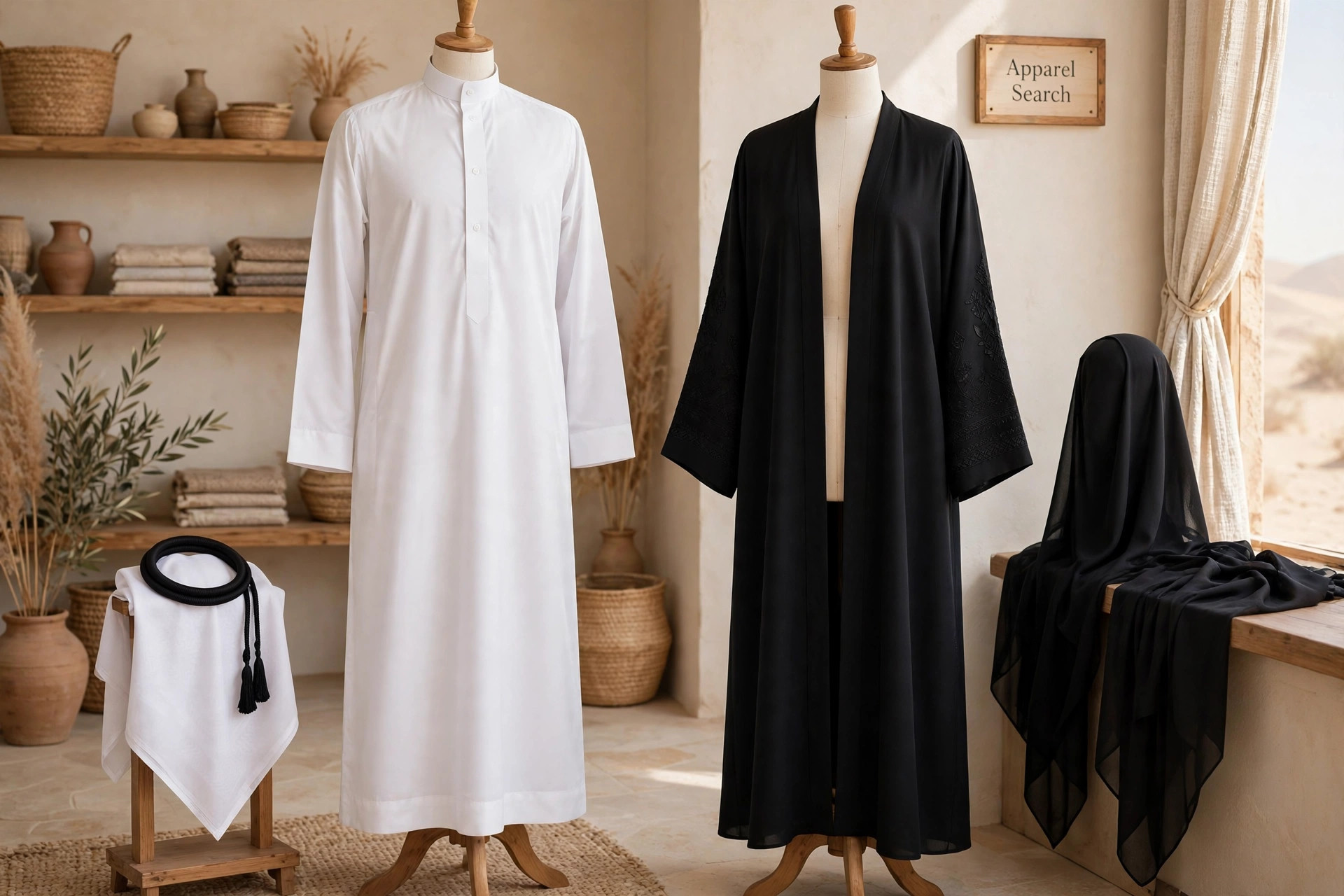
The Garments
One Robe, Many Names; One Cloak, Many Cuts
Across the Arabian Gulf — Saudi Arabia, the United Arab Emirates, Qatar, Kuwait, Bahrain and Oman — traditional dress is daily dress, worn in offices, mosques, malls and ministries as a matter of course. Its two central garments are the men's long robe and the women's black cloak. The robe is a single idea with regional names: thobe (also thawb) in Saudi Arabia, Qatar and Bahrain, dishdasha in Kuwait and Oman, and kandura in the Emirates. It is an ankle-length, long-sleeved robe, most often white, cut loose for a desert climate and worn with a headcloth. The women's garment is the abaya: a long, loose outer cloak, traditionally black, worn over other clothes in public, usually with a shayla, a long rectangular headscarf.
These garments answer the Gulf's conditions — fierce sun, heat, blowing sand — and its values at once. Loose white cloth reflects the sun and lets air move; a headcloth shades the head and neck; the abaya's flowing cut gives coverage without weight. They are also national dress in the fullest sense: in a region that has changed faster than almost any on earth, the thobe and abaya are a deliberate continuity, and their small regional differences — a collar here, a tassel there, a way of folding a headcloth — are read by Gulf Arabs the way accents are heard. This guide treats the garments with the respect due to living dress: styles vary by country, family, occasion and personal choice, and the descriptions below give the traditional patterns, not rules for individuals.
Anatomy
The Parts of the Outfits
- Thobe / dishdasha / kandura — the men's robe
- An ankle-length robe with long sleeves, worn over underclothes and often over loose white trousers. Most are white for summer; heavier and darker robes appear in winter. The regional cut — collar, cuffs, placket and tassel — is detailed in the table below.
- Tarboosh (farukha / furakha) — the neck tassel
- A cord tassel hanging from the neckline of the Emirati kandura, long, and of the Omani dishdasha, shorter. Tradition says the tassel could be dipped in perfume, so the wearer carried fragrance with him.
- Ghutra and shemagh — the headcloth
- A square cloth, folded and draped over a small cap. The plain white ghutra is worn across the Gulf; the red-and-white checked shemagh is especially associated with Saudi Arabia and Jordan. How the cloth is folded and draped is itself a regional and personal style.
- Agal (iqal) — the cord
- The black double cord worn over the headcloth to hold it in place. Omani men traditionally do not wear it, wearing the embroidered kumma cap or a wrapped mussar turban instead.
- Bisht — the formal cloak
- A light, open cloak worn over the robe for weddings, Eid, graduations and official occasions — the Gulf's equivalent of a dinner jacket — often edged with gold braid on formal examples.
- Abaya — the women's cloak
- A long, loose overgarment worn over a dress or outfit in public, traditionally black and ankle-length, cut to sit away from the body. Its cuts and details are described in the Fabric and Style section below.
- Shayla — the headscarf
- The long rectangular scarf worn with the abaya in the Gulf, draped over the hair and pinned or wrapped in regional and personal styles. In the Emirates it is also called the sheila.
| Country style | Robe name | Signature details |
|---|---|---|
| Saudi Arabia | Thobe | Stand-up or shirt-style collar, buttoned placket, cuffs that may take cufflinks; a more tailored cut |
| United Arab Emirates | Kandura | Collarless round neckline, long tarboosh tassel, plain sleeves without cuffs |
| Qatar | Thobe | Collar with a visible buttoned placket; a distinctive, sculpted way of styling the ghutra |
| Kuwait | Dishdasha | Soft low band collar, clean placket, a slimmer and simpler cut |
| Oman | Dishdasha | Collarless, short furakha tassel, sometimes embroidery at the neckline; colours beyond white are common, worn with kumma or mussar rather than ghutra and agal |
Formality
Everyday White, Ceremonial Bisht
Gulf formality is a matter of freshness, cloth and layers rather than different garments. The everyday thobe is immaculate white cotton or a cotton blend; a formal occasion calls for a robe of finer cloth, perfectly pressed, and — for the biggest moments — the bisht over it: black, brown or cream, its edges worked with gold braid for weddings and official ceremonies. Winter brings heavier robes in grey, beige and dark colours, and lined cloaks for cold desert nights. Women's formality works the same way within the abaya: a plain everyday cloak, then occasion abayas with embroidery at the sleeves and back, lace or beadwork, finer crepe and a more considered drape, worn over celebration dresses at weddings and Eid.
Cloth and Style
Fabric, the Abaya's Cuts and Quiet Decoration
Climate chooses the cloth. Men's robes are sewn from lightweight, breathable fabrics — cotton and smooth modern blends that hold a crease in heat — in white above all, because white reflects the sun and reads as cleanliness and formality at once. Abayas are cut from flowing crepes, of which the fine, matte cloth widely sold as nidha (nada) crepe is the best-known, chosen because it drapes without clinging, resists creasing and stays opaque in bright light. Within the abaya's shared silhouette, the cuts have names of their own: the open abaya, worn like a long coat over an outfit and fastened with snaps or a tie; the closed abaya, a pullover robe with no front opening; the flared kloosh (cloche) cut that swings wider toward the hem; the wide, square-shouldered bisht-style abaya borrowed from the men's cloak; and the head abaya, draped from the head rather than the shoulders. Decoration is traditionally restrained and placed with intent — tonal embroidery on sleeves and back, a lace hem, subtle beadwork for evening — though contemporary Gulf designers now offer coloured abayas in taupe, grey and soft shades alongside the classic black, and the abaya has become a fashion garment in its own right across the region.
Living Dress
When Thobe and Abaya Are Worn Today
Always. That is the Gulf's distinction: traditional dress here is not reserved for festivals but is the normal dress of public life — of government offices and universities, Friday prayers and family majlis gatherings, weddings, Eid and national days, when robes and abayas are at their finest and new outfits are commissioned for the occasion. Men who wear suits for some work still keep the thobe as the dress of home, mosque and ceremony; women style the abaya as daily fashion, with designers in the Emirates, Saudi Arabia and across the region presenting new collections each season. Dress also carries faith and custom together: modesty in dress is a value many Gulf Arabs hold as a matter of religious conviction and cultural identity alike, expressed through these garments in ways that are personal as well as traditional.
For visitors, the practical lesson is respect and ease: Gulf dress is welcoming to observe, easy to appreciate, and not a costume. Guests invited into formal or family settings may be offered a bisht to wear as an honour, and abayas are provided for women visitors at mosques that open to tourists, where staff will show how they are worn. The nearest country page in this series is our United Arab Emirates clothing industry page, covering the Emirates' apparel sector. For the abaya in depth, see Apparel Search's definition of abaya and our women's abaya guide.
Wearing
Wearing Basics
A thobe should fall straight and clean to the ankle, its collar fastened and its sleeves at the wrist; the whole effect depends on immaculate pressing, and Gulf tailors and laundries are masters of it. The ghutra is folded into a triangle, centred over the cap and draped evenly, then held by the agal set straight across — the final shaping of its folds and tails is personal style, and young men in particular make it their own. An abaya is worn over a complete outfit, fastened or held as its cut intends, with the shayla draped over the hair and arranged at the shoulders; the silhouette should flow, not cling. Visitors dressing for a mosque visit should follow the house's guidance, which is always given kindly and clearly.
Keeping
Care and Storage
White robes live or die by laundry: thobes are washed often, dried out of dust, and pressed to a crisp finish, with the collar and placket given particular attention. Many men keep a rotation of robes so a fresh one is always ready. Quality abaya crepe asks for gentle handling — cool washing or specialist cleaning for embroidered and beaded pieces, hanging storage so the cloth falls straight, and care with the fine shayla scarves, which snag easily and are best kept folded separately. A bisht, often a valuable garment with metallic braid, is stored folded in a breathable cover and cleaned only by specialists.
Acquiring
Buying and Tailoring
The Gulf is a tailor's region. Men commonly have thobes made to measure — cloth chosen in the shop, measurements on file, a robe cut to the national style the wearer prefers — and ready-made robes are sold everywhere from souks to luxury malls. When buying, name the style you want by its country and check its signature details: collar or none, cuffs or plain sleeves, tassel or none. Abayas are bought ready-made in an enormous range, from everyday crepe cloaks to designer occasion pieces; judge one by its fabric's drape and opacity, the finish of its fastenings and the quality of any embroidery, and try the shayla with it, since the two are worn as one silhouette. Visitors buying a robe as a keepsake will find souk tailors happy to measure and make within days.
Common Questions
Common Questions
What is the difference between a thobe, a dishdasha and a kandura?
They are regional names for the same garment — the men's ankle-length robe of the Gulf. Saudi Arabia, Qatar and Bahrain say thobe; Kuwait and Oman say dishdasha; the United Arab Emirates says kandura. The cuts differ in detail: a Saudi thobe usually has a collar and cuffs, an Emirati kandura is collarless with a long neck tassel, and an Omani dishdasha is collarless with a short tassel and sometimes neckline embroidery.
What are the ghutra and agal?
The ghutra is the square headcloth — plain white across most of the Gulf, red-and-white checked as the shemagh in Saudi Arabia and Jordan — folded and draped over a small cap. The agal, also written iqal, is the black double cord worn over it to hold it in place. Omani men traditionally wear instead the embroidered kumma cap or a wrapped mussar turban.
What is an abaya?
The abaya is the long, loose outer cloak worn by women in the Gulf over their other clothes in public, traditionally black and ankle-length, and usually worn with a shayla headscarf. Its named cuts include the open abaya worn like a coat, the closed pullover style, the flared kloosh cut and the wide bisht style, and modern abayas add tonal embroidery, lace and — increasingly — colour.
Why is the men's robe usually white?
White reflects the desert sun, and a loose white robe in breathable cloth is the coolest dress the climate allows; white also reads as clean and formal, which is why it dominates even though winter robes come in grey, beige and darker shades. The robe's whiteness is practical first — and its immaculate pressing is a point of pride.
Can visitors wear a thobe or abaya?
Visitors are guests, and Gulf dress is best appreciated respectfully rather than imitated as costume. Mosques that welcome tourists provide abayas for women visitors and explain how they are worn, and a guest offered a bisht at a formal occasion should accept it as the honour it is. A tailored thobe bought from a souk tailor is a welcome keepsake — wear it where your hosts would wear theirs.
Keep Exploring
More to Explore
In This Series
Traditional Dress by Country
The series hub — every country guide, from the kimono of Japan to the galabeya of Egypt, as each is published.
Visit the hub ↑United Arab Emirates Clothing Industry
The UAE clothing industry page — the nearest country directory for the Gulf, home of the kandura and a centre of abaya fashion.
Explore ↑Go Deeper on the Abaya
Search Apparel Search