Traditional Dress by Country · Ghana
Ghana — Kente
Kente is Ghana's cloth of honour — hand-woven in narrow strips on a wooden loom, sewn edge to edge into great draped cloths, and patterned with named designs that speak in proverbs. This guide explains how kente is made in Bonwire and Agotime, what patterns such as Emaa Da and Sika Futoro mean, how men drape it and women sew it into kaba and slit, and how a single woven strip became the graduation stole of the African diaspora.
The Cloth
What Kente Is
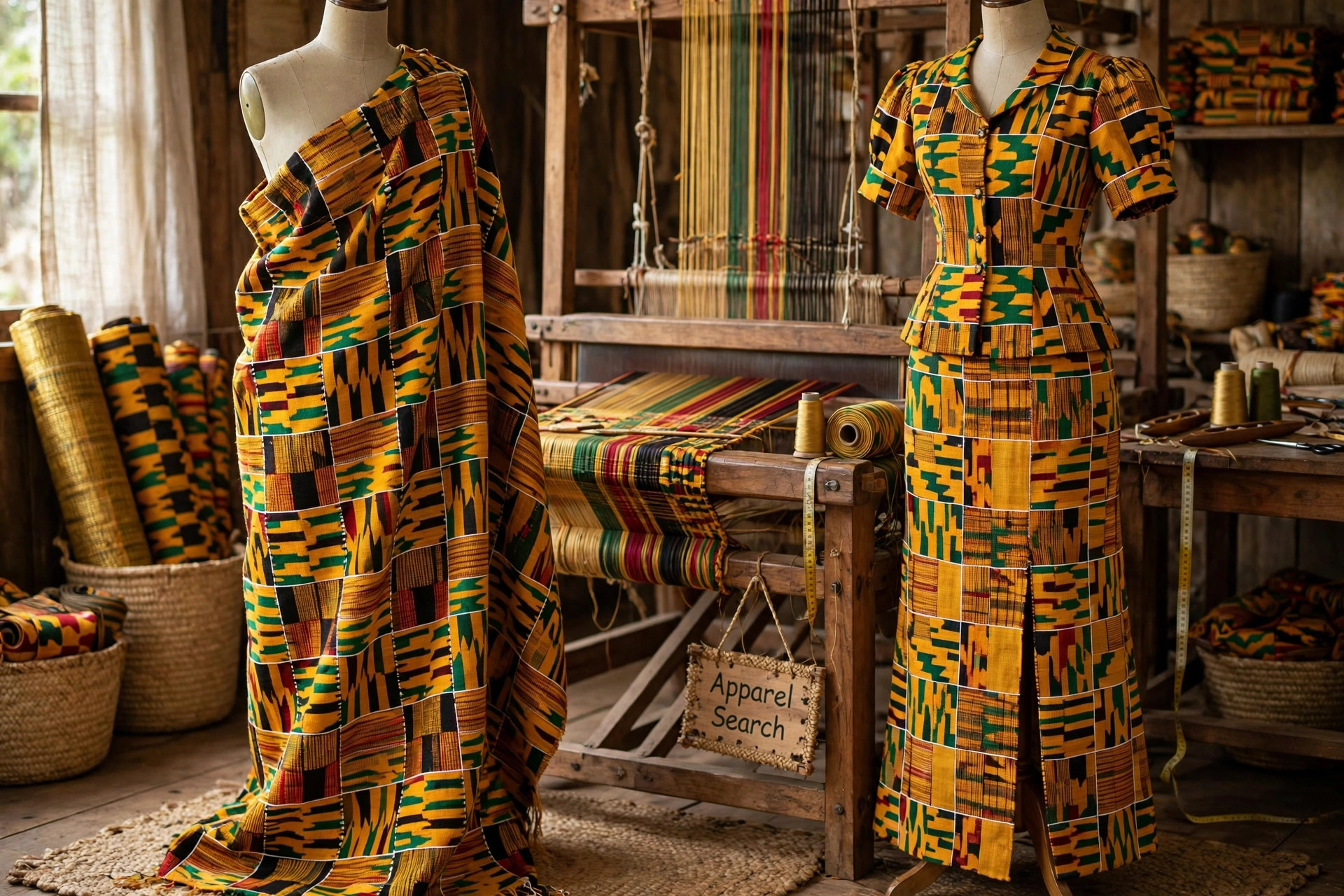
Kente is not, strictly, a garment at all. It is a cloth — Ghana's great hand-woven textile — and the garments are what people make of it and how they drape it. A kente cloth is built the slow way: a weaver works on a narrow loom, producing long strips only about a hand's width across, each strip a planned sequence of patterned blocks. Dozens of strips are then sewn edge to edge, selvedge to selvedge, until they form a cloth large enough to wrap a body. Look closely at a real kente and you can see the whole logic of it — the faint seams between strips, the design repeating in bands rather than flowing across the piece, the geometry changing from block to block along each strip.
Two peoples hold deep claims to the craft. The Asante (Ashanti) tradition centres on Bonwire, a weaving town near Kumasi, where oral tradition tells of weavers who studied the web of Ananse the spider and set out to copy its patterns in thread. The Asante name for the cloth, nwentoma, simply means woven cloth; the word kente itself is generally linked to kenten, an Akan word for basket, because the tight woven pattern resembles basketwork. The Ewe tradition, centred on Agotime in the Volta Region, developed its own techniques and designs — Ewe cloths are known for figurative motifs of people, animals and objects woven alongside the geometry, where Asante cloths stay boldly abstract.
For generations the finest kente was royal cloth. Woven in silk — at first from imported silk unravelled and rewoven by court weavers — the most prestigious patterns were reserved for the Asantehene, the Asante king, and his court, and particular designs belonged to particular rulers and occasions. That history is still legible in the cloth today: kente reads, to those who know it, as honour made visible, which is why it is worn at the moments a community most wants to mark.
Anatomy
How a Kente Cloth Is Worn
The same cloth becomes different dress on different bodies. The traditional ways of wearing it are precise, and getting the drape right matters.
- Men's draped cloth
- A large cloth wrapped around the body and draped over the left shoulder, toga-style, leaving the right shoulder and arm free — draping over the right shoulder is traditionally inappropriate. The cloth is arranged, adjusted and re-arranged through the day with practised, unselfconscious gestures, and is worn by chiefs and kings with gold jewellery and sandals.
- Women's kaba and slit
- Women traditionally wear kente as sewn dress: a blouse (kaba) with a long sewn skirt (the slit), often with a third piece of cloth folded as a shoulder or hand cloth. Modern tailors also cut kente into fitted dresses, gowns and jackets.
- The stole
- A single narrow strip or a small cloth worn over the shoulders. In the African diaspora — above all at graduations in the United States — the kente stole has become the cloth's most travelled form, worn over academic dress as a sign of heritage and achievement.
- Printed “kente” cloth
- Factory-printed cotton that copies kente geometry. It is everywhere, inexpensive and cheerful — but it is a picture of kente, not kente. The woven cloth's seams, weight and slight irregularities are the real thing's signature.
The Loom
Strip Weaving, Block by Block
Kente weaving has traditionally been men's work, learned through long apprenticeship to a master weaver, and the loom explains the cloth. The weaver sits at a horizontal loom and builds each strip from alternating sections: plain-weave bands in solid colour, and pattern blocks where extra weft threads float across the surface to draw the design. Because the pattern lives in the weft, a skilled weaver can change geometry every few centimetres — zigzags, stepped blocks, checkerboards and fine toothed lines succeeding one another down the strip like sentences. Asante cloths push this geometry toward dazzling, high-contrast abstraction; Ewe weavers add their figures — stools, hands, animals, objects — into the bands. When the strips come off the loom they are sewn together in order, and the finished cloth's rhythm of block and band is set for life. Silk was the prestige fibre of the old court cloths; cotton is the everyday standard, and rayon and modern yarns now serve the wider market.
Pattern and Meaning
Named Patterns and the Meanings of Colour
Weavers count hundreds of named kente designs. Their names come from proverbs, historical events, chiefs and queen mothers, plants and animals — and a cloth is chosen the way a speech is chosen, for what it says. A few of the best known:
| Pattern | Its name means | What it says |
|---|---|---|
| Emaa Da | “It has never happened before” | Novelty and creativity — a design made to mark something new and rare |
| Sika Futoro | “Gold dust” | Wealth and prosperity, recalling the gold dust once used as currency in Asante trade |
| Adwinasa | “All designs are used up” | A densely worked cloth of many patterns — mastery, and a weaver's quiet boast |
| Oyokoman | Named for the Oyoko clan | The clan of the Asante royal family; among the earliest colourful designs, now popular for weddings |
| Akyempem | “A thousand shields” | Military strength and protection |
| Kyeretwie | “The lion catcher” | Courage and bravery |
Colour carries meaning too, though readings vary between weavers and communities. Gold and yellow speak of royalty, wealth and high status. Green is growth, harvest and renewal. Blue is peace, harmony and love. Red carries political and spiritual intensity — sacrifice and struggle — and appears at moments of protest and mourning. Black is maturity, spiritual energy and the ancestors; white is purity and celebration; maroon is linked with the earth and healing, and purple and pink with the feminine. A knowledgeable buyer does not just ask whether a cloth is beautiful, but what it says and whether the occasion wants to hear it.
Living Dress
When Kente Is Worn Today
In Ghana, kente remains the cloth of the biggest days. Chiefs and queen mothers wear it at festivals and durbars, where the draped cloths of a whole court make the ceremony's colour. It wraps brides and grooms at traditional weddings, appears at naming ceremonies and funerals — with the pattern and colour fitted to the mood of each — and comes out for national occasions, church celebrations and graduations. A fine cloth is an heirloom: bought for a wedding, kept for a lifetime, and handed down.
Abroad, kente has taken a second road. In the African diaspora, and especially in the United States, the kente stole worn over a graduation gown has become a rite of passage in its own right — a way for graduates of African descent to carry heritage into the ceremony, often with the Golden Stool of the Asante woven or printed as its emblem. Kente appears in churches, at weddings and in fashion far from Ghana, in everything from woven heirloom cloth to printed cotton. Ghana has no single country page of its own on Apparel Search; our Africa clothing industry page covers the continent's wider apparel and textile sector, within which Bonwire and Agotime's weavers are among the most celebrated handcraft traditions in the world.
Wearing
Wearing Basics
The draped men's cloth is a skill: the cloth is wrapped around the body under the arms, rolled or folded at the waist to set its length, and the end brought up and over the left shoulder, with the right arm left free. It loosens as the day goes on and is re-arranged with a shrug and a tug that wearers perform without thinking — beginners should practise the drape before the event, and accept help gratefully when it is offered, as it often is. Women's sewn kaba and slit need no technique beyond good tailoring, though the folded shoulder cloth should match or deliberately complement the set. Whoever wears kente should know their pattern's name and meaning: at a Ghanaian occasion, someone will ask, and answering well is part of wearing it well.
Keeping
Care and Storage
A woven kente cloth is sturdy — it is, after all, strips of tightly woven cotton or silk sewn firmly together — but its colours and fibres deserve respect. Silk and fine cotton cloths are best washed gently by hand in cool water with mild soap, or entrusted to a cleaner who knows hand-woven textiles; printed cloth can take ordinary gentle machine washing. Dry in shade to protect the saturated golds and reds, and store the cloth folded along its strip seams, away from damp. Because each strip is woven separately, a damaged section can sometimes be repaired by a weaver in a way machine-made cloth cannot — one more reason an heirloom kente, properly kept, outlives its first owner.
Acquiring
Buying and Collecting
Buy the real thing from the people who weave it. Bonwire and Agotime sell cloth directly, and Ghanaian shops and cooperatives stock woven kente at every level from a single stole to a full royal cloth. Judge a cloth in your hands: woven kente has visible strip seams, weight, a firm hand and pattern blocks that are part of the cloth's structure — turn it over and the design is there in the weave, not sitting on the surface as print does. Ask the pattern's name and meaning, and who wove it; a good seller will know. Expect to pay for the weaving time — a large cloth represents many days at the loom — and be wary of “kente” at prices that could not pay a weaver for an hour. Printed kente-pattern cotton is a legitimate, joyful fabric in its own right; it should simply be sold, and bought, as print.
Common Questions
Common Questions
What is kente cloth?
Kente is Ghana's hand-woven prestige cloth. Weavers work on narrow looms to produce long strips about a hand's width across, each strip a planned sequence of patterned blocks, then sew dozens of strips edge to edge to form a full cloth. It was developed by Asante weavers around Bonwire and by Ewe weavers around Agotime, and its patterns and colours carry named meanings.
How is kente worn?
Men traditionally wear a large kente cloth draped toga-style over the left shoulder, with the right shoulder and arm left free. Women wear kente sewn as a kaba blouse with a long slit skirt, often with a matching folded cloth. In the African diaspora, a single kente strip worn as a stole over graduation dress has become a widely recognised sign of heritage and achievement.
What do kente patterns mean?
Each woven pattern has a name drawn from a proverb, an event, a person or the natural world. Emaa Da, “it has never happened before,” speaks of novelty and creativity; Sika Futoro, “gold dust,” of wealth and prosperity; Adwinasa, “all designs are used up,” of mastery. Colours carry meanings too — gold for royalty and wealth, green for growth and renewal, blue for peace, red for sacrifice and struggle, black for maturity and the ancestors.
What is the difference between woven kente and kente print?
Woven kente is built strip by strip on a loom: the pattern is the cloth's structure, visible on both sides, and the finished cloth shows the seams where strips were sewn together. Kente print is factory-printed cotton that copies the geometry on one surface. Print is inexpensive and popular, but it is a picture of kente — the woven cloth's weight, seams and two-sided pattern are the genuine article's signature.
Can visitors wear kente?
Yes, worn respectfully and for a real occasion — a festival, a wedding, a graduation — and bought from Ghanaian weavers where possible. Learn your pattern's name and meaning, drape the cloth over the left shoulder, and avoid treating royal cloth as a costume. A stole or a sewn garment in woven kente is the most welcome way for a visitor to begin.
Keep Exploring
More to Explore
In This Series
Traditional Dress by Country
The series hub — every country guide, from the kimono of Japan to the galabeya of Egypt, as each is published.
Visit the hub ↑Africa Clothing Industry
Apparel Search's Africa clothing industry page — the continent-wide directory for the region Ghana's weaving towns work within.
Explore ↑Search Apparel Search