Traditional Dress by Country · Egypt
The Galabeya of Egypt
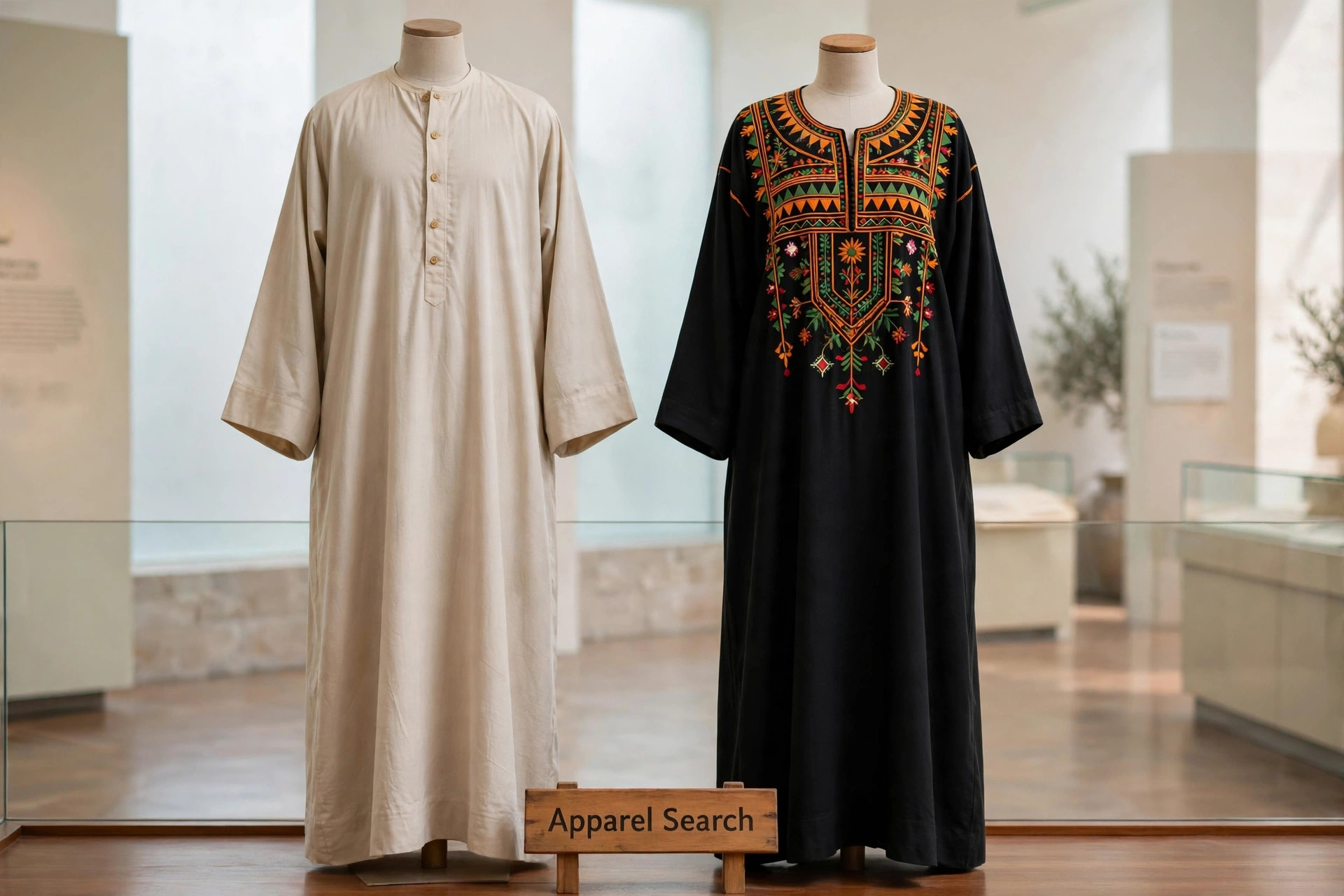
The galabeya is Egypt’s answer to its own climate: a loose, ankle-length robe that shades the body and lets the air move, worn by men and women from the Mediterranean Delta to Nubia. But plain as the everyday robe is, its embroidered forms — the sun-ray needlework of Siwa Oasis, the metal-thread telli of Asyut, the trailing black gergar of Nubian brides — are among the most distinctive dress traditions in North Africa. This guide explains the robe, its parts, its regions and its needlework, and how it is worn, cared for and collected today.
The Garment
What a Galabeya Is
The galabeya — also spelled galabiya, jalabiya or jellabiya, from the Arabic jallābīyah — is Egypt’s traditional robe: a long, loose garment that falls from the shoulders to the ankles, worn by men and women alike across the Nile Valley, the Delta, the desert oases and the Red Sea coast. It is not a costume kept for festivals. In villages and small towns it is everyday dress, and in the cities it is what many people change into when the working day ends — a garment for the coffee house, the market, Friday prayers and receiving guests at home.
The cut explains its survival in one of the world’s hottest inhabited valleys. The galabeya hangs straight from the shoulders with no shaping at the waist, so air moves freely around the body underneath. The neckline is open, the sleeves are long and wide, and the hem swings clear of the legs. In summer it is sewn in white or pale cotton or linen; in winter the same pattern is cut in heavier flannel or wool in grey, dark green, olive, blue or tan, sometimes striped. A heavier robe can be worn over a lighter one, and a scarf or shawl goes around the neck or over the head against the sun and the evening chill.
The galabeya belongs to a family of robes worn across North Africa and Arabia, but its Egyptian form has its own character: a wider cut than the Arabian thawb, typically no collar, and longer, wider sleeves. Its roots run deep in the valley’s history of linen dress — ancient Egypt clothed itself in flax linen, and Coptic tunics carried woven decoration at the neck and shoulders — and the robe in its present form settled during the Islamic centuries in Lower Egypt before spreading through the whole country. Every region then made it its own, which is why this guide treats “the galabeya” as a family of garments rather than a single uniform.
Anatomy
The Parts of the Outfit
The robe is the centre of the outfit, but it is rarely the whole of it. Head coverings, under-layers and wraps complete the dress, and they differ between town and country, men and women.
- The galabeya itself
- The ankle-length robe. A man’s everyday galabeya in the countryside has a wide neckline with a simple slit opening and very wide sleeves and hem; farmers’ versions have sewn-in pockets for tobacco, money and small tools. In the city the slit is usually replaced by a buttoned chest placket, and the cut is a little closer. Women’s robes divide into two great patterns, described below.
- Galabeya frangi and galabeya scandarani
- The two collared men’s styles. The frangi (“foreign”) has a Western shirt collar; the scandarani, named for Alexandria, has a stand collar. Both add breast pockets and a buttoned placket and are cut slightly tighter — the smarter, more urban face of the robe.
- Under-robes, trousers and the kaftan layer
- Loose trousers (sirwal) may be worn beneath the robe, and in colder weather or for formal visits a coat-like kaftan, belted with a sash, goes over it. Working men hitch the robe up and tuck it around the thighs to free their legs in the fields.
- Taqiyah and ammama — cap and turban
- The small round cotton skullcap (taqiyah) is worn on its own or as the base for the ammama, the turban of wound cloth that shades the head and neck in Upper Egypt and the countryside. The red felt tarboosh (fez), once the mark of an urban gentleman, is now rarely seen.
- Tarha and headscarves
- Women’s head coverings range from the long Delta tarha, a generous length of light cloth draped over the head, to scarves and shawls chosen for sun, dust, custom and occasion.
- Melaya liff — the city wrap
- A large black rectangular wrap, historically worn by urban women over their home clothes when going out, wound skilfully around the body and over the head. Once a familiar sight in Cairo and Alexandria, the melaya liff is now uncommon, but it remains one of the most recognisable silhouettes in Egyptian dress history.
The two main patterns of the women’s galabeya:
| Style | Construction | Where it is characteristic |
|---|---|---|
| Galabeya bi wist | “With waist” — a fitted bodice joined to a gathered or bell-shaped skirt, the waist set high; sleeves three-quarter length or longer | Worn widely, in town and country |
| Galabeya bi sufra | “With yoke” — loose and straight, its ornament concentrated on a decorated yoke at the chest, with gathers or pleats falling from it and long, full sleeves | Especially the Nile Delta, where sleeves taper to a cuff and carry rows of fine tucks |
Regions
One Robe, Many Egypts
Egypt is a long country, and the galabeya changes along its length. Reading a robe — its colour, its embroidery, its weight — tells you where its wearer comes from.
The fellahin of the Delta and valley. The farming women known as fellaha (the word for a female farmer; the men are fellahin) work in dark blue or black cotton galabeyas that stand up to field labour, changing into brighter, printed or embroidered dresses for visits and celebrations. The Delta’s bi sufra dresses carry their decoration on the yoke and sleeves, with fine horizontal tucks worked into the cloth.
Upper Egypt — the Sa‘id. In the south, women’s robes are large and T-shaped, in black or dark blue, their necklines, sleeves and seams framed with embroidery in red silk or in telli — flat metal thread worked into geometric patterns, a speciality long associated with the city of Asyut, whose telli shawls and dresses are collected worldwide. Men pair a heavier galabeya with the wound turban against the stronger southern sun.
Nubia. Around Aswan and in the Nubian villages, men wear white galabeyas with a neck scarf and turban, while women’s dress is the most colourful in Egypt: long, wide dresses, wedding outfits in vivid red, green, fuchsia or pink, and over everything the gergar (also written jarjar), a sheer black overdress whose hem trails behind the wearer.
Siwa Oasis. In the Western Desert, the Amazigh (Berber) Siwi people embroider dresses unlike anything in the Nile Valley — covered in the next section. Sinai and the Eastern Desert add the vivid cross-stitch embroidery, coin-decorated veils and belts of the Bedouin communities.
Cloth and Pattern
Fabric, Embroidery and Meaning
Climate chooses the cloth first. Summer galabeyas are cotton or linen — cool, washable, quick to dry — and Egypt’s long tradition of both fibres shows in the quality of its plain everyday robes as much as in its festive ones. Winter robes turn to flannel and wool. Men’s robes stay sober: solid colours, stripes and quiet checks. Women’s robes carry the colour and the needlework, and embroidery is where regional identity is written.
Siwa Oasis embroidery is the most distinctive needlework in Egypt. Siwi dresses are cut in a great T shape with wide sleeves, and the front is embroidered in floss silk — today often rayon — in five traditional colours: black, green, orange, red and yellow, the colours of the oasis landscape, of dates at every stage of ripening, of palm fronds and olives. The design radiates from a set of embroidered squares at the neckline like the rays of the sun, and mother-of-pearl buttons and discs, called the “eye of the sun,” are sewn into the work. A bride’s dresses — among them the white ashera nauak and the black dress worn after the wedding — were traditionally embroidered by the girl herself with her mother and female relatives, a trousseau begun years before the marriage.
Elsewhere the needle tells other stories. Asyut’s telli work stitches thin strips of metal into net and cloth, so a black dress glitters silver or gold as it moves. Delta yokes carry couched cords, tucks and small floral sprigs; Sinai Bedouin embroidery works bold geometric cross-stitch in reds and oranges, with coins and beads added to veils and belts. In every region the principle is the same: the robe’s plain, practical body is the canvas, and the embroidery at its neck, chest and sleeves is the signature.
Living Dress
When the Galabeya Is Worn Today
The galabeya never became a relic, because it never stopped being useful. In the villages of the Delta and Upper Egypt it is still the default dress of the farming day. In Cairo and Alexandria, where office and street dress is largely Western, many men keep a light cotton galabeya as house dress and evening dress, and it appears at the coffee house, at family visits and at Friday prayers. Women wear colourful galabeyas at home and for hosting, with embroidered versions brought out for holidays, weddings and celebrations such as Ramadan evenings.
Regional dress is at its most visible at weddings and festivals, when Nubian colours, Siwi embroidery and telli work come out in full — and in the work of Egyptian designers and craft workshops, who draw on the robe’s cut and its embroideries for contemporary fashion while oasis and village needleworkers sell their stitching to visitors. The garment sits inside a much larger industry of cotton growing, weaving, tailoring and retail: our Egypt clothing industry page profiles the wider apparel and textile sector of the country that produces it.
Wearing
Wearing Basics
The galabeya is one of the easiest traditional garments in this series to wear well, because its rules are practical ones. It should hang from the shoulders without pulling, fall to the ankle, and leave the sleeves long and free — a robe that clings or stops at the calf has lost the point of the design, which is shade and moving air. Men usually wear it over light trousers or on its own at home, adding the skullcap or turban outdoors and a heavier robe, kaftan or shawl in winter. Women’s styles are worn with a headscarf or tarha as the wearer chooses, and festive dresses are layered with jewellery rather than altered in cut. Visitors who buy a galabeya — they are sold in every market — will find the plain men’s and women’s styles welcomed as ordinary, comfortable dress; the heavily embroidered bridal and regional pieces are better admired, photographed with permission, or bought as the textiles they are.
Keeping
Care and Storage
Everyday cotton and linen galabeyas are working clothes and are washed as such — they are among the most washable garments in this series, and their loose cut means they dry quickly in dry heat. The care rules tighten as the needlework grows richer. Embroidered dresses should be washed gently and infrequently, inside out, and dried in shade, since the strong Egyptian sun that the robe is designed against will fade silk and rayon thread just as happily. Telli work needs particular respect: the metal strips tarnish and can cut their ground cloth if a dress is scrubbed or wrung, so telli pieces are best sponge-cleaned or taken to a cleaner who knows the work. Siwi dresses with mother-of-pearl buttons should be stored flat or rolled rather than hung by their wide sleeves, with the buttons protected from chipping. Wool winter robes are stored clean, against moths, like any woollen garment.
Acquiring
Buying and Collecting
A new everyday galabeya is an inexpensive, practical purchase anywhere in Egypt, and buying one to wear is the best introduction to the garment. Judge it as you would any robe: even, strong stitching at the placket and underarms, generous width in the body and sleeves, and cloth with some substance — thin, shiny fabric wears out and hangs badly. For collectors, the value lies in the embroidered regional pieces: a hand-worked Siwi dress, an Asyut telli shawl or dress, or a Nubian wedding outfit. Hand embroidery is recognised by its slight irregularity and by the work visible on the reverse; machine-embroidered imitations, sold widely, are flatter and perfectly regular, and are priced accordingly. Ask where a piece was made and by whom — the oasis workshops of Siwa and the makers of Asyut can usually be named — and expect honest handwork in silk or fine rayon to cost many times a market robe. Bought fairly, it is money that goes directly to the women who keep the tradition alive.
Common Questions
Common Questions
What is a galabeya?
A galabeya is Egypt's traditional robe: a loose, ankle-length garment with long, wide sleeves, worn by men and women. It hangs straight from the shoulders with an open neckline, so air circulates around the body in the Nile Valley heat. It is also spelled galabiya or jalabiya. Plain cotton versions are everyday dress; embroidered versions serve for festivals and weddings.
What is the difference between a galabeya and a thawb?
The galabeya is the Egyptian member of a family of robes worn across North Africa and Arabia, but its cut is its own: it is wider than the Arabian thawb, typically has no collar, and has longer, wider sleeves. City versions add a buttoned chest placket, and the collared frangi and scandarani styles add breast pockets and a slightly closer cut.
What is a melaya liff?
The melaya liff (also written melaya leff) is a large black rectangular wrap that urban Egyptian women historically wore over their home clothes when going out, wound around the body and over the head. Once a familiar sight in Cairo and Alexandria, it has become uncommon today, but its draped silhouette remains one of the most recognisable images of older Egyptian city dress.
What makes Siwa Oasis embroidery distinctive?
Siwa Oasis embroidery is worked in floss silk in five traditional colours — black, green, orange, red and yellow — the colours of ripening dates, palms and olives. On the T-shaped Siwi dress the pattern radiates from embroidered squares at the neckline like the rays of the sun, and mother-of-pearl buttons and discs, called the “eye of the sun,” are sewn into the work.
Can visitors to Egypt wear a galabeya?
Yes. Plain men's and women's galabeyas are ordinary, practical dress, sold in markets across Egypt, and visitors who wear one are generally received with approval — it is comfortable, modest and suited to the climate. Heavily embroidered bridal and regional pieces, such as Siwi wedding dresses, are best treated as collectable textiles rather than everyday wear.
Keep Exploring
More to Explore
In This Series
Search Apparel Search