Traditional Dress by Country · Morocco
Morocco — Caftan and Djellaba
Morocco dresses by a clear and elegant logic: the caftan for the feast, the djellaba for the street. One is a belted robe of velvet and gold braid, buttoned with hand-knotted aakads and layered into the bridal takchita; the other is the hooded robe a whole country wears over its clothes, from mountain villages to city mosques. This guide explains both garments part by part — sfifa, mdamma, qob and all — and the embroidery craft of Fes that finishes them.
The Garments
A Robe for the Feast, a Robe for the Street
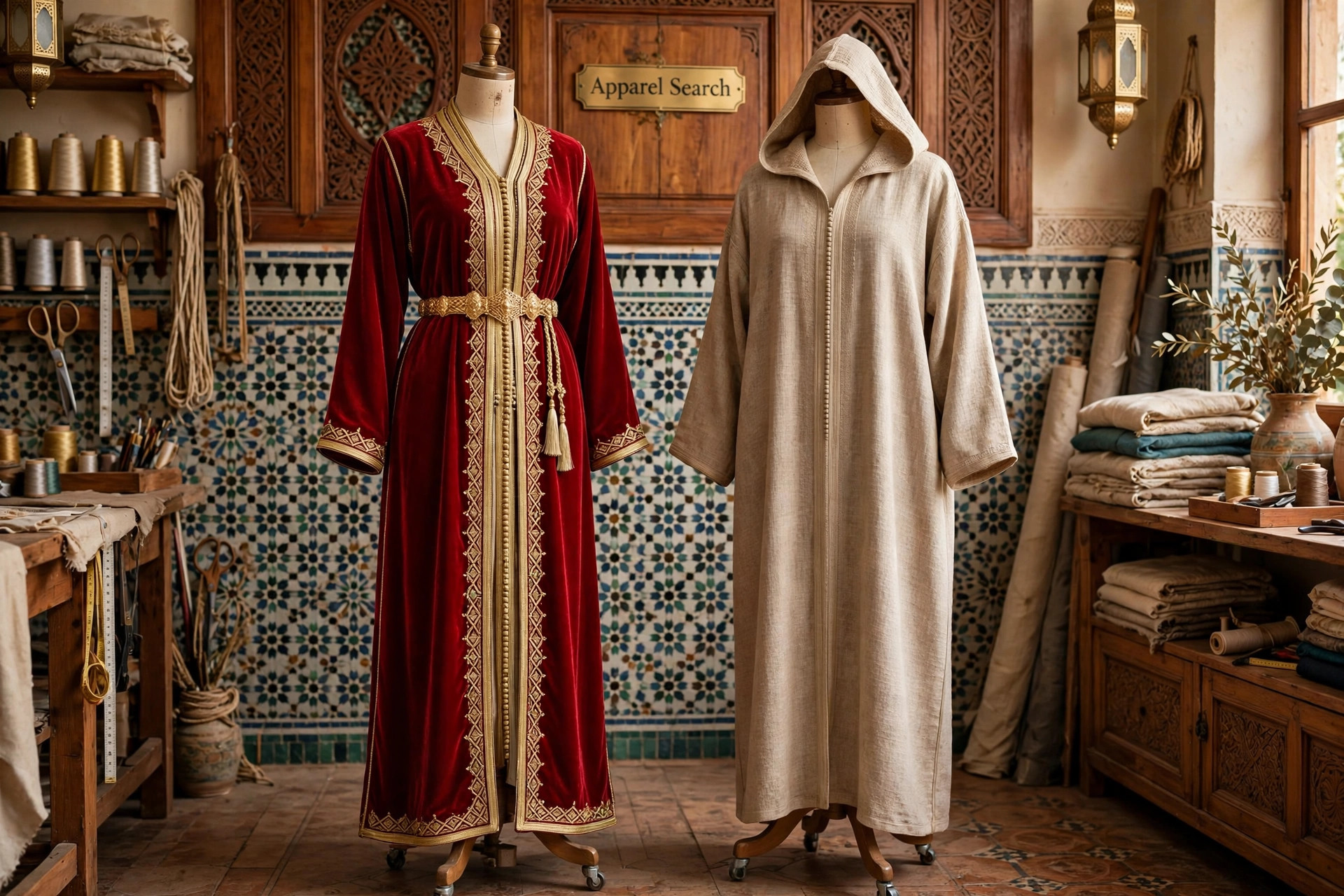
Moroccan traditional dress is organised around two great robes, and telling them apart is the first step to reading a Moroccan street or wedding. The caftan is the celebration robe: a long, unhooded garment of rich cloth — velvet, silk, brocade — worked with embroidery, braid and hand-knotted buttons, and drawn in at the waist by an ornate belt. The djellaba is the everyday robe: long, loose and full-sleeved, defined by the pointed hood, the qob, that rises at its back. The caftan belongs indoors, at weddings and feasts; the djellaba belongs everywhere — market, mosque, mountain village and city street, worn by men and women alike over ordinary clothes.
Both garments are old, and both were reshaped in Morocco. The caftan travelled the Islamic world as a robe of honour before Moroccan court culture — above all in Fes, the country's ancient centre of embroidery and fine cloth — made it unmistakably its own: front-opening, braided, buttoned and belted. The djellaba's roots are North African and Amazigh, a practical hooded outer robe for sun, wind and mountain cold that became the shared dress of a whole society. Moroccan women adopted and transformed both garments, and today the women's caftan is the summit of Moroccan couture while the women's djellaba, in everything from plain cotton to embroidered silk, is daily dress.
The two robes meet at the wedding, Morocco's great dress occasion, where a bride may change through several caftans in an evening, carried in procession between changes, while her guests arrive in their own caftans and best djellabas. Understanding Moroccan dress means understanding that these are living garments — tailored today, argued over by designers, and worn without self-consciousness by millions of people going about ordinary life.
Anatomy
The Parts of the Outfit
Moroccan dress has a precise vocabulary, and its words name construction, not decoration. The essential terms:
- Sfifa — the braid
- A woven braid trim that runs down the caftan's front opening and finishes its collar and cuffs, traditionally made by hand from silk thread. Together with the buttons, the sfifa defines the front of a Moroccan caftan or a fine djellaba.
- Aakads (aqad) — the buttons
- Small hand-knotted or braided buttons, formed one at a time from cord, marching in a row down the front beside the sfifa. On a handmade garment each button is a tiny knot of thread — a detail machine copies imitate but rarely match.
- Mdamma — the belt
- The wide ornamental belt that cinches a caftan at the waist and transforms its silhouette. Mdamma range from embroidered cloth to worked metal, and on a takchita the belt is often the most finished piece of the whole outfit.
- Takchita — the two-layer caftan
- The most formal form of women's celebration dress: an inner dress (the tahtia) worn under an open, richly embroidered overdress (the dfina), the two layers belted together with a mdamma. A caftan is one robe; a takchita is two, and the layering is what makes it bridal.
- Qob — the hood
- The pointed hood of the djellaba. Raised, it shelters against sun, wind and cold; lowered, it falls down the back in a point. If a robe has no hood, it is not a djellaba — the qob is the garment's signature.
- Tarz — the embroidery
- Embroidery itself, named by style and city. Fes is famed for its fine embroidery traditions, and tarz from different cities — with their scrollwork, floral and geometric manners — lets a knowledgeable eye place a garment's making.
- Babouches — the slippers
- The flat leather slippers, plain or embroidered, that complete every traditional outfit for men and women alike.
| Garment | Pieces | Hood | Worn for |
|---|---|---|---|
| Caftan | One robe + belt | No | Weddings, celebrations, formal evenings |
| Takchita | Two layers + belt | No | Bridal and highest-formality dress |
| Djellaba | One robe | Yes — the qob | Everyday to formal, men and women |
Formality
Reading the Occasion
Formality in Moroccan dress is read from cloth, handwork and layers. A cotton djellaba is a working garment; the same cut in fine wool with sfifa braid is Friday and festival dress; a silk djellaba with embroidery is a celebration piece. Caftans climb from printed or lightly worked cloth for a family gathering to velvet and brocade dense with hand embroidery for a wedding — and the takchita, with its double layer and great belt, stands above them all. Men's formal dress follows its own ladder: the djellaba for most occasions, and the two-piece jabador — tunic and matching trousers — a groom's and festival favourite. What never changes is the logic: the more handwork, the richer the cloth, the bigger the day.
The Wedding Wardrobe
A Moroccan wedding is a fashion show with a ceremony inside it. The bride, attended and celebrated through the evening, traditionally appears in a succession of caftans and a takchita — green for the henna, white or ivory, gold-worked velvet — each change greeted by her guests. Her female guests answer in kind, in caftans saved and commissioned for such nights. Few dress traditions anywhere keep couture-level handwork — the braid, the knotted buttons, the embroidery of Fes — in such regular, joyful use.
Cloth and Craft
Fabric, Braid and the Embroidery of Fes
The caftan's fabrics are the rich shelf of celebration cloth: velvet for winter weddings, silk and satin, and brocades whose patterns are woven into the cloth itself rather than printed or embroidered on. Against these grounds the handwork stands out — sfifa braid in gold or matching silk thread, aakads buttons knotted from the same cord, and tarz embroidery at the collar, front and cuffs. Embroidery is city craft in Morocco, and Fes, the old imperial and scholarly capital, is its most famous name: Fassi embroidery, worked with extraordinary fineness, has dressed brides and households for centuries, and the city's artisans remain a byword for the art. The djellaba's cloth tells a plainer story — wool for the cold months, sometimes in the natural striped weaves of mountain tradition, and cotton, linen and light modern cloth for summer, with sabra, the glossy plant-fibre cloth often sold as cactus silk, at the dressier end.
Living Dress
When Caftan and Djellaba Are Worn Today
The djellaba never stopped being worn. It is Morocco's default outer garment: over work clothes in the market, over a suit in the city, in white or fine cloth for Friday prayer and Eid, in wool against a mountain winter. Women's djellabas are a fashion field of their own, redesigned each season in new cloths and embroideries while keeping the hood and the loose, comfortable cut. The caftan's calendar is the celebration calendar — weddings above all, but also baptisms, religious festivals, formal evenings and national occasions, when women who wear Western dress all week appear in caftans as a matter of course.
Moroccan designers have carried both garments onto international runways, cutting caftans as evening couture and djellabas as luxury outerwear, while at home the tailor's shop remains the heart of the system: cloth chosen, measurements taken, braid and buttons commissioned by hand. Our Morocco clothing industry page profiles the wider industry around this craft. For the garments as clothing to wear today, see our women's kaftan guide and our men's djellaba guide.
Wearing
Wearing Basics
A caftan is worn belted: the robe falls straight, the mdamma is fastened at the natural waist, and the front braid and buttons sit centred — check them in a mirror, since the whole effect lives in that straight, worked line. A takchita adds the overdress, which should open to show the inner dress beneath, both layers caught by the one belt. The djellaba asks less: it goes over your clothes, sleeves down, hood down the back unless weather says otherwise. Visitors invited to a Moroccan wedding should know that dressing up is the compliment — a guest in a caftan or a fine djellaba, bought or rented locally and fitted by the shop, will be received as someone who understood the occasion.
Keeping
Care and Storage
Celebration caftans are investment garments and are kept like bridal wear everywhere: cleaned rarely and by specialists, since velvet, metallic braid and hand embroidery punish rough washing, and stored hanging with room around them or folded in breathable covers away from light. The knotted aakads buttons are the fragile point — inspect them before storage, and have a loose knot re-worked rather than letting it unravel. Wool djellabas want the classic wool care of airing, brushing and protection from moths; cotton and summer djellabas wash gently and often. A good mdamma belt, especially a metal one, is stored flat and dry and polished, not washed.
Acquiring
Buying and Collecting
The authentic route is the tailor's: choose cloth in the souk or the fabric shop, agree the style, and have the caftan or djellaba made to measure, with handmade sfifa and aakads specified — this is still how most Moroccans acquire their best garments, and medina tailors in Fes, Marrakech and other cities welcome visitors. Ready-made ranges from honest everyday djellabas to couture caftans. Judge handwork up close: handmade braid is supple and slightly irregular, knotted buttons are individual knots, and embroidery sits in the cloth rather than on it. Machine-made festive caftans can be beautiful cloth at fair prices — buy them as what they are. For a wedding guest on a deadline, reputable shops rent takchita and caftans with the belt and fitting included, which is how many Moroccans solve the same problem.
Common Questions
Common Questions
What is the difference between a caftan and a djellaba?
A caftan is an unhooded celebration robe, richly embroidered and braided, worn belted with a mdamma for weddings and formal occasions. A djellaba is a loose, full-sleeved everyday outer robe defined by its pointed hood, the qob, worn by men and women over ordinary clothes. The quick rule: hood means djellaba; belt and braid mean caftan.
What is a takchita?
A takchita is the two-layer, most formal form of the Moroccan caftan: an inner dress, the tahtia, worn under an open, richly embroidered overdress, the dfina, with both layers fastened at the waist by a wide ornamental belt, the mdamma. It is the standard of bridal and highest-formality dress in Morocco.
What are sfifa and aakads?
They are the handmade front finish of a Moroccan caftan. Sfifa is the woven braid that runs down the front opening and edges the collar and cuffs; aakads are the small buttons knotted by hand from cord that march beside it. Together they are the signature detail of Moroccan robe-making, and the first place to look for genuine handwork.
What is the qob?
The qob is the pointed hood of the djellaba — the feature that defines the garment. It shelters the wearer from sun, wind and cold when raised, and falls down the back in a point when not in use. Every Moroccan djellaba has one; a robe without a hood is a different garment, whatever a market stall calls it.
Can visitors wear a caftan or djellaba in Morocco?
Yes. Djellabas are ordinary dress that anyone may wear, and a guest at a Moroccan wedding who arrives in a caftan or takchita — bought from a tailor or rented from a reputable shop, belt and fitting included — is paying the hosts a compliment. Dressing up is expected at celebrations; let the shop fit the mdamma and centre the braid and buttons.
Keep Exploring
More to Explore
In This Series
Traditional Dress by Country
The series hub — every country guide, from the kimono of Japan to the galabeya of Egypt, as each is published.
Visit the hub ↑Morocco Clothing Industry
Morocco's apparel and textile industry directory — the modern industry around the caftan and djellaba craft.
Explore ↑Go Deeper on the Caftan and Djellaba
Search Apparel Search