Men's Boubou & Agbada Guide
West Africa's grand flowing robes — the wide boubou and the Yoruba agbada, worn with ceremony, embroidery and unmistakable presence.
Shop Boubou & Agbada Now
Shop on Amazon Shop on eBayThe Amazon and eBay links on this page are affiliate links. If you make a purchase through them, Apparel Search may earn a commission.
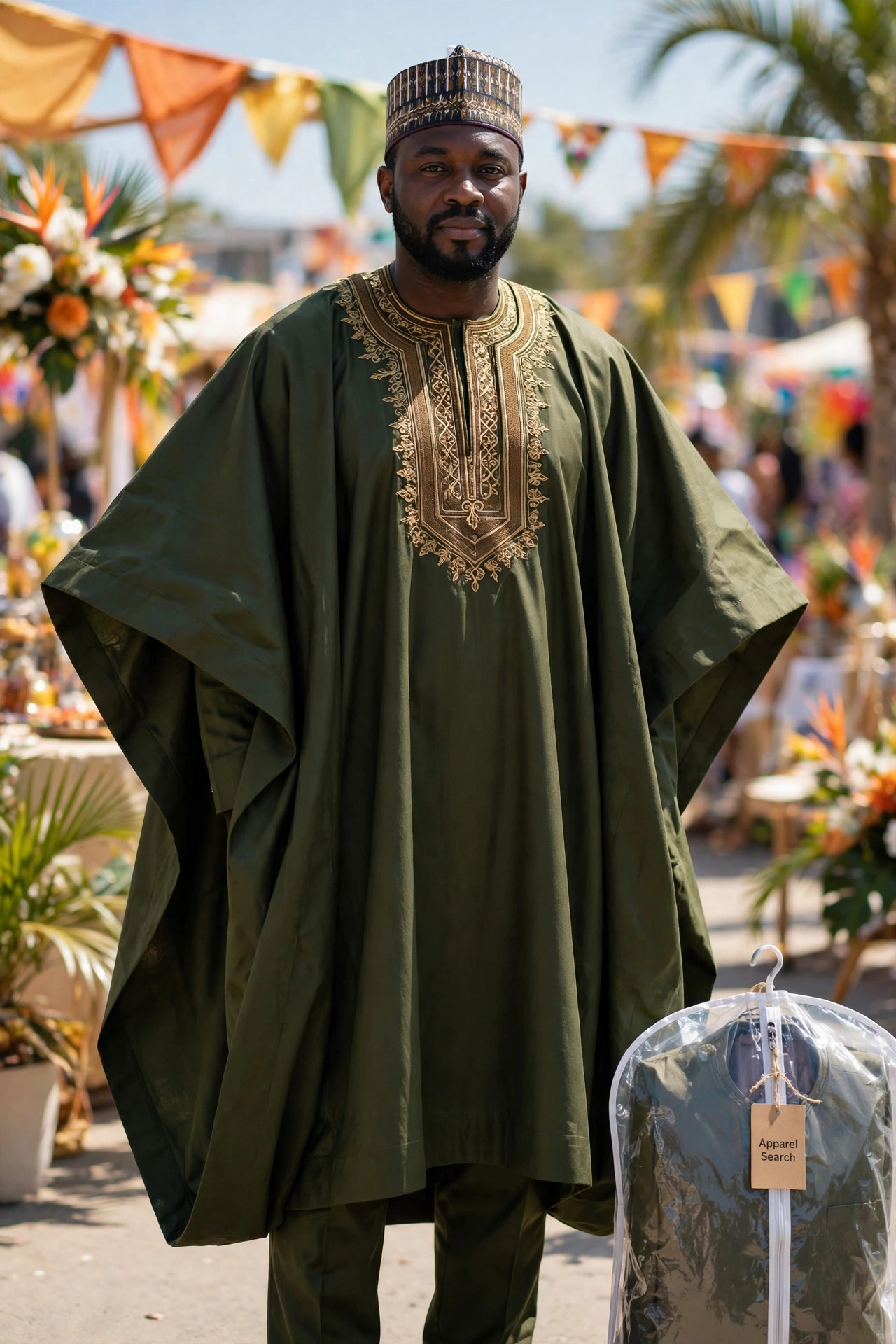
The boubou is the great flowing robe of West Africa: a wide, generous garment that falls from the shoulders to the ankles, with deep, sweeping sleeves and an ease of movement suited to a hot climate. Within that family, the agbada is the grand form developed in Yoruba dress in southwestern Nigeria and neighbouring regions — a ceremonial robe of real presence, worn over a matching tunic and trousers for weddings, naming ceremonies, religious festivals and formal gatherings. Understanding the two together explains much of West African formal menswear.
How Boubou and Agbada Relate — and Differ
Think of boubou as the family name and agbada as its most formal member. A boubou can be simple: a single wide robe, plainly finished, worn at home, at market or for daily prayers across Senegal, Mali, Guinea and beyond, where names and cuts vary by country and language. An agbada, by contrast, is deliberately grand. Its sleeves are cut exceptionally wide — the wearer gathers and lifts the cloth over one shoulder as he moves, a practised gesture that is part of the garment's elegance. Its embroidery is heavier, its fabric richer, and it is almost always part of a coordinated set rather than a single piece.
Construction and Embroidery
A traditional agbada is built from wide panels joined to create its volume, then finished with embroidery concentrated at the neckline, chest and back. Geometric and interlacing motifs are stitched in contrasting or tonal thread, traditionally by hand and now also by specialist machine embroidery that preserves the dense, raised effect. The neck opening is usually round or a short V, edged cleanly so the embroidered panel sits flat. A boubou follows the same basic construction more simply, with a narrower embroidered placket or a plain neckline and sleeves that, while wide, stop short of the agbada's dramatic sweep.
Fabrics and Colour
Fabric gives the robe its stature. Brocade and cotton damask hold their shape and catch light across their woven pattern; polished cotton gives a smooth, formal finish; and fine voile makes a cooler, lighter boubou for everyday wear. White and cream agbada read as classic and ceremonial, while deep green, royal blue, burgundy and gold signal celebration. Because the set is coordinated, the tunic and trousers beneath are usually cut from the same cloth, with the embroidery providing the contrast.
How It Is Worn
The full agbada outfit has three layers: trousers, often called sokoto, drawn at the waist; a long-sleeved tunic, the buba, worn over them; and the agbada itself on top, its volume arranged over the shoulders. A traditional cap — the Yoruba fila, or a knitted or embroidered cap in other regions — and leather slippers or formal shoes complete it. Men wear the grand set for weddings, Eid and other festivals, chieftaincy and family occasions, and photographs, where matching sets for a groom's party or a family express unity and honour.
Choosing and Care
Choose first by occasion: a richly embroidered brocade agbada for weddings and ceremonies, a lighter cotton boubou for regular wear. The robe should reach near the ankle without pooling, and the embroidery should lie flat, dense and even. Tailoring matters — most fine sets are made to measure, so allow a tailor to judge sleeve width against your height. Care for embroidered sets gently: dry-clean brocade, or wash plain cotton inside out on a gentle cycle, dry in shade, and press the embroidery from the reverse so its raised stitching keeps its definition.
Common Questions
What is the difference between a boubou and an agbada?
The boubou is the wider West African family of flowing robes. The agbada is its grand Yoruba form — a wide-sleeved ceremonial robe worn over a tunic and trousers, usually richer in embroidery and occasion.
What is an agbada worn over?
A matching long-sleeved tunic, often called a buba, and trousers, often called sokoto, in the same or a coordinating fabric. A cap such as a fila completes the outfit for formal occasions.
What fabric makes the best agbada?
Brocade, fine cotton damask and polished cotton hold the robe's wide shape and take embroidery well. Lighter cotton voile suits hot weather and simpler, everyday boubou styles.
Traditional & Cultural Dress Guides
Traditional and cultural dress from around the world — every guide in this cluster:
- Men's Boubou & Agbada
- Men's Achkan
- Men's Arkhalig
- Women's Baju Kurung
- Men's Baju Melayu
- Women's Buibui
- Men's Burnous
- Men's Chokha
- Men's Chullo
- Women's Churidar
- Women's Chut Thai
- Women's Deel
- Men's Djellaba
- Women's Dupatta
- Women's Huipil
- Men's Kanzu
- Women's Kebaya
- Women's Kitenge
- Men's Longyi
- Women's Patiala Salwar
- Men's Pheran
- Women's Sampot
- Women's Sinh
- Women's Songket
- Women's Terno
- Women's Hanbok
- Women's Ao Dai
- Women's Dirndl
- Women's Dashiki
- Women's Cheongsam
- Women's Salwar Kameez
- Women's Yukata
- Women's Kaftan
- Women's Abaya
- Men's Lederhosen
- Men's Thawb
- Men's Barong
- Women's Kimono
- Women's Silk Sari
- Women's Sarongs
- Men's Guayabera Shirts
Continue north to Morocco's hooded robe, worn from medina streets to family celebrations.
Next: Men's Djellaba Guide: North Africa's hooded robe »Looking for Men's Clothing Stores?
This guide helps you understand and choose boubou & agbada styles with confidence. To browse where to buy, visit our mens clothing store directory, where you can find retailers that carry them.