Men's Guayabera Shirts Guide
A men's guayabera shirt is a warm-climate shirt distinguished by two vertical rows of closely sewn pleats - alforzas - that run the length of the front and back of the shirt, worn untucked over a straight hem. It is popular across the Caribbean, in Colombia, Mexico, Ecuador and Venezuela, through Central America and the Caribbean, in Southeast Asia and throughout Africa, and it is also known as a wedding shirt. Few shirts carry a passport like this one: a garment formal enough for weddings and state occasions in the tropics, practical enough for field work in its legend, and so regionally claimed that its origin remains, honestly, a mystery.
Shop Men's Guayabera Shirts Now
Shop Men's Guayabera Shirts on Amazon Shop Men's Guayabera Shirts on eBayThe Amazon and eBay links on this page are affiliate links. If you make a purchase through them, Apparel Search may earn a commission.
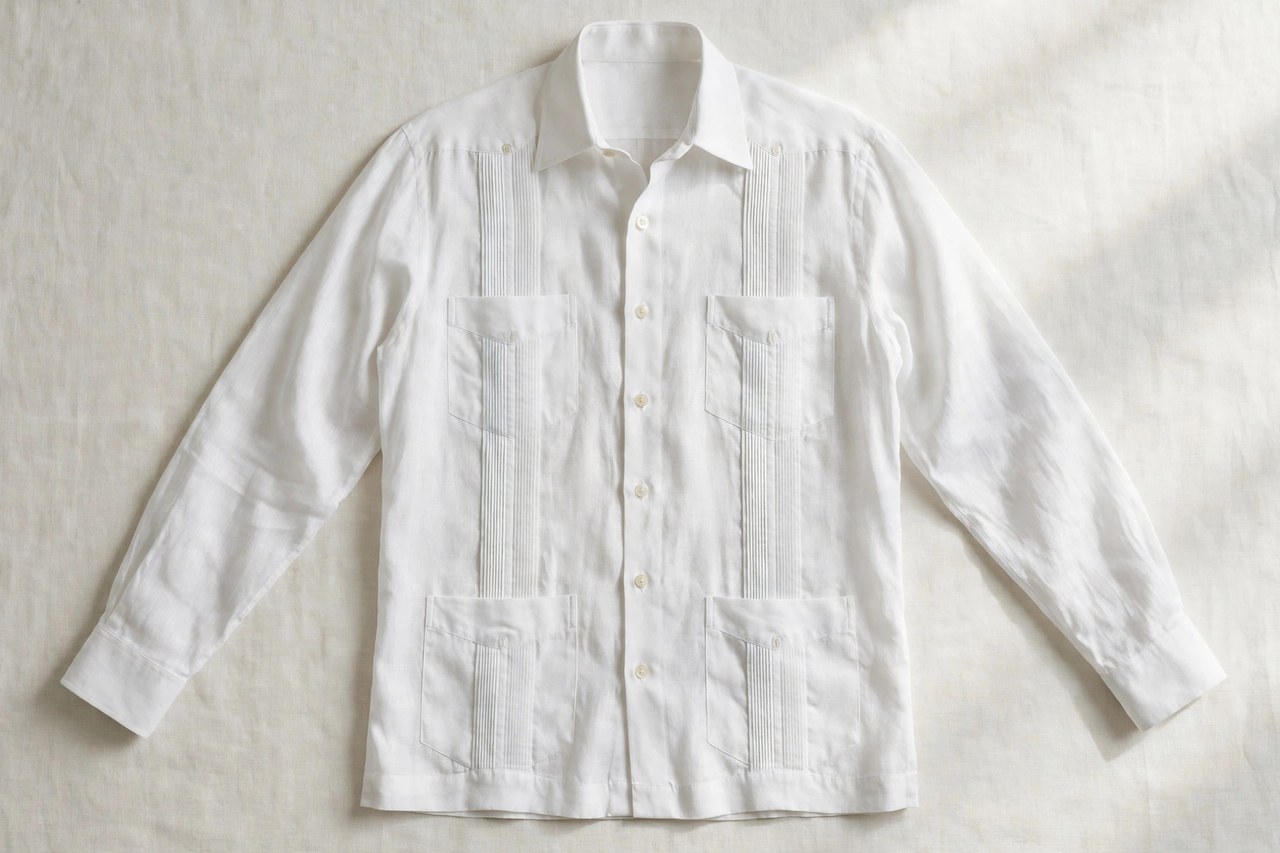
A men's guayabera shirt is a warm-climate shirt distinguished by two vertical rows of closely sewn pleats - alforzas - that run the length of the front and back of the shirt, worn untucked over a straight hem. It is popular across the Caribbean, in Colombia, Mexico, Ecuador and Venezuela, through Central America and the Caribbean, in Southeast Asia and throughout Africa, and it is also known as a wedding shirt. Few shirts carry a passport like this one: a garment formal enough for weddings and state occasions in the tropics, practical enough for field work in its legend, and so regionally claimed that its origin remains, honestly, a mystery. This guide is built around the questions buyers actually ask: which style, which size, which fabric, and what will it look like after a year of real use - answered in order, with the trade-offs stated plainly.
Styles and Construction
The design is a checklist, and a true guayabera ticks it. Either two or four patch pockets, separately detailed with identical alforzas aligned with the alforza rows on the body, each pocket topped with a matching shirt button, as are the bottoms of the pleat rows. Alforzas themselves are fine, tiny pleats, usually ten, sewn closely together in each row. Vertical rows of adjusting buttons often appear, one on each side at the bottom hem, beside the side slits many versions carry. Most versions have no placket covering the buttons, though a few newer designs add one. The hem is straight and is not tucked into the trousers - that untucked finish is the silhouette. Traditionally white and pastels, the shirt now comes in many solid colors; the black guayabera embroidered with colorful flowers and finished with French cuffs has been formalwear in Mexico for decades, and Mexican versions often use complicated embroidery in place of, or alongside, the alforzas. Linen and cotton are the classic fabrics, chosen for heat.
A top earns its keep in finishing: seams that hang straight and stay even at eight to twelve stitches per inch, collars and plackets that lie flat after washing, buttons sewn with thread shanks so they sit in their holes without pulling. Hold the cloth to the light - a tight, even weave or knit outwears a loose one at the same labeled weight, and pattern pieces cut on grain keep the garment from twisting around your body by the third wash.
Fit and Sizing
Fit a guayabera as the untucked shirt it is: the body should hang cleanly from the shoulders with room for air to move - this is hot-weather engineering, and a tight guayabera defeats its own purpose - while the straight hem ends at mid-fly, level all around, since an untucked hem is a horizon line the whole room can judge. The alforza rows should run vertically without bowing at the chest; bowing means the chest is too small, whatever the label says. Sleeves come short for the everyday shirt and long for the formal and wedding versions. Pockets should lie flat when empty. Because the shirt is worn over trousers in place of a jacket in its home climates, its fit standard is a jacket's: deliberate, level, and finished at every edge.
Fit tops shoulders and chest first, because tailors cannot cheaply move either: the shoulder seam ends at the shoulder bone, the chest closes without pulling, and both arms raise without the hem escaping the waistband. Tucked lengths must stay tucked sitting; untucked lengths should end mid-fly. Sleeves are the cheap alteration, shoulders the permanent one - reject a wrong shoulder for any reason, forgive a long sleeve for many.
Wearing and Care
Care honors the pleats and the cloth. Linen and cotton guayaberas wash cool or warm and dry low or on the line; the alforzas are pressed from the back with the pleats aligned, which sounds fussy and takes two minutes once learned - it is the difference between the shirt's architecture and a wrinkled camp shirt. Embroidery is washed inside out and never bleached. Store on hangers so the straight hem and pleat rows hang true, and rest the shirt between wears in heat. A well-kept guayabera improves with age as linen softens; a neglected one loses its pleats first and its dignity immediately after, which is why the pressing is not optional.
Launder tops by the label with three defaults: cool or warm water to protect color and trims, dark and printed pieces inside out, and low or line drying, which is the largest single lever on a shirt's lifespan. Fasten buttons and zips before washing to protect the whole load, treat stains before the dryer can set them, and store knits folded so their shoulders keep the shape they were knitted with.
Common Questions
What are alforzas?
Alforzas are the guayabera's defining detail: fine, tiny pleats - usually ten to a row - sewn closely together in two vertical rows that run the length of the front and back of the shirt. The pockets carry identical alforzas aligned with the rows on the body, and the bottoms of the pleat rows are finished with matching shirt buttons. They are decoration with structure: the rows give the light tropical cloth body, presence and a formal vertical line.
Where does the guayabera come from?
Its origin remains a mystery, and the claims are part of its charm. One Cuban legend tells of a poor countryside seamstress sewing large patch pockets onto her husband's shirts for carrying guavas - guayabas - from the field. Another derives the name from the yayabero, the nickname for those who lived near the Yayabo River in Cuba; Baní, in the Dominican Republic, also claims it, for guava harvesting there. A trade theory holds that Mexican shirts from Veracruz or the Yucatán reached Cuba and then the Philippines via Spanish routes - or that the shirt traveled the Manila-Acapulco galleon trade the other way. In the Dominican Republic it is the chacabana; Jamaica knows the style as a bush jacket; the Philippines' formal Barong Tagalog shares features and may be a relative or a precursor.
Is a guayabera formal enough for a wedding?
In its home cultures, it is not merely acceptable - it is the wedding shirt, one of its traditional names. The formal version is long-sleeved, in white or black, finely pleated or embroidered, sometimes with French cuffs, worn untucked with tailored trousers. Context is the rule: at a Caribbean, Mexican or tropical wedding the guayabera is correct formal dress; at a temperate black-tie wedding it is not a substitute for the code the invitation names. When the region's formality is the guayabera, wear the finest version of it.
More in Men's Clothes Guide G
Alforzas, Weddings and a Mystery
The guayabera is distinguished by two vertical rows of closely sewn pleats running the length of front and back, typically worn untucked, also known as a “Wedding Shirt”; two or four patch pockets detailed with identical alforzas — fine, tiny pleats, usually ten, sewed closely together — aligned with the pleats on the body; a matching button atop each pocket and at the bottoms of the alforza rows; adjusting buttons at the side slits of a straight hem; traditionally white and pastels, now in many solid colors, with black guayaberas, embroidered with colorful flowers and festooned with French cuffs, long-standing formalwear in Mexico, and Mexican versions using complicated embroidery in place of or as a supplement to the alforzas. The origins are weighed from several sides: the Cuban seamstress sewing pockets for guavas, the yayabero of the Yayabo River, Baní in the Dominican Republic, the Veracruz and Yucatán theories, the Manila-Acapulco galleon trade in both directions, the Dominican chacabana, the shirt-jac and Jamaican bush jacket, Samoa’s safari set, and the Philippines’ Barong Tagalog — more formal, without pleats or pockets, in hand-woven piña or jusi — as relative or precursor. The origin of the guayabera shirt remains a mystery.
More to Explore on Apparel Search
Looking for Men's Clothing Stores?
This guide explains men's guayabera shirts. To browse where to buy, visit our men's clothing store directory, where you can find retailers that carry them.