Guayabera Shirt
Clothing Definitions — definitions of garments and clothing terms from Apparel Search
Search Apparel Search
At a Glance
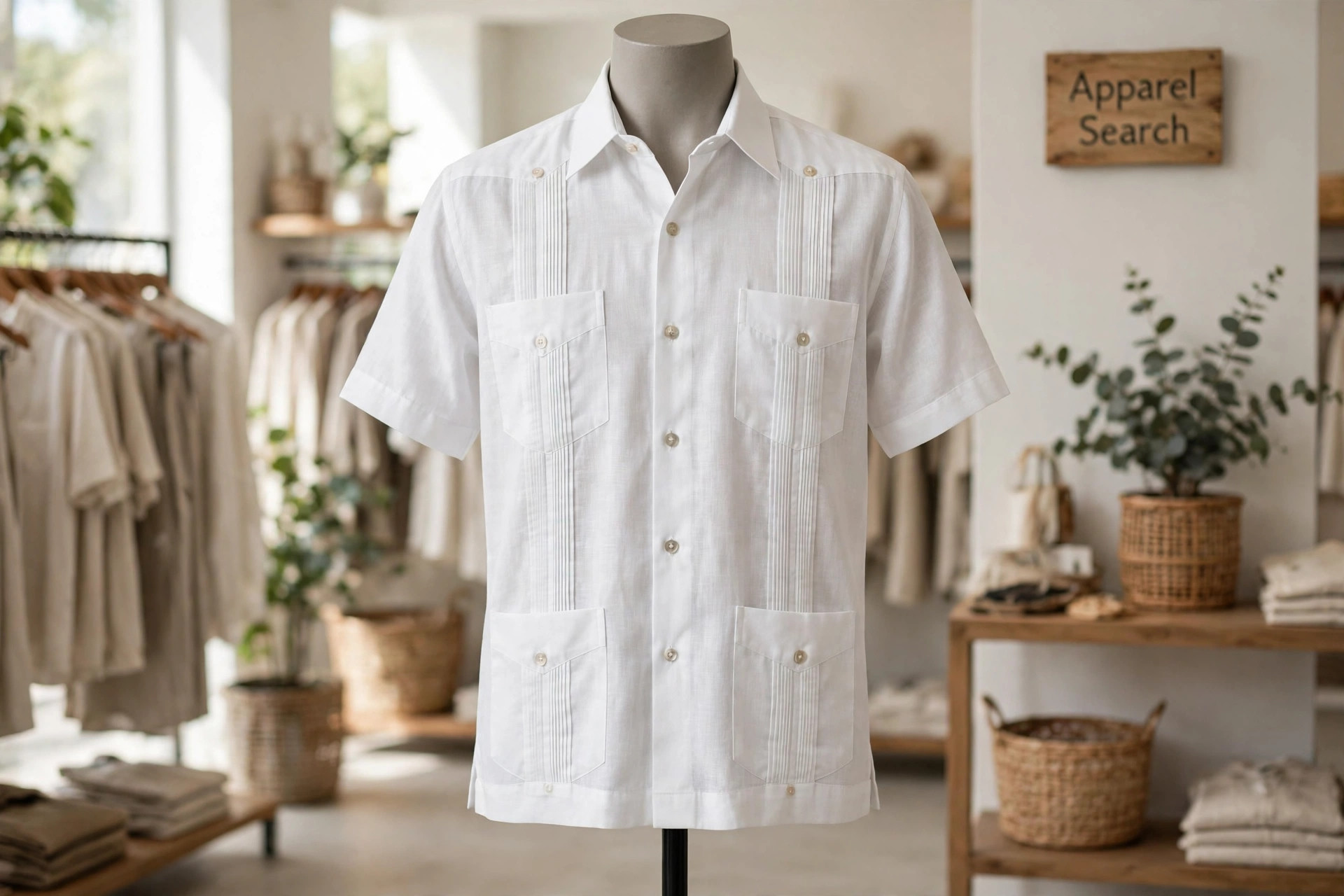
Definition: The guayabera is a men's shirt from the Spanish-speaking Caribbean, recognised by its four pockets and two vertical rows of fine pleats or embroidery, cut straight at the hem to be worn untucked.
Also known as: Mexican wedding shirt
Pronunciation: gwy-ah-BEH-rah
Category: Clothing Definitions
Word Origin
The name is usually explained as the shirt of the guayaba (guava) picker, its four pockets said to be made for carrying guavas — but that explanation may be a folk etymology attached to an unrelated word, and both the shirt's birthplace, claimed by Cuba and by Mexico, and its name remain genuinely unsettled.
The guayabera is the shirt that does a suit's job in a hot climate. Across Cuba, Mexico, the Caribbean and Latin America it is correct dress for weddings, christenings, formal business and government — a single lightweight garment carrying all the formality that a jacket and tie carry elsewhere. Its identity is written on its front: four pockets and two vertical bands of fine pleating and embroidery, on a straight hem that is never tucked in. This page explains those defining details, the genuinely unsettled argument over where the shirt and its name come from, and how to wear and choose one.
The Defining Details
A guayabera can be recognised from across a room by three features. First, the pockets: four of them, two on the chest and two at the hips, usually with flaps and buttons — an arrangement no ordinary dress shirt carries. Second, the fronts: two vertical rows of alforzas, fine pin-tucks or pleats, run from shoulder to hem on either side of the button placket, frequently combined with embroidered motifs worked along the same lines; the brief's older descriptions call these the shirt's two vertical lines of embroidery passing by the pockets. Third, the hem: straight all the way round, often with small side vents, because the shirt is designed from the outset to be worn outside the trousers.
Everything else supports those three marks. The fabric is light and breathable — linen, cotton, or blends, classically white, with cream and pastel colours for less formal wear. Short sleeves are the everyday and warm-weather standard; long sleeves read as more formal. Buttons are sometimes covered or decorative, and the collar is a soft camp or banded style that sits comfortably without a tie. Remove any one of the pockets, pleats or straight hem and the garment stops being a guayabera and becomes an ordinary shirt.
Cuba or Mexico? An Unsettled Origin
Honesty requires saying plainly: the guayabera's origin is not settled. The shirt has been worn across Latin America and the Caribbean since the late nineteenth century, and two countries claim it. The Cuban account places its birth in the Sancti Spíritus region, where tradition tells of a shirt commissioned with extra pockets and pleated fronts in the eighteenth or early nineteenth century. The Mexican account points to Yucatán, where the same shirt became standard wear and where, as the Mexican wedding shirt, it is the expected dress for grooms and wedding guests — to an outsider's eye, the identical garment under its other name.
The name is as uncertain as the birthplace. The popular explanation derives guayabera from guayaba, the guava: the shirt of the guava picker, its four pockets supposedly made for carrying the fruit. It is a neat story, and it may be true — but it may equally be a folk etymology, a plausible tale attached later to a word that came from somewhere else entirely, possibly a place name. What is documented is the spread: from its Caribbean home the shirt travelled throughout the Spanish-speaking Americas and beyond, becoming regional formal dress wherever heat made the European suit punishing.
Formal Dress for a Hot Climate
The guayabera's social role explains its survival. Formal occasions do not stop for heat, and the shirt answers them on its own terms: the pleated, embroidered front supplies the dressed, finished character that a jacket supplies in a temperate climate, while the light fabric and untucked cut keep the wearer bearable in tropical temperatures. Heads of state and government officials in the region have long worn guayaberas for official business, which fixed the shirt's standing as genuinely formal — not a casual substitute for formality, but a parallel formality of its own.
At weddings the shirt's role is clearest. The Mexican wedding shirt — the guayabera in white, worn by the groom and often by male guests — is the centrepiece of warm-weather wedding dress across Mexico and in Mexican-American celebrations, paired with light trousers and worn with the same intent as a suit. In the Philippines, the related barong tagalog occupies the same formal-shirt position, a reminder that Spain's tropical colonies all faced, and solved, the same clothing problem.
Wearing and Choosing One
Wear a guayabera untucked, always — tucking it defeats the cut and hides the hem the design depends on. Fit should be relaxed through the body without billowing; the pleated fronts should hang vertically and the four pockets lie flat. White in linen is the most formal and the classic wedding choice; cotton and blends in white, ivory or soft colours serve for business and social wear, and short sleeves lower the formality a step without leaving the category.
Quality shows in the alforzas: the pleats should be fine, even and stitched — not printed — and the embroidery, where present, worked rather than applied. Our Men's Guayabera Shirts guide and Women's Guayabera Shirts guide survey current makers and styles, women's versions adapting the same four-pocket, pleated-front pattern. As formal wear goes, the guayabera is the rare case where the comfortable option is also the correct one.
Common Questions
What defines a guayabera shirt?
Four pockets — two on the chest and two at the hips — two vertical rows of fine pleats called alforzas, often with embroidery, running down the front, and a straight hem worn untucked over the trousers. Short or long sleeves are both standard.
Where does the guayabera come from?
Nobody knows for certain. Cuba and Mexico both claim the shirt, which has been worn across Latin America and the Caribbean since the late nineteenth century, and the popular explanation of the name — the shirt of the guava picker — may be a folk etymology rather than the true origin.
Why is a guayabera worn untucked?
The guayabera is cut with a straight hem precisely so it can be worn outside the trousers. In the hot climates where it is formal dress, the untucked cut is cooler, and the pleated, pocketed front carries the formality that a jacket would supply elsewhere.