Men's Burnous Guide
North Africa's heavy hooded cloak in thick wool — the winter layer worn over robes from Algeria to Morocco.
Shop Burnous Now
Shop on Amazon Shop on eBayThe Amazon and eBay links on this page are affiliate links. If you make a purchase through them, Apparel Search may earn a commission.
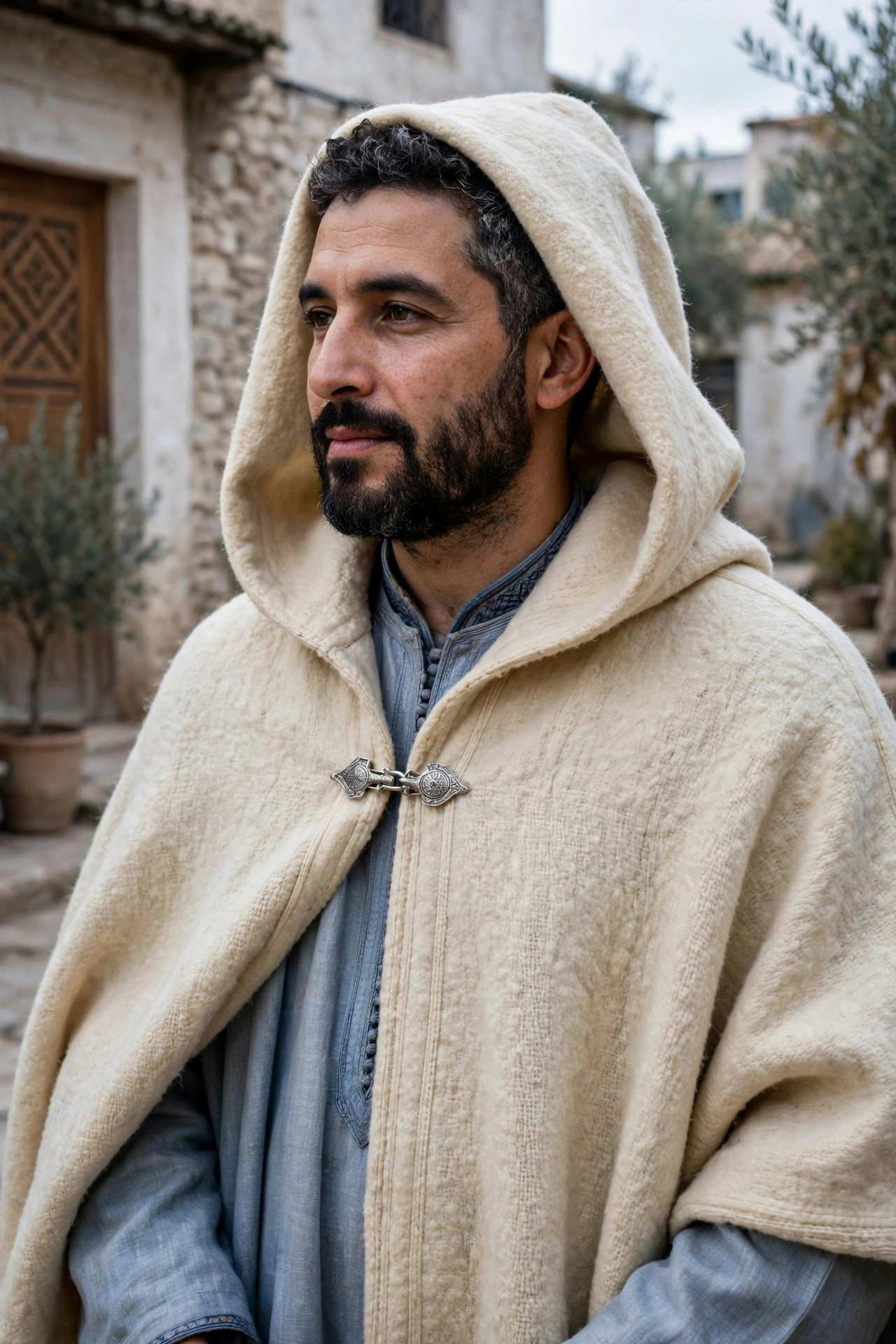
The burnous is the long, hooded cloak of North Africa: a heavy, sleeveless wrap of woven wool, worn by men over a robe or djellaba against mountain cold, desert wind and winter rain. It is among the oldest continuously worn garments of the Maghreb and the wider Berber world, depicted for centuries and still made by weavers in Algeria, Morocco and Tunisia. Where the djellaba is daily dress, the burnous is its weatherproof outer layer — and, in fine white wool, a garment of honour in its own right.
Construction of the Cloak
A burnous is woven or cut as a large, shaped cloak that falls from the shoulders to below the knee or the ankle, open at the front and fastened at the chest with a cord, clasp or knotted closure. The hood is generous and pointed or rounded depending on region, large enough to pull over a cap or turban. Because there are no sleeves, the wearer's arms stay free beneath the cloth, and the cloak can be gathered, thrown back over one shoulder, or wrapped close as weather demands. Seams and edges are finished to withstand hard use; a good burnous is dense enough to shed light rain.
Wool, Weave and Colour
Traditional burnous wool is thick and slightly coarse, woven for warmth rather than softness, sometimes mixed with goat hair to resist damp. Everyday cloaks come in undyed or earthy shades — brown, grey, black and striped weaves that hide dust and wear. Ceremonial burnous reverse that logic: fine, smooth wool in white or cream, worn by dignitaries, grooms and honoured guests, and in Algeria notably associated with formal and state dress. The weight is the point — a burnous should feel substantial, because its warmth comes from the mass and density of its cloth.
How the Burnous Is Worn
Men wear the burnous over a djellaba or other robe in cold weather, on journeys, for evening prayers in winter, and on horseback, where its length protects the legs. The hood goes up against wind and rain and rests down the back in calm weather. In ceremonial settings a white burnous is worn over festive dress as a mark of respect and status, its clean expanse of wool framing the embroidered garments beneath. Shepherds, travellers and elders have long valued the same garment for a simpler reason: wrapped fully, it can serve as a blanket-like shelter on a cold night.
Regional Character
Weaving traditions give each region's burnous its character. Algerian burnous are celebrated for fine white wool and a distinguished, formal presence. Moroccan versions range from heavy striped mountain cloaks to smoother urban weaves, and Tunisian cloaks carry their own hood and fastening habits. Related hooded cloaks appear under local names around the Mediterranean, but the North African burnous remains defined by its combination of hood, weight and open, sleeveless fall.
Choosing and Care
Choose a burnous by climate and purpose: the heaviest, coarsest weaves for real cold and outdoor work; finer, lighter wool for ceremony and travel. It should reach well below the knee, close comfortably at the chest without pulling, and have a hood that covers the head fully. Wool cloaks need little washing — brush off dust, air them regularly, and dry-clean only when necessary. Store folded with protection against moths, and a well-made burnous will serve for decades, softening slightly while keeping its weatherproof density.
Common Questions
What is a burnous?
A long, heavy hooded cloak, traditionally woven from wool, worn by men in North Africa over a robe or djellaba. It protects against cold, wind and rain and carries ceremonial as well as practical use.
How is a burnous different from a djellaba?
A djellaba is a sleeved robe worn as the main garment. A burnous is a sleeveless cloak worn over it — thicker, more open at the front, and made for warmth and weather protection.
What is a burnous made from?
Traditionally thick woven wool, sometimes blended with goat hair for weather resistance. Ceremonial burnous may use finer wool in white or cream with a smooth, dense weave.
Traditional & Cultural Dress Guides
Traditional and cultural dress from around the world — every guide in this cluster:
- Men's Burnous
- Men's Achkan
- Men's Boubou & Agbada
- Men's Arkhalig
- Women's Baju Kurung
- Men's Baju Melayu
- Women's Buibui
- Men's Chokha
- Men's Chullo
- Women's Churidar
- Women's Chut Thai
- Women's Deel
- Men's Djellaba
- Women's Dupatta
- Women's Huipil
- Men's Kanzu
- Women's Kebaya
- Women's Kitenge
- Men's Longyi
- Women's Patiala Salwar
- Men's Pheran
- Women's Sampot
- Women's Sinh
- Women's Songket
- Women's Terno
- Women's Hanbok
- Women's Ao Dai
- Women's Dirndl
- Women's Dashiki
- Women's Cheongsam
- Women's Salwar Kameez
- Women's Yukata
- Women's Kaftan
- Women's Abaya
- Men's Lederhosen
- Men's Thawb
- Men's Barong
- Women's Kimono
- Women's Silk Sari
- Women's Sarongs
- Men's Guayabera Shirts
Travel to East Africa for the kanzu, the white ankle-length tunic worn for prayers and celebrations.
Next: Men's Kanzu Guide: East Africa's white robe »Looking for Men's Clothing Stores?
This guide helps you understand and choose burnous styles with confidence. To browse where to buy, visit our mens clothing store directory, where you can find retailers that carry them.