Women's Buibui Guide
The flowing black covering of Kenya and Tanzania's coast — worn over bright dresses, with grace and long tradition.
Shop Buibui Now
Shop on Amazon Shop on eBayThe Amazon and eBay links on this page are affiliate links. If you make a purchase through them, Apparel Search may earn a commission.
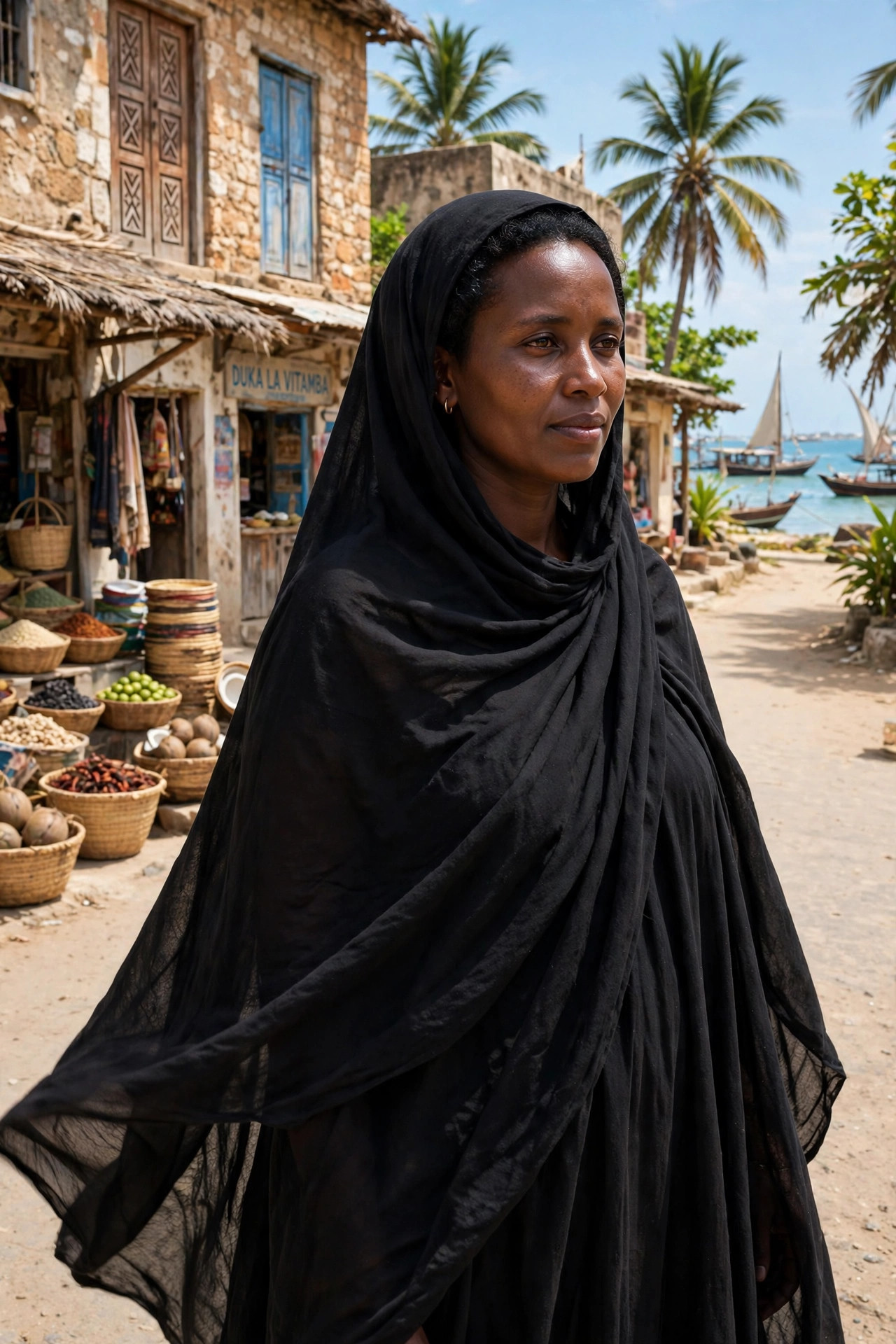
The buibui is the long, flowing black covering worn by women along the Swahili coast — in Mombasa, Lamu, Zanzibar, Dar es Salaam and coastal communities across Kenya and Tanzania. Worn over a dress whenever a woman goes out, visits, shops or attends prayers and occasions, it moves with a distinctive, graceful sweep. Its deep black surface is not plainness but a canvas: beneath it, glimpsed at the hem and sleeves, are the bright colours of the dress it covers, a contrast the coast has made its own.
Construction and Silhouette
A buibui is cut generously and simply: a long, loose body falling from the shoulders to the ankles, with wide sleeves and an opening that allows it to be slipped on quickly over other clothes. Some styles close at the front with small fastenings; others are worn open over the dress, held by the wearer's movement and a head covering worn with it. Better examples are finished with subtle detail — neat edge stitching, a softly shaped neckline, or restrained embroidery at the cuffs and front — detail that reads at close range rather than across a street, in keeping with the garment's modest purpose.
History on the Swahili Coast
The buibui reflects the coast's centuries of Indian Ocean trade and Islamic culture, during which dress from Arabia and beyond met local tailoring and became something distinctly Swahili. Related modest over-garments are explored in our women's Abaya guide; the buibui developed its own local character in fabric weight, cut and the way it is styled over vividly patterned coastal dresses. For generations it has been everyday dress for women of the coast — practical in sun and sea air, respectful in company, and elegant in motion.
Fabrics and Finish
Most buibui are made from lightweight black fabrics that drape and flow — crepe, georgette, fine polyester and cotton blends chosen to stay cool over layers in a hot, humid climate. The cloth should be fully opaque, matte rather than shiny for traditional wear, and fluid enough to move as the wearer walks. Heavier or lined versions exist for travel to cooler climates. Because black shows lint and fading readily, quality shows in a deep, even dye and fabric that keeps its smooth surface after repeated washing.
How the Buibui Is Worn
A woman puts on her buibui over a house dress or her best printed dress alike — for the market, the mosque, a wedding visit or a journey, it is the layer that makes an outfit ready for the world. Head coverings are worn as each woman chooses, from scarves coordinated with the dress beneath to coverings worn with the buibui for prayer. At celebrations, the bright dress beneath takes the lead once the buibui is set aside indoors among women, making the pairing a practical two-part outfit: modest covering outside, celebration dress inside.
Choosing and Care
Choose a buibui long enough to cover the dress beneath fully, with sleeves that reach the wrist and cloth that stays opaque against bright coastal light. Seams should be flat and hems even, since the garment's beauty is in its uninterrupted fall. Wash gently in cool water with dark colours, dry in shade to protect the deep black, and hang rather than fold to keep the drape smooth. A well-kept buibui needs little pressing — its flowing line is its finish.
Common Questions
What is a buibui?
A long, loose, usually black covering garment worn by women along the Swahili coast of Kenya and Tanzania and in Zanzibar. It is worn over a dress when going out, for prayers, visits and occasions.
What is worn under a buibui?
A dress — often a brightly coloured or patterned one — with a head covering as the wearer chooses. The contrast between the black buibui and a colourful dress beneath is characteristic.
Is a buibui the same as an abaya?
They serve a similar purpose as modest over-garments and share influences, but the buibui is the Swahili coast's own form, with its local cut, history and styling traditions.
Traditional & Cultural Dress Guides
Traditional and cultural dress from around the world — every guide in this cluster:
- Women's Buibui
- Men's Achkan
- Men's Boubou & Agbada
- Men's Arkhalig
- Women's Baju Kurung
- Men's Baju Melayu
- Men's Burnous
- Men's Chokha
- Men's Chullo
- Women's Churidar
- Women's Chut Thai
- Women's Deel
- Men's Djellaba
- Women's Dupatta
- Women's Huipil
- Men's Kanzu
- Women's Kebaya
- Women's Kitenge
- Men's Longyi
- Women's Patiala Salwar
- Men's Pheran
- Women's Sampot
- Women's Sinh
- Women's Songket
- Women's Terno
- Women's Hanbok
- Women's Ao Dai
- Women's Dirndl
- Women's Dashiki
- Women's Cheongsam
- Women's Salwar Kameez
- Women's Yukata
- Women's Kaftan
- Women's Abaya
- Men's Lederhosen
- Men's Thawb
- Men's Barong
- Women's Kimono
- Women's Silk Sari
- Women's Sarongs
- Men's Guayabera Shirts
Continue in East Africa with kitenge, the bold printed cloth tailored into dresses, skirts and wraps.
Next: Women's Kitenge Guide: Bold wax-print cloth »Looking for Women's Clothing Stores?
This guide helps you understand and choose buibui styles with confidence. To browse where to buy, visit our womens clothing store directory, where you can find retailers that carry them.