Fashion on Television · Screen Style Topics
Emily in Paris: Maximalist Costumes in the City of Light
A Chicago marketing executive lands in Paris dressed for the city she imagined — and the world went shopping for her hats. This guide tells the wardrobe story of Emily in Paris correctly: Marylin Fitoussi, the costume designer and lead from season one; Patricia Field, consultant for the first two seasons only; the beret and bucket-hat search spikes that followed the premiere; and the study that named the show the leading screen inspiration for visiting Paris.
At a Glance
- Series
- Emily in Paris (Netflix, 2020– ), created by Darren Star
- Setting
- Paris — a Chicago marketing executive joins a French luxury marketing firm
- Costume designers
- Marylin Fitoussi (costume designer and lead from season 1); Patricia Field, costume consultant for seasons 1–2 only
- Signature look
- Maximalist Parisian fantasy — clashing prints, bold color, berets and bucket hats, against a tailored Parisian counterpoint
- The fashion effect
- Outfit searches up 242% after the October 2020 premiere; bucket hats up 342%, berets up 41%; the most-cited screen inspiration for visiting Paris in a 2024 CNC study
The Design Story
Fitoussi Leads, Field Consults: Getting the Credit Right
Most coverage of Emily in Paris reaches for the famous name first, and gets the credit wrong in the process. The famous name is Patricia Field, the costume designer who defined television fashion with Sex and the City — and Field's role on this series was real but specific: she served as costume consultant for the first two seasons. The costume designer of Emily in Paris, from the first season onward and as the lead throughout, is Marylin Fitoussi. That distinction is not pedantry. It is the key to understanding why the wardrobe looks the way it does, because the eye behind it is a French designer's, not an American one restaging her earlier hit in a new city.
The premise hands the designer a gift. Emily Cooper, a marketing executive from Chicago, arrives in Paris to bring an American point of view to a French luxury marketing firm, and the scripts run on fashion and beauty clients — launches, campaigns, influencer events. Emily's job is persuasion, and her clothes do the same work in every frame: they announce her before she speaks. Fitoussi dressed that announcement in loud color, mixed prints and emphatic accessories, set deliberately against the Parisians around her, whose black, navy and camel register as the local uniform. The clash is the characterisation. Emily is not failing to dress like a Parisian; she is refusing to, and the wardrobe makes the refusal joyful rather than apologetic.
Field's consultancy in the first two seasons connected the series to a lineage. Darren Star created both Sex and the City and Emily in Paris, and Field's presence signalled that clothes would again be treated as a lead character — shopped for, talked about and searched for. But the execution was Fitoussi's, working in Paris, mixing vintage and thrift finds with contemporary pieces, and building a look that French critics could call a fantasy while audiences worldwide treated it as a shopping list. Both reactions were, in their way, correct — and both were good for the show.
The cleanest proof of authorship came with the third season. Field's consultancy ended after season two, and Fitoussi took full reins for season three — the season that brought her first solo Emmy nomination for the costumes. A designer who had supposedly been working in a legend's shadow stepped forward, alone, and was recognised by the Television Academy for the same maximalist wardrobe, now entirely hers. Any honest account of this series' fashion starts there: consultant Field, designer Fitoussi, and from season three, Fitoussi unaccompanied.
The Wardrobe
The Paris Wardrobe, Piece by Piece
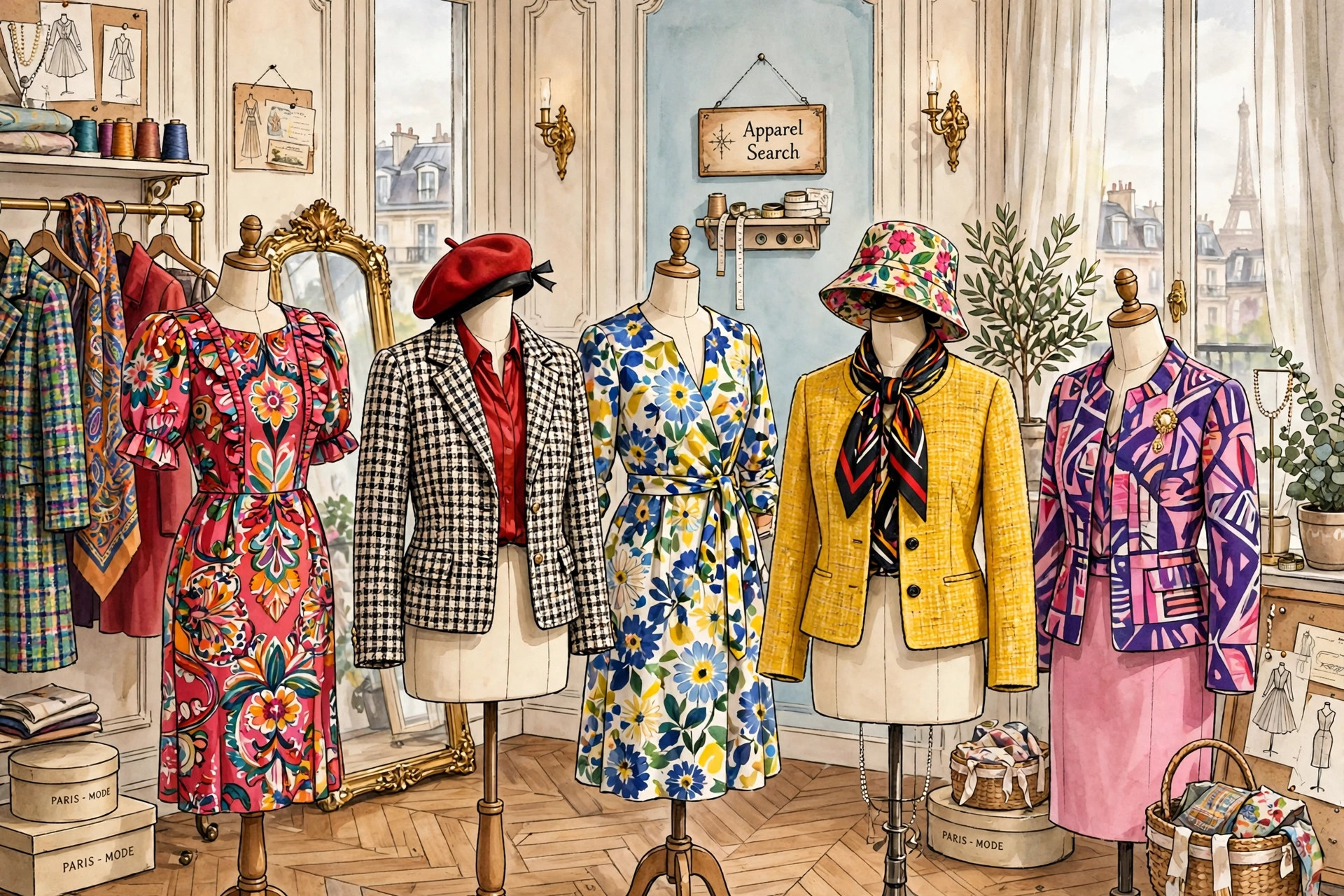
The beret. No single item carries the show's argument like Emily's berets. The beret is the world's shorthand for Paris — so familiar it borders on costume-party cliché — and Fitoussi leaned straight into it, styling it as a deliberate, cheerful provocation. On Emily it reads as an American's love letter to an idea of Paris; on the search charts, as the effect section below shows, it read as an instruction to buy one.
The bucket hat. If the beret was the cliché, the bucket hat was the surprise. A casual, almost anti-chic shape became one of the first season's most-searched items, proof that the wardrobe's power lay not in couture price tags but in repeatable, wearable pieces a viewer could find by Friday. Fitoussi's mix — vintage and thrift finds alongside contemporary designer pieces — kept that door open: the look was aspirational in attitude, attainable in parts.
Pattern on pattern. Checks against florals, stripes against prints, color against color: the Emily formula layers pieces that conventional styling would separate. The method matters more than any single outfit. Each element is recognisably classic — a tweed jacket, a tailored coat, a printed dress — but the combinations are turned up until the classic becomes exuberant. It is maximalism built from familiar parts, which is precisely why it travelled: viewers could copy the method with their own closets.
The Parisian counterpoint. A maximalist heroine needs a foil, and the wardrobe supplies one in Sylvie, Emily's boss, whose dressing runs to the opposite pole: restraint, tailoring, black and neutrals, luxury worn quietly. The two women's clothes stage the show's central argument — American enthusiasm against French understatement — in every office scene, without a line of dialogue. Costume design teachers could build a lecture on the contrast alone: same city, same industry, two complete philosophies of dress, legible at a glance.
Evening and occasion dressing. Because the plots turn on launches and parties, the series is also a catalogue of event dressing — cocktail dresses, statement coats, dressed-up daywear pushed one notch further than the occasion strictly requires. That one notch is the Fitoussi signature: Emily is always slightly overdressed, and the slightness is the point. She dresses for the Paris she imagined, and the show's pleasure is watching the real city slowly meet her halfway.
Character in Clothes
Two Cities in One Wardrobe
Underneath the shopping phenomenon sits a serious piece of character work. Emily arrives dressed for a postcard; the seasons since have tracked, in clothes, how a person changes in a new city without surrendering to it. The prints stay bold, but the combinations grow more assured; the Parisian counterpoint softens as colleagues borrow each other's registers. Fitoussi, who in interviews has framed the costuming as a way to represent the characters' personalities rather than to copy what real people wear, uses the wardrobe as the show's most honest narrator — the dialogue says Emily is finding her footing, and the clothes prove it.
A beret, a bucket hat and a search chart: Emily in Paris is the rare series whose loudest arguments are made entirely in clothes.
That approach explains the show's unusual double life. As drama, it is a romantic comedy about work and love in Paris. As fashion media, it functions like a weekly editorial — each episode a styled shoot with a plot attached — arriving in an era when viewers shop from the pause button. The costume department was, in effect, art-directing both at once, and the audience numbers and search behaviour that followed suggest viewers understood the assignment instinctively: watch the story, screenshot the outfit.
It also explains the criticism, which the guide should record fairly. French reviewers objected that the Paris on screen — and the Parisian style it claimed to celebrate — was a fantasy of clichés. Fitoussi's defence is built into the work itself: Emily's wardrobe was never documentary. It is the inside of an outsider's imagination, dressed. Judged as realism it fails on purpose; judged as character design, the clichés are the character.
The Making
From Consultant Era to Solo Emmy Nomination
The production story of this wardrobe is a handover handled gracefully. Seasons one and two paired Fitoussi's design leadership with Field's consultancy — two generations of television fashion in one department, the Sex and the City era advising the streaming era. When the consultancy ended, nothing about the show's visual identity broke: the prints, the hats and the color confidence continued seamlessly into season three, because the hand that had been building them all along remained. The Emmy nomination that followed — Fitoussi's first solo nomination — settled the authorship question in the industry's own record.
The working method behind the continuity is worth noting for students of the craft. Fitoussi mixes vintage and thrift finds with contemporary pieces, remixing decades rather than dressing from a single season's rails. That method gives the wardrobe its density — an outfit can hold three eras at once — and its resilience: a look assembled from many sources cannot be reduced to one brand's collection, which is why the show's style stayed recognisable even as individual pieces came and went. It is also, not incidentally, how the audience copies it: a vintage jacket here, a high-street hat there, the method reproduced in a million closets.
The Fashion Effect
242 Percent: The Outfits Become a Search Term
Television fashion effects are often claimed; this one was counted. After the series premiered in October 2020, searches for "Emily in Paris outfits" rose 242 percent — the audience was not merely admiring the wardrobe, it was querying it by name, the streaming-era equivalent of asking a shop assistant to recreate a look. The item-level numbers are sharper still: searches for bucket hats rose 342 percent, and beret searches rose 41 percent. A comic hat and a cliché hat, both converted into retail demand within weeks of a premiere, by a costume department working in a city the viewers mostly could not visit at the time.
The longer effect was on Paris itself. A 2024 study by the CNC, France's national cinema centre, found the series was by far the most-cited screen inspiration for visiting Paris — a costume-led romantic comedy out-polling every drama and documentary as a reason to travel — with beret sellers among those reporting an uptick. Screen tourism is usually credited to landscapes; here the landscape was a wardrobe. Visitors were not only coming to see Paris; they were coming to dress in it, beret first.
The mechanism is the one our Fashion on Television overview traces across the modern era: a series, unlike a film, lives with its audience for weeks, repeating its signature pieces until they become familiar, then desirable, then searched. Emily in Paris intensified the mechanism by making the signatures cheap and findable — a beret, a bucket hat — rather than couture-exclusive. Field had pioneered the designer-lending relationship that let television borrow real fashion houses; Fitoussi completed the circuit by making television send real shoppers back to those houses, and to every high-street rail that copied them.
Legacy
What Emily in Paris Changed
The series' legacy in costume design is, first, a correction it forced on the record. The consultant-versus-designer distinction — Field advising, Fitoussi designing — is now the standard way the credit is reported, and the solo Emmy nomination made it undeniable. For an industry that has historically let famous names absorb their collaborators' work, the Emily in Paris credit is a small, useful precedent: the lead designer is the designer, however celebrated the consultant.
Second, the show recalibrated what a comedy wardrobe can do commercially. Its signatures were accessories — hats, above all — and accessories are the most democratic fashion purchase: one size, lower price, instant transformation. A drama can make viewers covet a coat; Emily in Paris made them buy a beret on their lunch break, and the 342 percent bucket-hat spike is the receipt. Future productions studied that math. When a series wants a measurable fashion footprint, it now knows to seed the wardrobe with pieces the audience can actually acquire.
Third, there is the Paris effect: a national cinema centre documenting a costume comedy as the leading screen inspiration to visit a capital city. Fashion on television has sold clothes, launched designers and named trends before — our Fashion on Television hub follows that whole history — but Emily in Paris added tourism to the list, with the wardrobe as the attraction. Fitoussi dressed an American's fantasy of Paris so vividly that the real Paris gained visitors from it. However the series is judged as drama, as costume design that is an achievement few departments in any era can match.
Common Questions
Questions & Answers
Who designed Emily in Paris's costumes?
Marylin Fitoussi is the costume designer of Emily in Paris and has led the wardrobe from season one. Patricia Field served as costume consultant for the first two seasons only; she was never the lead designer on this series. Fitoussi took full reins from season three, which brought her first solo Emmy nomination.
Why does Emily wear berets and bucket hats so often?
The hats are character design. Fitoussi dressed Emily, an American newcomer, in emphatic, joyful pieces — berets, bucket hats, bold prints — set against the black, navy and camel restraint of her Parisian colleagues, so the clothes announce her outsider optimism before she speaks. Viewers copied both hats: after the October 2020 premiere, bucket-hat searches rose 342 percent and beret searches rose 41 percent.
What fashion impact did Emily in Paris have?
Searches for Emily in Paris outfits rose 242 percent after the October 2020 premiere, and the effect reached beyond retail: a 2024 study by the CNC, France's national cinema centre, found the series was by far the most-cited screen inspiration for visiting Paris, with beret sellers reporting an uptick — a costume comedy functioning as tourism advertising for a real city.
In This Series
The Fashion on Television hub this guide belongs to, the parent film section, two sister shows from the same television-fashion lineage, and the profile of this series' celebrated consultant.
Search Apparel Search